Hoskinson in Fuzzy Space: His Own Projects Take Priority Over Cardano Promotion
Charles Hoskinson explained why he is directing his efforts toward his own projects while expecting other organizations to take greater responsibility for developing Cardano’s ecosystem. Speaking with the Fuzzy community, he also outlined plans for Midnight City, private AI agents, and connections between blockchain networks.
By SongMarketCap
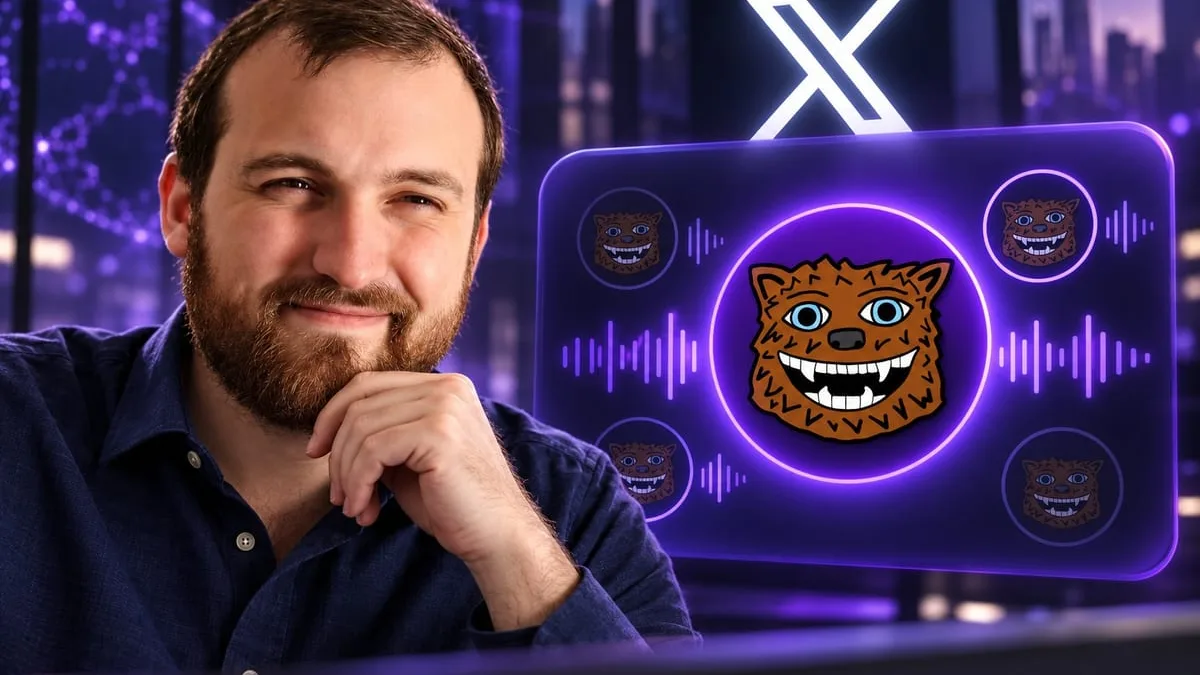
Charles Hoskinson wants to concentrate on building his own products rather than assume responsibility for promoting every project on Cardano. During the X Space “Fuzzy friday chill vibes,” hosted by Stav, he described his changing priorities and explained how his work on Midnight, RealFi, and Bitcoin DeFi infrastructure connects with the growth of the broader ecosystem.
Hoskinson joined the later portion of the conversation, whose recording runs slightly longer than five hours. He expanded the earlier discussion of Fuzzy, NFT collections, physical trading cards, and liquidity into financial permissions for AI agents, private trading, bank deposits, and developer support.
His Own Projects and His Role in Cardano
The direct discussion of Cardano began when a participant asked about applications capable of reaching people outside the crypto community. The participant contrasted Cardano’s technical development with the need for products that give users a concrete reason to join.
Hoskinson accepted the criticism that its DeFi ecosystem is not strong enough. He explained that he had spent years concentrating on the protocol, while commercial development, project support, and ecosystem promotion were supposed to have other organizational owners.
He criticized the Cardano Foundation and EMURGO for what he considers unmet expectations in those areas. In his account, Input Output took on responsibilities for which it had not originally assembled the appropriate teams or received a mandate.
His account also included criticism of how those gaps had been addressed. After describing the creation of cFund and work on governance and the constitutional convention, he acknowledged shortcomings in the response.
“We didn’t do it as well as we should have, and we had a very lopsided ecosystem as a result,” he said.
As a specific example of the difficulties facing projects, he claimed that Midnight had not been included in Cardano’s booth at TOKEN2049. He contrasted that experience with the welcome he received at a Solana event and advocated a more accommodating approach to projects, access to investors, and practical development assistance.
He described inadequate support for builders as a problem that threatens the ecosystem’s ability to grow.
“That’s a serious problem. And Cardano cannot succeed if that problem continues to propagate.”
He also called for a refresh of Cardano’s branding. He believes the network’s longstanding reputation for limited activity makes it harder to communicate its development. Alongside messaging, he highlighted the experience of developers who need funding, contacts, and help bringing products to market.
Hoskinson described a decision to delegate more of the responsibility for infrastructure to the ecosystem and devote his time to the products he is developing. He identified Midnight, Midnight City, RealFi, and Bitcoin DeFi among his areas of involvement.
“I’m gonna focus on building on Cardano and building projects on Cardano,” he explained. He presented his ventures as a way to attract capital and users to Cardano while also pursuing customers and business relationships across other networks.
He put specific, conditional ambitions behind that strategy. If successful, he argued, his projects could bring billions of dollars in total value locked and millions of users into the Cardano ecosystem. He connected that potential contribution with his decision to concentrate on building products.
He also linked the shift to years of criticism and conflict surrounding his role. After attempting to address broader ecosystem issues, he wants to concentrate on areas where he believes his work can have the greatest impact.
He rejected the expectation that founding Cardano makes him personally responsible for promoting every project or that his work should revolve around promoting ADA. He emphasized that he does not have unilateral control over the treasury and that a decentralized ecosystem contains multiple independent organizations with separate responsibilities.
He identified Draper and Alpha Growth as organizations funded to support business development and the DeFi ecosystem. Projects seeking broader assistance should approach the relevant teams, while proposals involving his own ventures should offer customers, revenue, and benefits for both parties. He offered to connect potential collaborators with the appropriate commercial or research teams.
Midnight’s development targets multiple blockchain networks. In his explanation, the product should serve Cardano, XRPL, and Solana users equally well. His commercial priorities therefore extend across a wider market, with the expectation that the growth of those projects will also contribute to Cardano.
RealFi is a Cardano-connected protocol linking digital assets with credit markets and other reserve assets. He described Bitcoin DeFi as an opportunity to connect bitcoin capital with applications and liquidity on other networks.
Midnight City Opens the Door to Memecoin Communities
Hoskinson described Midnight City as an environment containing persistent AI agents that users can own and direct. He wants to offer memecoin communities their own spaces, customized appearances, special interactions, and functions connected to membership or token ownership.
His invitation extended across networks, including Fuzzy on the XRP Ledger. Under his proposal, participation would build on existing community identities while enabling collaboration across blockchain boundaries.
Midnight is a separate blockchain for applications with programmable privacy, connected to the Cardano ecosystem. Midnight City uses it as a technological foundation for experimenting with agents and their interactions. Hoskinson emphasized that City does not have a separate token of its own, while the underlying network has the NIGHT token.
Discussing his attitude toward memecoins, he acknowledged that technically focused development teams had paid insufficient attention to communities generating activity and attracting users. He cited Solana as an ecosystem that recognized their role earlier.
One proposed function is private trading through AI agents. A user could assign a strategy to an agent and enable it to operate on supported networks. A strategy’s creator could charge for access while protecting the details that provide a competitive advantage.
Hoskinson also described a model in which some of that revenue funds community token buybacks. Such a system would connect strategy usage with revenue and funding for shared activities. He presented it as a development possibility without announcing terms, costs, or projected returns.
Other potential community applications included proving ownership without revealing identity, private voting, confidential treasury payments, and simpler user addresses. He also discussed using tokens as loan collateral, allowing holders to access liquidity while retaining exposure to their assets.
He invited Fuzzy to collaborate on entering Midnight City. He expressed willingness to create an appropriate wallet and temporarily use a customized profile picture if the community began building in that environment. The discussion remained an invitation to explore possibilities, without a formal partnership announcement.
He also recalled David Schwartz’s assistance during preparations for Midnight’s token distribution to XRPL users. According to Hoskinson, Schwartz explained technical details to his engineers and helped them identify an appropriate approach.
Private AI Agents and Tokenized Bank Deposits
Hoskinson compared Midnight’s broader role to a VPN for decentralized finance. His intended user experience is a switch inside a wallet that activates private mode while allowing the user to continue accessing applications on other networks.
That simplicity requires infrastructure for connecting blockchains, signing transactions, and supporting different asset types. He explained that integrations must account for each network’s characteristics. Working with existing wallets and projects should make the functions accessible without adding technical complexity for users.
Alongside transaction privacy, he discussed Nightframe, a concept for a personal AI agent designed to protect information and preserve the owner’s control over funds. He warned that an agent that understands someone’s habits and can spend their money becomes a particularly sensitive security point.
He connected Midnight Passport with agent identity and authorization. He also mentioned work involving agent payment and wallet standards, including x402. He presented these components as parts of a system in which an agent has an identity, limited permissions, and the ability to perform financial tasks.
Discussing tokenized assets, he stressed the need for programmability, market depth, and available capital. In his assessment, financial product issuers seek infrastructure where assets can be sold, used as collateral, or connected with existing markets.
He cited Monument Bank as an example of institutional adoption. During the Space, he expressed the expectation that approximately £250 million in tokenized deposits could arrive on Midnight within the following 60 to 90 days.
The project had previously been formally announced with a first-phase target of up to £250 million, with tokens representing deposits held at the bank. The timeline given in the conversation remains Hoskinson’s estimate.
On development, he explained that he is personally working on part of the cryptographic infrastructure and using multiple testing and formal verification methods to check circuits. He connected advances in AI tools with attackers’ growing ability to discover vulnerabilities that are difficult to detect.
He expects some new capabilities to roll out over the following three to six months, while greater attention to memecoin communities also forms part of his plans for 2027. For their integration, he outlined a specific sequence: connect the networks, support their assets, integrate with wallets, and test the functions with interested communities.