Charles Hoskinson Says Bitcoin’s Quantum Risk Is Becoming a Governance Test as Cardano and Midnight Prepare for the Next Crypto Era
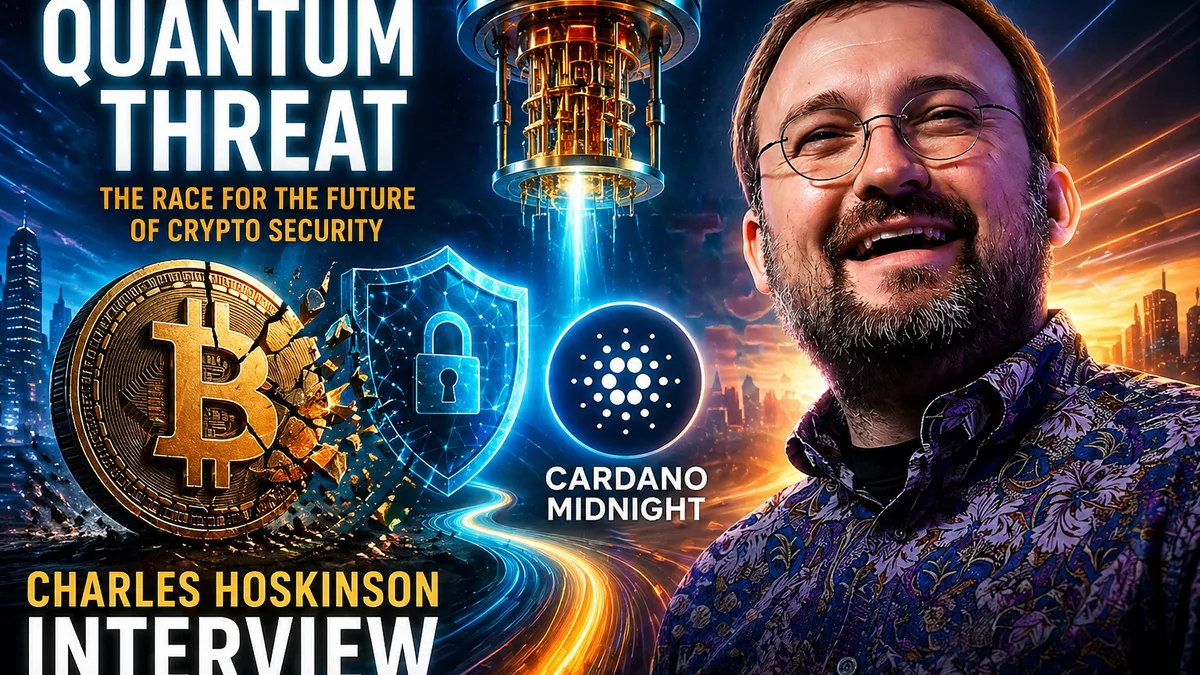
In a new Paul Barron Network interview, Charles Hoskinson discussed Bitcoin’s quantum security challenge, Cardano’s post quantum preparation, Midnight Passport, real world assets, AI agents, the Clarity Act and the long term fight between open blockchain infrastructure and closed institutional networks.
By SongMarketCap
Updated:
Bitcoin Quantum Risk Turns Into a Governance Question
Charles Hoskinson’s new interview on the Paul Barron Network began with a question that is moving from cryptography circles into the center of the crypto debate, what happens if future quantum computers become powerful enough to threaten Bitcoin’s current signature model.
The discussion was not framed as a simple market scare. Hoskinson pointed to institutions with the strongest incentive to measure the risk correctly, including the United States government, the military, intelligence agencies and DARPA’s Quantum Benchmarking Initiative. His argument was that crypto does not need to guess the timeline in isolation. Governments and defense institutions are already studying whether cryptographically relevant quantum computers could arrive within the next decade, and what those machines may be able to break.
That matters because Bitcoin’s quantum problem is not only about stronger cryptography. It is about timing, coordination and decision making. If a network waits too long, vulnerable coins may become exposed. If it moves too aggressively, it may force difficult choices on users who have not migrated.
Hoskinson also discussed the role of NIST post quantum standards. The industry already has possible countermeasures, but they are not free upgrades. Post quantum signatures are larger and heavier than today’s elliptic curve signatures. They can create performance costs for blockchains that care about throughput, storage, transaction size and user experience.
For Bitcoin, the technical path may be simpler than for some proof of stake or zero knowledge systems. A proof of work network mainly needs to secure its signature scheme and maintain confidence in its hash assumptions. Proof of stake networks and ZK based systems must also consider additional cryptographic components. But Bitcoin faces a harder social and legal problem because many old addresses may never migrate.
That is where the interview became more important. Hoskinson explained that Bitcoin has several possible paths. It can do nothing and accept the risk. It can add a post quantum signature path and allow voluntary migration. Or it can attempt to freeze legacy coins and create a stronger migration process.
None of those options is clean.
If Bitcoin does nothing, old coins may eventually become vulnerable. If it allows only voluntary migration, users who do not move may lose funds. If it freezes legacy coins, the network enters a dangerous property rights debate because someone must decide what happens to assets that may still belong to legitimate owners.
This is why Hoskinson framed the issue as a governance test. Bitcoin has no on chain voting system, no formal constitution and no clear process for resolving a dispute of this scale. That has often been part of Bitcoin’s identity. But in a quantum migration scenario, the lack of formal governance could become a coordination problem.
The institutional layer makes the situation even more complex. Large holders and asset managers may not accept the idea that a significant portion of Bitcoin’s supply could one day be stolen and sold into the market. Long time Bitcoin purists may see that as the cost of individual responsibility. Institutions with fiduciary duties may see it as an unacceptable operational and regulatory risk.
That is the real pressure point. A post quantum upgrade is not just a software change. It forces Bitcoin to confront the relationship between security, ownership, ideology and institutional capital.
Cardano and Midnight Prepare for Post Quantum and Privacy Infrastructure
Hoskinson then connected the quantum discussion to Cardano and Midnight. He said networks such as Cardano, Midnight, Algorand and Ethereum are likely to be in a better position over a 24 to 48 month horizon because they already have research paths, active development and communities thinking about post quantum security.
For Cardano, this fits the network’s long standing approach. Cardano has built much of its identity around peer reviewed research, formal methods and cryptographic analysis. Hoskinson noted that Input Output had already studied Bitcoin under a quantum adversary model years ago. That does not remove every future risk, but it shows that the topic has been treated as an engineering problem rather than a last minute emergency.
Midnight was presented as part of that wider preparation. Hoskinson referred to Nightstream, a project based on work from Stanford and Microsoft, being developed with the Linux Foundation and LFDT as part of a post quantum foundation. That is important because Midnight is often described only as a privacy focused partner chain. In this interview, it was positioned more broadly as infrastructure for privacy, identity, regulated applications and future security requirements.
The UTXO connection between Bitcoin and Cardano also matters. Hoskinson said Bitcoin can look at Cardano as a useful reference point when considering how a UTXO based system behaves when stronger cryptographic primitives are introduced. Cardano cannot solve Bitcoin’s governance problem, but it can provide technical lessons for similar architecture.
The strongest Cardano specific part of the interview came through Midnight Passport. When Paul Barron asked about accredited investor verification appearing in the Midnight Passport teaser, Hoskinson used the example to explain why real world assets need privacy infrastructure.
Real world assets are not a distant concept. Stablecoins already represent one of the largest RWA categories in crypto because they connect tokenized assets with treasury bills, bank deposits and regulated issuers. But a broader RWA market requires more than token issuance. It needs identity checks, KYC, AML screening, suitability rules, jurisdiction restrictions and compliance logic.
On a fully transparent blockchain, that creates a problem. Personal information should not be placed directly on chain. Once it is public, it is permanent and difficult to remove. That is not acceptable for banks, regulated products, institutions or serious users.
Midnight’s answer is selective disclosure through zero knowledge technology. A user does not need to reveal a full identity, home address or complete jurisdictional profile. Instead, the user can prove that a specific condition is true. For example, an application may need to know that a user is eligible for a product, not exactly who that user is in every detail.
That is a practical difference. Midnight is not presenting privacy as a way to avoid rules. It is presenting privacy as a way to make rules usable without exposing personal data.
Hoskinson also emphasized that this logic sits at the application level, not as a protocol level backdoor. Different DApps can build different verification models depending on their needs, while the underlying network does not need to expose or control user data. The system can support regulated use cases without turning the blockchain into a permanent public database of personal information.
This is where Midnight’s positioning becomes clearer. It is not only a privacy chain. It is trying to become a privacy based infrastructure layer for identity, tokenized assets, accredited investor access, jurisdiction proofs and institutional workflows across open crypto networks.
The role of $NIGHT also fits that design. Midnight separates ownership and governance from the consumptive resource layer used to operate the network. Hoskinson later connected this dual token model to payment use cases, where merchants or providers may cover transaction costs so users do not need to manually think about blockchain fees. That matters because mainstream users do not want to manage gas, bridges and signatures every time they interact with an app.

If Midnight can make compliance, identity and transaction costs less visible to the user while preserving privacy and verification, it could become more relevant to real financial applications than systems built only for crypto native traders.
Midnight, AI Agents and Open Blockchain Systems
The second half of the interview moved into real world assets, banks, Canton, the Clarity Act, AI agents and the difference between open blockchain systems and closed institutional networks.
Hoskinson’s position was clear. Open infrastructure still has a long term advantage. He compared today’s debate around institutional chains to earlier battles between permissioned blockchain consortia and open public networks. In previous cycles, many expected private or permissioned chains to dominate enterprise adoption. Instead, open networks captured most of the developer energy, liquidity and public attention.
His criticism of closed systems was direct. Federated networks can be faster, cheaper and more vertically integrated. But they are clubs. Access depends on permission, institutional approval and suitability rules. If a builder, user, bank or application does not fit the club, it can be excluded.
Open networks are harder to coordinate, but they allow broader participation. Anyone can build, connect and create new applications without asking for permission from a central group. Hoskinson argued that crypto has repeatedly preferred open systems over walled gardens, even when the open path is slower or more difficult.
That point became especially important when the discussion turned to AI agents. Hoskinson said one of the largest sources of user growth in crypto over the next five to ten years may not be people, but artificial intelligence agents.
The logic is simple. Crypto is still too complex for most users. People do not want to understand every chain, bridge, wallet standard, settlement rail and fee model. Over time, users may delegate tasks to agents that can interact with wallets, make payments, compare services, move assets and execute instructions across multiple networks.
That future depends on open standards. Hoskinson referenced x402 and open wallet frameworks as part of a broader agent based economy. If agents operate inside closed systems, their actions are limited by gatekeepers. If they operate across open networks, they can interact with many chains, applications and payment environments.
This connects Midnight to a wider Cardano narrative. The network is not only competing for human users. It may also need to become usable by autonomous digital actors that require identity, permissions, privacy, payments and policy based execution. In that environment, privacy and compliance are not optional features. They become part of the infrastructure that agents need in order to operate safely.
Hoskinson also connected Midnight to banking through the Monument Bank relationship and tokenized deposits. He described a future where banks do not simply issue isolated crypto products, but participate in broader networks for deposits, compliance, financial services and cross institution settlement. Smaller and mid sized banks may have a strong incentive to explore this because compliance costs are extremely high and operational burdens continue to grow.
His broader point was that zero knowledge proofs and privacy preserving credentials could reduce part of that burden. Instead of manually repeating compliance processes across fragmented systems, institutions could use verifiable proofs to automate parts of identity, eligibility and jurisdiction checks. In that model, blockchain is not only a settlement layer. It becomes compliance infrastructure.
The regulatory part of the interview was sharper. Hoskinson criticized the idea of supporting the Clarity Act without carefully reading the text. His concern is that a poorly written law could be worse than current ambiguity. If definitions are structured badly, a future hostile SEC could use the law to keep new crypto projects classified as securities, while older projects remain protected.
That would create a dangerous market structure. Older assets could benefit from clarity, while new builders face a heavier burden. Banks and large incumbents could enter crypto with significant capital, then use the same legal framework against non bank crypto projects. In Hoskinson’s view, regulation that looks helpful on the surface can become a weapon if the details are wrong.
The lightning round added several notable points. Hoskinson said Lazarus and AI are a more immediate threat than quantum computers today. He said proof of stake is likely to be favored by future administrations because it is more environmentally friendly and offers more governance flexibility. He also discussed USDCX as a practical path between centralized exchanges and Cardano wallets through Circle related infrastructure. When asked whether $SNEK could go cross chain through Midnight, he said it could happen, while also noting the project’s loyalty to the Cardano ecosystem.
The interview’s value is not in one isolated statement. Its value is in how the themes connect. Quantum security, governance, Midnight Passport, RWA compliance, AI agents, banks and crypto regulation are now part of the same strategic conversation.
For Bitcoin, quantum risk may force the network to answer a question it has avoided for years, how does a system without formal governance make a high stakes decision about security and property rights. For Cardano and Midnight, the challenge is different. They must prove that research driven architecture, privacy preserving identity and open network design can become usable infrastructure for regulated assets, autonomous agents and real financial activity.
That is why this interview matters. It shows crypto moving into a phase where slogans are less useful than coordination, security design and execution. The networks that matter most in the next cycle may not be the ones with the loudest narratives, but the ones able to upgrade under pressure, protect user data and still remain open enough for the next generation of builders, institutions and agents.