Charles Hoskinson Says AI Agents Could Run Crypto as Midnight Targets Privacy and Cross Chain Execution
Charles Hoskinson joined @CryptoMichNL on the New Era Finance Podcast to discuss AI agents, Midnight, privacy infrastructure, chain abstraction and Cardano’s role in automated blockchain use.
By SongMarketCap
Updated:
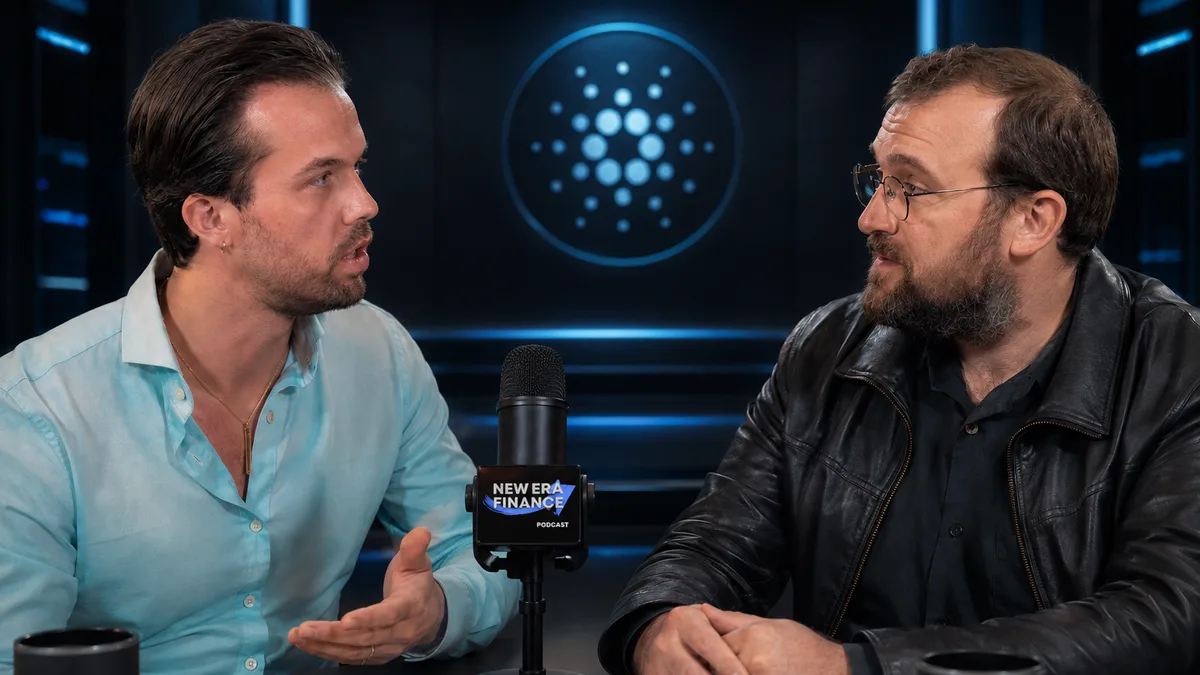
Charles Hoskinson appeared on the New Era Finance Podcast in an interview hosted by @CryptoMichNL, where he discussed AI agents, Midnight, privacy technology and the future of automated crypto use. The conversation focused on how blockchain activity could move from manual wallet interactions toward agent driven execution, with Cardano, Midnight, intents and cross chain infrastructure forming part of the discussion.
Hoskinson said long term crypto usage will increasingly depend on users delegating authority to AI agents. Those agents could execute transactions, select routes, manage risk and interact with blockchain systems in the background, while users define the intended outcome.
Cardano, AI Agents and Simpler Crypto UX
Hoskinson said users do not want to manage the technical complexity of blockchain systems, including network selection, bridge risk, address safety, fees, tokens, stablecoins and settlement details. According to his explanation, the crypto industry needs an experience where the user sets an intent and the system finds the execution path.
In that model, AI agents act as an operational layer between users and blockchain infrastructure. They can check addresses, reduce human error, identify spoofed websites, follow predefined limits and execute transactions according to user rules. Blockchain provides the deterministic rules, proof systems and verifiable settlement behind those actions.
Hoskinson connected this direction with chain abstraction and account abstraction. Users would not need to know which network executes a transaction, which bridge is used or which cryptographic component runs in the background. Applications, agents and protocols would handle the complexity while presenting a simpler interface.
The interview also addressed what agent based execution could mean for token models. If agents choose networks, protocols and routes based on price, security, liquidity and user rules, token value becomes tied more directly to execution utility, liquidity access and security guarantees. In that environment, tokens compete less on human attention alone and more on whether they can function inside automated transaction flows.
Hoskinson also rejected the idea that users will migrate to one new network simply because a project expects them to. His framing points toward a future in which users interact with applications and agents, while settlement and routing happen across infrastructure layers. Cardano enters that discussion through partner chains, research driven design and infrastructure that can support more complex execution models.
Midnight, Privacy and Web 2.5 Infrastructure
A large part of the interview focused on Midnight, privacy and selective disclosure. Hoskinson described privacy through practical needs for users, businesses and institutions, including personal data protection, commercial agreements, intellectual property, identity verification and access rules.
In that context, Midnight was presented as an infrastructure layer for privacy, compliance and rules that can be executed through blockchain systems. Hoskinson discussed situations where a user or business does not need to reveal a full identity, but only prove a specific claim. That can include jurisdiction, age, professional qualification, authorization or access eligibility.
The identity problem becomes more important when humans, agents, institutions and automated systems all operate on chain. Networks need to distinguish who or what has permission to perform an action without publicly exposing every identity detail. Selective disclosure and credential systems allow required conditions to be proven while keeping unnecessary data protected.
Hoskinson also connected Midnight with the concept of Web 2.5. Web2 companies already have users, regulation, business models and operating systems, while Web3 brings settlement, digital ownership, self custody and open networks. Midnight was described as a network that can help companies use blockchain infrastructure while preserving rules, data protection and security requirements.
The interview also mentioned Midnight Passport as part of the user experience. According to Hoskinson, the phone can become the central access point for wallets and crypto functions, reducing the need for users to manually manage seed phrases and complex recovery processes. In that model, $NIGHT sits within a broader infrastructure discussion around privacy, usability and cross chain functionality.
Hoskinson also discussed the security framework required for AI agents. He mentioned trusted execution environments, zero knowledge proofs and multiparty computation as technologies that can support agent sandboxing, behavior verification and coordination without publicly exposing sensitive data. That security layer is central to the idea of agents acting at scale without relying only on manual human review.
Bitcoin DeFi, Intents and Cross Chain Liquidity
Hoskinson described a future Bitcoin DeFi flow through Cardano and Midnight. He said he plans to use his own Bitcoin in a DeFi process involving movement toward Cardano, stablecoin liquidity, real world asset yield and the return of value back toward the Bitcoin network.
For the user, that model would appear as a simple yield function. In the background, bridge, lending, stablecoin and cross chain steps would take place. Hoskinson said stablecoins such as $USDC could have an operational role in those flows, while the user would see the result without manually managing each technical step.
Hoskinson connected that example with the intents model. If agents select where a transaction executes based on price, safety, availability and user rules, liquidity can move toward the most efficient routes. The user does not need to see every protocol and network through which the transaction passes.
That creates different requirements for blockchain infrastructure. Machine speed transactions, agent wallets and automated execution require verifiability, privacy, security rules and coordination across multiple systems. Hoskinson tied those requirements to the need for agents to operate inside frameworks governed by rules and proofs, rather than open ended trust.
In this framework, Cardano and Midnight are positioned around cross chain execution that can remain mostly invisible to the user. The interview presented AI agents, intents and privacy infrastructure as a possible shift in how crypto transactions are initiated, routed and settled. The central question is no longer only which network users choose directly, but which infrastructure agents use when value moves across chains.