Charles Hoskinson Frames Midnight as a Defense Against Surveillance Capitalism
Charles Hoskinson used a new video to warn that mass data collection, artificial intelligence and private surveillance infrastructure could create a new form of digital control. His message placed Midnight at the center of a broader Cardano discussion about privacy, identity and user owned data.
By SongMarketCap
Updated:
Cardano, Midnight and the New Privacy Debate
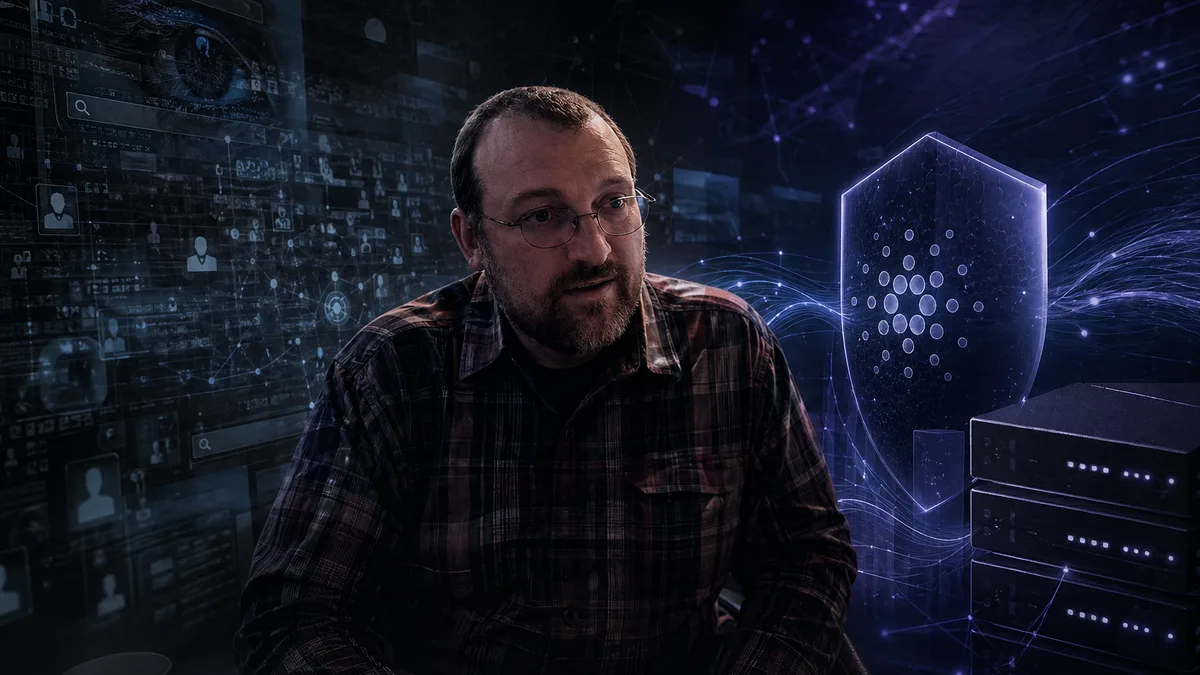
Charles Hoskinson published a new video titled “The Hundred Flowers of Surveillance Capitalism”, linking historical patterns of political control with modern digital systems built around large scale data collection. The video focused on the relationship between online search behavior, artificial intelligence, private technology companies and government structures that increasingly depend on digital information.
Hoskinson discussed proposals related to access to online search data, including search queries, clicks, results, devices and other user behavior patterns. In his interpretation, those data sets, when shared with third parties through technical and regulatory mechanisms, can become the foundation for highly detailed profiling of citizens.
His message went beyond one regulation or one market. He described privacy as a technical condition for freedom of movement, economic activity, communication and digital identity.
In that framework, Midnight was not presented as just another partner chain or another technical extension of the Cardano ecosystem. Hoskinson connected it to the need for systems where users retain control over their own data, their own identity and their own access to the digital economy.
Surveillance Capitalism and Data Control
The central metaphor of the video comes from the historical concept of the “Hundred Flowers”, which Hoskinson used as a warning about systems where people reveal their views, weaknesses and behavioral patterns, only for that information to later be used against them. His point was not only historical. He argued that modern digital systems can make surveillance far more efficient than earlier models of control.
In older surveillance systems, tracking individuals was expensive, slow and limited. It required people, institutions, resources and time. Hoskinson warned that artificial intelligence changes that equation. When large data sets are connected to AI models, a system can analyze the behavior of millions of people and draw conclusions about their habits, beliefs, risks and social connections.
A key part of the video was the distinction between state power and private power. Hoskinson argued that the main risk no longer comes only from formal government control, but from the combination of governments, private companies and platforms that already hold data about communication, finance, movement and online behavior.
That is the core of the surveillance capitalism argument. If private platforms control access to communication, banking services, identity, applications and digital money, users may still have formal rights while losing practical access to essential digital functions. Deplatforming in this context is not only removal from one social network. It can mean losing access to accounts, identity tools, financial infrastructure or digital markets.

For the blockchain industry, this debate returns to one of its original questions, how much control over digital life should remain in the hands of intermediaries. Hoskinson’s answer in this video was clear, users need a technical path to own their identity, their money and their data.
Why Hoskinson Connects Midnight to Digital Freedom
The most important part of the video came when Hoskinson connected the argument directly to Midnight. His message was that users cannot preserve freedom of association, commerce and expression if trusted third parties know everything about them, control the flow of information and control the flow of money. In that view, privacy is not an optional feature. It is a basic security layer for digital society.
Midnight is positioned as infrastructure that can help users and applications disclose data selectively, instead of exposing everything permanently to public networks or centralized intermediaries. That distinction matters. Privacy in blockchain does not have to mean hiding everything. In a serious regulatory and commercial environment, it means proving what needs to be proven without revealing everything else.
That gives $NIGHT a broader meaning than token economics alone. If Midnight delivers practical tools for privacy, identity and data control, its value to the Cardano ecosystem will not only come from a new network. It will come from enabling a new class of applications that can work with sensitive information without forcing users to surrender personal autonomy.
That model could matter for financial applications, health data, enterprise systems, AI agents, reputation models, digital identity and other use cases where public blockchain transparency is not enough by itself. Cardano has spent years building its reputation around security, formal methods, decentralization and long term design. Midnight adds a layer that is becoming harder to ignore, controlled privacy.
Hoskinson’s video places Midnight in a wider context than the usual discussion about a new network, a token or partner chain architecture. The question is no longer only what Midnight can technically do. It is what kind of digital environment it is trying to make possible. $NIGHT will therefore be watched through a larger lens, whether privacy can become usable infrastructure for users, developers and institutions that do not want to choose between total transparency and total centralized control.
For Midnight, this is also the real test. A major philosophical argument for privacy only carries weight if it becomes products developers can build with, applications users can understand and systems that function without constantly exposing personal data. That is where the strength of Hoskinson’s message will be measured, not in the warning itself, but in whether digital privacy can become working infrastructure inside the Cardano ecosystem.