Charles Hoskinson Calls for Cardano Governance Reset as Input Output Vote Nears
Charles Hoskinson used his final message before the remaining Input Output votes to frame the decision as a wider test for Cardano governance, research funding, builder incentives and the network’s ability to form a clear post-Voltaire roadmap.
By SongMarketCap
Updated:
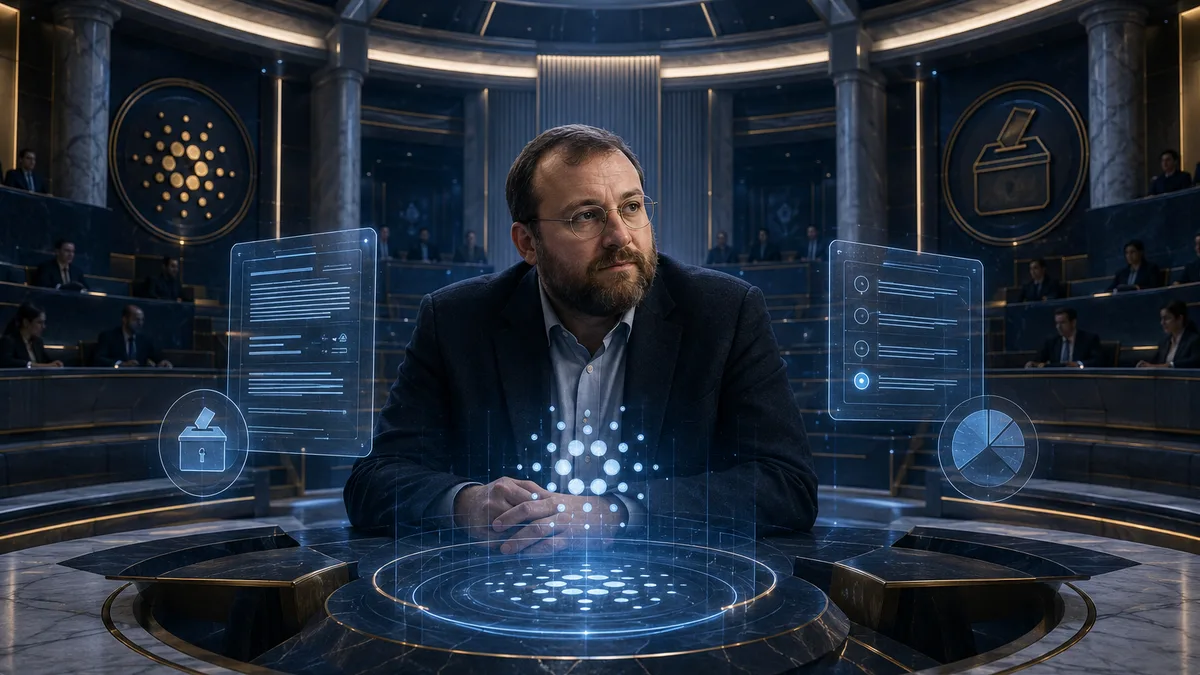
Charles Hoskinson has issued a final appeal ahead of the remaining votes on Input Output’s Cardano proposals, placing the current treasury decisions inside a broader debate about governance, development funding and the future operating model of the network.
The message came at a sensitive point for Cardano. After moving through Byron, Shelley, Goguen, Basho and Voltaire, the ecosystem is now testing whether decentralized governance can fund core development, coordinate long-term research and preserve a clear technical direction without relying on the older model of centralized roadmap leadership.
Hoskinson said the current vote is about more than one funding cycle. It is also a decision about whether Cardano wants Input Output to remain one of its major development actors, or whether the ecosystem is ready to build a different structure for roadmap ownership, execution and technical coordination.
Cardano Governance Faces Its Post-Voltaire Test
Hoskinson opened the video by contrasting traditional product development with the challenges of building a decentralized protocol. In a conventional company, product managers, engineers, marketing teams and executives work around shared goals, quarterly planning, KPIs and a defined roadmap. Cardano now has to reproduce part of that coordination through on-chain governance, DReps, treasury votes and public debate.
He pointed to Midnight as an example of a project where product direction, team execution and public communication are more tightly aligned. He referenced its mainnet launch, token launch, partnerships, engineering work and future technical components such as Star Stream and Nightstream. In that part of the message, Midnight served as a comparison point for what structured execution can look like when a project has a unified mission and a clear operating rhythm. $NIGHT was presented in the context of a privacy-focused ecosystem with a defined product path.
The tone changed when Hoskinson turned back to Cardano. He said discussions around roadmap, marketing, treasury funding and Input Output’s role have increasingly become personal and politically charged. According to him, the governance process has created more public conflict, more suspicion toward builders and less room for serious disagreement about technical priorities.
A central point in the speech was the lack of executive function inside the current governance model. Cardano has a treasury with significant capacity, but Hoskinson argued that money alone does not create strategy. The ecosystem also needs structures that can set priorities, coordinate delivery, manage budgets and create accountability for long-term development.
He raised the possibility of an elected budget committee, a clearer roadmap process and more defined responsibility for areas such as marketing, KOL coordination, brand positioning and public perception. His criticism was aimed at the current governance mechanics, not at decentralization as a goal. The argument was that decentralized decision-making still needs institutional design if it is expected to manage a complex technology network.
Hoskinson also criticized the role of X in shaping Cardano governance debates. He said too many important conversations happen in an environment that rewards conflict, public attacks and short-form polarization. He called for more productive forums where DReps, developers, founders and community members can challenge each other without turning every dispute into a personal fight.
Input Output Vote Becomes a Funding and Builder Incentive Debate
Hoskinson directly addressed DReps and voters, saying they have the right to reject Input Output’s proposals if they believe the company no longer provides enough value to Cardano. At the same time, he said such a decision would change the relationship between the network, the company and the future development of the protocol.
He described the Input Output proposals as part of the final stage of decentralizing Cardano development. According to his remarks, the intended direction includes spinning the Haskell node out from Input Output, implementing and integrating Leios, and moving more core development into the hands of a broader ecosystem of companies and community developers.
Hoskinson spent a large part of the video defending the value of Cardano’s research and engineering history. He described nearly a decade of chief scientist meetings, protocol design work and difficult technical decisions around VRF, finality, staking, the UTxO model, ledger upgrades and network resilience. His point was that Cardano’s stability did not happen by accident. It came from a long research process that shaped the protocol before many of the current governance debates existed.
The technical roadmap he referenced included Leios, Hydra, partner chains, the Pogan approach to Bitcoin DeFi, zero knowledge work, post-quantum readiness and security challenges linked to artificial intelligence. Hoskinson framed those areas as the kind of long-term work Cardano must keep funding if it wants to remain competitive among major blockchain ecosystems.
The governance side of the issue is equally important. Treasury funding should come with transparency, clear deliverables, cost discipline and accountability. Cardano’s funds belong to the ecosystem, and no organization can treat them as automatic funding. Hoskinson’s counterargument was that advanced protocol research, cryptography, security engineering and roadmap continuity also require stable financing and experienced teams.
He also warned that Cardano risks damaging its builder economy if teams are expected to work for shrinking budgets while facing rising public pressure and limited recognition after delivery. He mentioned projects and companies such as JPEG Store, Book.io, TapTools, Midgard, SundaeSwap and Midnight as examples of teams that have helped build value inside the ecosystem.

That point reaches beyond Input Output. Blockchain ecosystems compete for developers, founders, researchers, liquidity, users and institutional attention. If Cardano wants a more decentralized development model, it still needs a credible way to attract and retain serious teams. A governance process that funds carefully, rewards delivery and protects builders from constant political exhaustion becomes part of the network’s competitive infrastructure.
Cardano Roadmap Debate Moves Beyond One Treasury Vote
The final part of Hoskinson’s speech moved from the current vote to the larger question of Cardano’s next mission. He described Bitcoin DeFi, RealFi, digital identity, banking the unbanked and privacy infrastructure as areas where crypto still has meaningful problems to solve.
On Bitcoin DeFi, he discussed the Pogan BTC mirroring concept. The idea, as he described it, is to reflect Bitcoin value into the Cardano environment and make it usable through smart contracts, while preserving a different security and user model from traditional bridge designs. Hoskinson positioned that opportunity as a major market for Cardano if the ecosystem can execute properly.
On RealFi, he returned to one of Cardano’s longest-running ambitions: giving people outside the traditional banking system access to digital identity, wallets and financial infrastructure. He referenced years of work across Africa and Latin America, where blockchain-based identity and mobile-first finance could become a practical entry point into Web3 services.
Privacy was the third major theme. Hoskinson connected Midnight with the right to private communication, private commerce and user-controlled digital identity in a world shaped by AI, CBDCs and digital surveillance infrastructure. In that context, $NIGHT was tied to privacy technology, AI agents and Web 2.5 applications aimed at broader user adoption.
Hoskinson then turned the question back to Cardano. The network needs a goal large enough to motivate scientists, engineers, founders, DReps and everyday users through the next phase of development. A governance system focused only on price recovery, treasury defense or short-term political wins cannot replace a roadmap that gives builders a reason to keep working inside the ecosystem.
He linked his own deeper involvement in Cardano to two conditions: a return to civil debate and a renewed focus on technical problems large enough to justify long-term commitment. He said he does not want the next stage of his career to be defined by repeated budget fights, personal accusations and political exhaustion around every major development decision.
Hoskinson placed the responsibility for the next step on Cardano governance. He said he did not become a DRep, did not vote with his ADA and gave the community a choice. The ecosystem now has to decide whether it wants Input Output to remain a major development contributor or whether it is prepared to support a different coordination model after this budget cycle.
The next test for Cardano begins after the vote. If the Input Output proposals pass, the focus moves to delivery, transparency, decentralization of development and measurable progress. If they fail, governance will need to show that it has a credible alternative for research, core engineering, roadmap coordination and long-term technical leadership.

Voltaire gave Cardano a political system. That system now has to prove it can make decisions that protect the network’s technical depth, keep builders engaged and restore a shared direction. Hoskinson’s message placed the treasury vote inside that larger challenge: Cardano is deciding what kind of governance structure can carry the network through its next phase of development.