Charles Hoskinson at Consensus Miami 2026: Privacy, AI Agents and Midnight Move Into Crypto’s Main Debate
At Consensus Miami 2026, Charles Hoskinson framed privacy as a core requirement for the next phase of the internet, especially as AI agents begin handling search, payments, commerce and personal decision making on behalf of users.
By SongMarketCap
Updated:
Cardano, Midnight and the new privacy debate
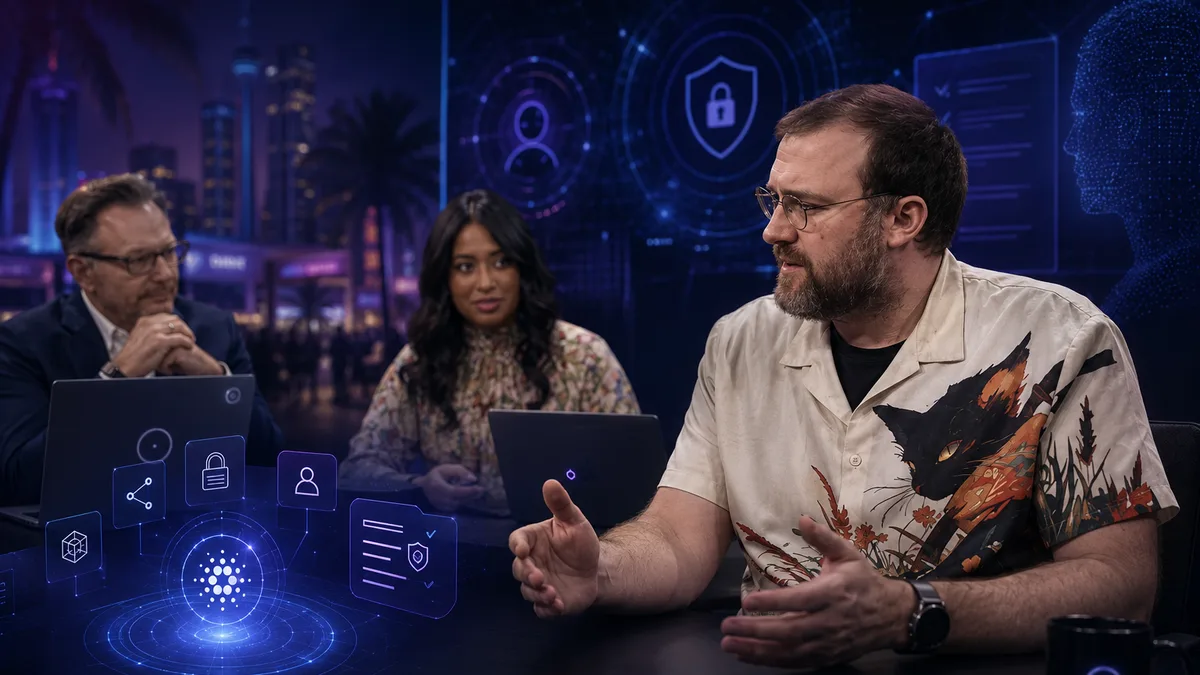
Charles Hoskinson used his CoinDesk Live appearance at Consensus Miami 2026 to move the privacy debate beyond anonymous transactions. His central point was that privacy is becoming a practical requirement for AI agents, digital identity, agentic finance and the next generation of internet infrastructure.
The conversation began with a broader question that has followed crypto for years, whether public blockchain transparency has been both a strength and a limitation. Hoskinson argued that the industry did understand the need for privacy, but the technology was not ready for serious mainstream use.
He pointed to earlier privacy models such as ring signatures and mixnets, which offered important ideas but were not flexible, programmable or efficient enough for broad blockchain adoption. Zero knowledge cryptography has existed for decades, but according to Hoskinson, only in recent years have ZK systems become practical enough to support more than simple anonymous transfers.
Older ZK systems were too slow, proofs were too large and the performance gap compared with standard cryptographic signatures was too wide. That made mobile use, programmable privacy and high volume applications difficult. In his view, the crypto industry had to wait for a series of technical improvements before privacy could become a usable infrastructure layer rather than a niche feature.
That is where Midnight enters the discussion. Hoskinson presented privacy not as an optional feature for privacy maximalists, but as a foundation for AI agents, financial applications, selective disclosure, identity and secure automation. This marks an important shift in the tone of the broader crypto conversation. Privacy is no longer only about hiding activity. It is increasingly about allowing users to benefit from intelligent systems without permanently exposing their personal data.
Hoskinson also connected this directly to the rise of agentic systems. He said that by 2035, most searches, online transactions, e-commerce activity and information discovery could be handled by agents rather than people. That would challenge the current business models of Google, Amazon, Meta and other internet platforms, because agents do not click ads, do not shop emotionally in the same way humans do and do not consume information through the same patterns.
For crypto, this creates three immediate questions. How do agents make payments, how do agents hold wallets and what does privacy look like when agents act on behalf of users. Hoskinson referenced standards such as x402 and the Open Wallet Standard as important pieces of that future, but he also made clear that without privacy, the model becomes dangerous. An agent must know a lot about a user to be useful. The same knowledge becomes a liability if it is exposed, stored or misused.
Midnight Passport and agentic finance
The most concrete part of the interview centered on Midnight Passport. Hoskinson described it as a credential that could run on a phone, laptop or desktop computer and allow users to send and receive funds across different networks. He also said it could allow users to delegate authority to smart contract agents that also have a passport.
The idea is simple but significant. Instead of manually approving every step of every interaction, a user could give an AI agent limited authority to perform a specific task. The agent would then complete the task and return with cryptographic proof that it actually did what it was instructed to do.
This matters because Hoskinson is not describing AI agents as smarter chatbots. He is describing them as future financial and operational actors. The problem is that AI systems are nondeterministic. They can make mistakes, hallucinate and claim a task was completed when it was not. In that environment, zero knowledge proofs take on a second role. They are not only a privacy tool, they become a verification tool.
Before an agent says the task is complete, it should be able to generate proof of the event. If the proof verifies, the system knows the task was actually completed. In a world where agents may move value, interact with applications and make decisions for users, that kind of proof is not a technical luxury. It becomes the boundary between trustworthy automation and automation that only sounds convincing.
This is an important direction for Cardano and Midnight because it connects two themes that are often discussed separately, AI safety and blockchain privacy. In that framework, $NIGHT and DUST should be understood as part of a broader Midnight design, not as a simple token story. NIGHT carries the network and governance dimension, while DUST is designed as a consumable resource for using the network. That distinction helps separate Midnight from the classic model where every blockchain action is fully public by default.
Hoskinson also raised the security side of the issue. He said the average crypto user often lacks strong operational discipline, including users who do not properly back up their wallets. From that perspective, AI agents could become a positive security layer if they help users verify whether an address is real, whether a dApp is authentic, whether a wallet is legitimate and whether an application is an impersonation attempt.
But that benefit comes with a serious risk. An agent that helps the user may also gain access to sensitive information. That creates a new attack surface. Hoskinson’s proposed control model includes trusted execution environments, restricted access and zero knowledge proofs. In other words, an agent should not be treated as a digital employee with unlimited authority. It needs to operate inside a sandbox, with defined limits, rules and evidence.
According to Hoskinson, the industry is still in the phase where many of these standards need to be written. The encouraging part is that some of the necessary patterns are already emerging from the broader software industry, especially in areas where agents write code according to strict specifications. The same approach, formal constraints, defined instructions and verifiable output, could be applied to financial agents. It does not eliminate risk, but it creates a more realistic model than simply giving private data and financial authority to a black box.
Crypto as a truth layer for the AI internet
The second major part of the conversation moved beyond financial infrastructure. Hoskinson warned that AI is pushing society toward an erosion of truth and trust. He described a shift from a blacklist society to a whitelist society.
In a blacklist model, people generally assume something is true until it is proven false. In a whitelist model, the starting assumption changes. Everything could be AI generated, everything could be synthetic and only verified content receives trusted status. That is an uncomfortable but increasingly realistic direction for an internet shaped by deepfakes, synthetic voices, generated images and fake identities.
Hoskinson sees crypto infrastructure as one of the strongest candidates for solving part of that problem. Blockchains can timestamp events, prove provenance, verify digital identity and support selective disclosure. In that context, NFTs are not presented as speculative collectibles, but as potential certificates for human generated content, verified people or authentic digital records.
That is a meaningful shift for the Cardano audience because it moves privacy away from the narrow frame of anonymous transactions. The question becomes broader. Who has the right to see specific data, how is truth verified, how are vulnerable users protected and how can agents help without becoming a new centralized point of failure.
Hoskinson gave the example of older people who could become targets of AI deepfake scams. If someone receives a call that sounds like a family member asking for money, AI can be both the threat and the defense. In the right model, an agent could help verify whether the request is real, detect fraud and protect the user. But to do that effectively, the agent must know enough about the user, the family context, behavioral patterns and financial situation. Without a privacy layer, that amount of knowledge becomes dangerous.
That is why the main message of the interview was more serious than another conference comment about AI. Hoskinson is positioning Midnight as infrastructure for a world where agents do not merely talk to users, but manage money, access, identity and decisions. In that world, privacy is not a luxury and it is not simply about hiding from systems. Privacy becomes the mechanism that allows users to benefit from intelligent systems without permanently surrendering their data.
The final part of the conversation turned to quantum computing and post quantum cryptography. Hoskinson mentioned DARPA QBI as an important signal and said there is a greater than 50 percent chance that a working commercial quantum computer at scale could exist by 2033. His point was not panic, but preparation. Standards already exist, but migration will be costly because signatures are larger, systems are less efficient and cryptographic stacks will need to be rebuilt.
For Cardano and Midnight, this interview shows where the next strategic battleground may form. The question is no longer only whether a blockchain can be faster or cheaper. The question is whether a blockchain can become a trusted layer for agents, privacy, proof of truth and secure automation. If AI agents become the dominant users of the internet, networks that can manage authority, proofs and selective disclosure will occupy a very different category than networks that only record public transactions.