Leopoldo López Says He Was Barred From Banking Since 2008 in Midnight Documentary
The Venezuelan opposition leader describes how financial surveillance can expose political movements and restrict access to essential resources. His testimony highlights the distinction between public blockchains and Midnight's approach to programmable privacy.
By SongMarketCap
Updated:
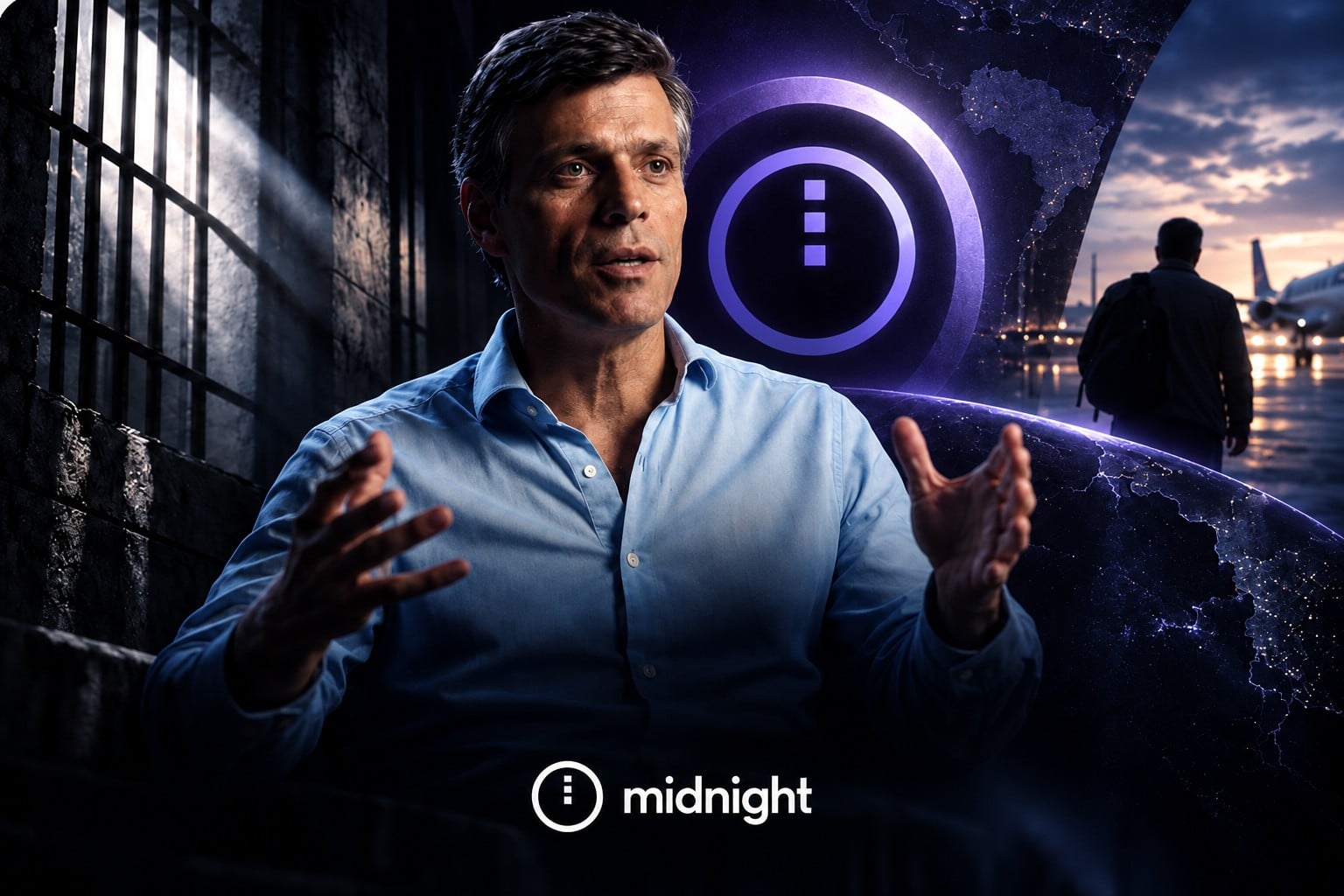
Venezuelan opposition leader Leopoldo López says he has been prohibited from holding a bank account in his home country since 2008, describing financial restrictions as a powerful instrument of political control.
The claim appears in Hacking the System, the final episode of Midnight's four-part Freedom Fighters documentary series, released on October 22, 2026.
López's account raises a question that extends beyond Venezuela: what happens when the institutions responsible for processing payments can also identify, monitor, and potentially restrict the people supporting a political movement?
How Financial Surveillance Can Expose an Entire Movement
López argues that authoritarian control increasingly extends into the financial systems people depend on for ordinary economic activity.
In the documentary, he explains that access to bank accounts is not simply a matter of convenience. It can determine whether individuals and organizations are able to receive funding, support their operations, and distribute resources.
He says Venezuelan authorities prevented him from holding a bank account beginning in 2008, although the documentary does not provide independent banking records to substantiate the restriction.
The wider concern involves the information generated by financial transactions.
When authorities can inspect account activity, they may identify who contributes money, where resources are transferred, and which individuals or organizations are financially connected.
For opposition movements operating under political pressure, such visibility can expose supporters and create additional opportunities for surveillance or retaliation.
López describes similar risks in digital communication, where governments can restrict access to online platforms, monitor activities, or interrupt internet connectivity.
After leaving Venezuela in 2020, he began exchanging experiences with democracy campaigners from other countries who had faced comparable forms of pressure.
Their conversations reinforced his argument that protecting individual identities and financial relationships is essential to maintaining independent civic organizations.
Why Bitcoin Transparency Creates a Different Privacy Problem
In Hacking the System, López identifies Bitcoin and open-source blockchain technology as potential tools for transferring resources without relying entirely on traditional financial intermediaries.
However, removing a bank from the transaction process does not automatically make financial activity private.
Bitcoin transactions are recorded on a public blockchain. Although addresses do not directly reveal personal names, transaction histories remain visible and can be analyzed to identify financial relationships.
This creates a distinction between permissionless transactions and confidential transactions.
Midnight addresses that distinction through its dual-state architecture, which separates publicly verifiable blockchain information from private data maintained locally by users.
Developers use Midnight's Compact programming language to specify what information must appear on the public ledger and what should remain private.
Zero-knowledge proofs then allow the network to verify that an operation satisfies the relevant rules without requiring disclosure of the underlying confidential information.
For example, an application could prove that a user has sufficient funds to complete a transaction without publicly revealing the user's private balance.
Selective disclosure provides another layer of control by allowing applications to reveal particular information when verification or compliance requires it, without exposing unrelated personal records.
These protections are not automatic for every transaction. Information deliberately designated as public, including unshielded token activity, remains visible on Midnight's ledger.
[NEWSBREAK]
What Privacy Technology Can and Cannot Protect
López presents decentralized and open-source technologies as tools that could help individuals retain greater control over their digital identities and financial activities.
Midnight's architecture offers a specific technical approach to that goal: limiting the sensitive information that applications need to publish while preserving the ability to verify legitimate transactions.
The distinction matters because financial privacy does not necessarily require hiding every aspect of an interaction. It can involve proving that a payment is valid, that a user meets a requirement, or that sufficient funds exist without revealing additional information.
However, cryptographic privacy has operational limits.
Zero-knowledge proofs do not prevent authorities from blocking internet access, seizing devices, compromising accounts, or imposing restrictions through regulated financial institutions.
The level of protection also depends on how developers design applications and which information they choose to make public.
The documentary does not establish that López or Venezuelan opposition organizations have used Midnight for financial transfers. His testimony provides context for the problems the technology is intended to address, rather than evidence of a deployed political use case.
Midnight's practical contribution lies in allowing developers to separate information that must be verified from information that does not need to be disclosed. That distinction directly addresses the financial visibility López describes, while leaving broader problems such as banking exclusion and government-controlled connectivity outside the blockchain's ability to solve on its own.