Midnames Tests Identity and Domains on Midnight Preprod
A new Build Club Masterclass showed QR and NFC credential flows, a coffee loyalty prototype and a developer-facing name service. The Midnames stack is open for testing on Midnight preprod, although credential verification still relies on a trusted server.
By SongMarketCap
Updated:
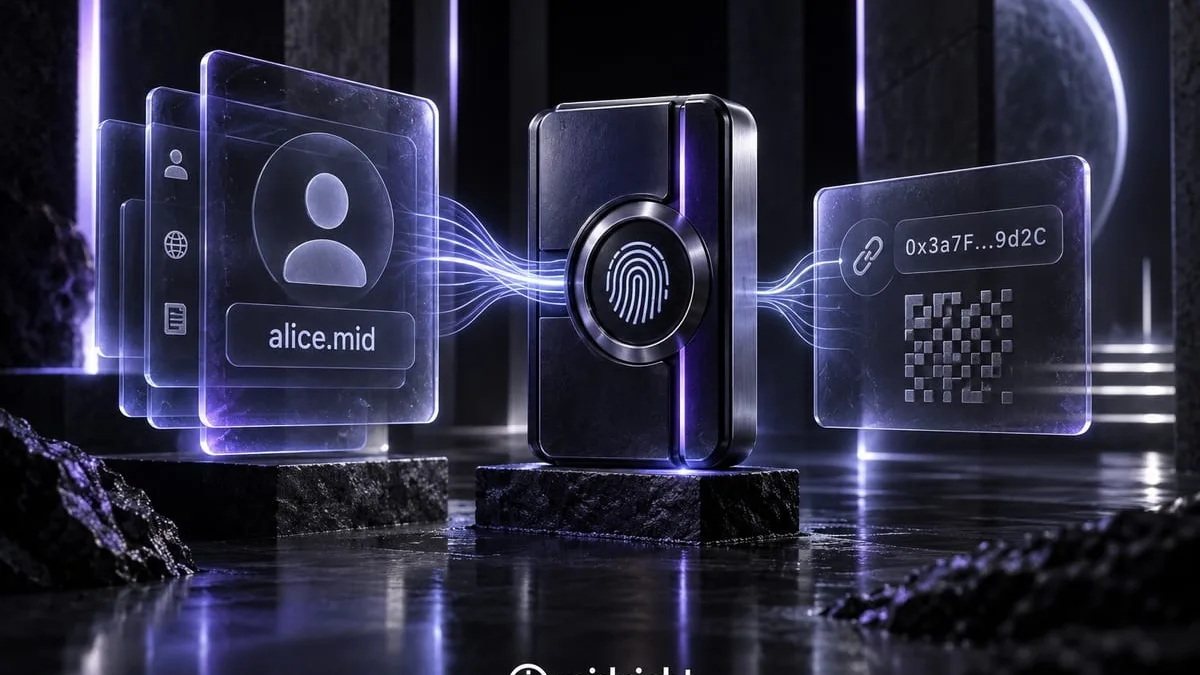
Midnames is developing an identity layer that combines decentralized identifiers, verifiable credentials and human-readable domains for Midnight applications.
Builders can access the stack through an SDK, embeddable profiles and domain ownership checks, while Lace provides the wallet connection to the wider Cardano ecosystem. The session paired working product flows with the technical limits still affecting production use.
The Identity Wallet Connects DIDs, Devices and Credentials
Midnames’ longer-term objective is to build a proof-of-personhood layer for a digital environment increasingly populated by automated accounts and AI agents. Its current identity wallet focuses first on microcredentials, including certificates for completed courses and acquired skills.
The wallet uses decentralized identifiers, known as DIDs, and verifiable credentials. An organization can digitally sign a credential, while another party can verify its authenticity without querying the issuer’s central database.
Midnames said the standards-based credentials can also be used by compatible identity wallets rather than remaining locked inside one application.
This structure can support checks for individual properties, such as whether someone meets an age or compliance requirement, without repeatedly sharing a full name, address or complete identity record.
In the demonstration, a credential was connected to a DID deployed on Midnight preprod. A holder key can be backed up, while a separate hardware key remains bound to the mobile device on which the credential was issued. A verifier can therefore distinguish between a restored credential and one that is also confirmed by its original device.
Midnames also added recovery through Google Drive, allowing users to restore access to the wallet and stored certificates. The team described this as a usability choice rather than a fully decentralized storage design.
Credential verification currently takes place on the server side. Midnames plans to replace that trusted step with zero-knowledge verification when the required circuits can run on mobile devices. Compact, Midnight’s smart contract language, produces zero-knowledge circuits from contract logic, but the demonstrated mobile flow still relies on the Midnames server.
QR and NFC Bring Credentials Into Physical User Flows
The demonstration showed a credential being issued through a QR code, confirmed with biometric authentication and later checked through an NFC reader. Issuance can also begin with an NFC tap, while Midnames is developing phone-to-phone verification so businesses do not need dedicated readers at every location. Applications can require the hardware key when a credential must remain bound to its original device.
The team applied the same identity model to a coffee shop loyalty prototype. A customer registers by scanning a code, after which a public key is connected to a DID. Each purchase adds a digital stamp, and the customer can redeem a reward after reaching the merchant’s configured threshold.
The QR codes used to add stamps are time-limited and single-use, preventing customers from reusing a screenshot. A merchant interface displays registrations, issued and redeemed coffees and basic activity data. Midnames said it is discussing the product with coffee shop owners in Buenos Aires, but the session did not identify a live merchant deployment.
The loyalty application keeps the DID and contract interactions behind a familiar process of scanning, collecting stamps and redeeming a reward. It demonstrates how the same credential infrastructure can support educational certificates, verification at physical locations and commercial loyalty programs.
Midnames Opens Its Name Service to Midnight Builders
The Midnames name service is available for external testing on Midnight preprod. It connects a human-readable name to a wallet or contract address, similar to how an internet domain replaces an IP address. Users can access the application through Lace and its Midnight wallet support.
Each domain contains a target address and additional fields. The target can resolve to a wallet or smart contract, while the fields can store a profile type, links, application identifiers or other data. Applications can define how they use and display those flexible records.
The team also demonstrated a Discord integration in which a token is bound to a specific domain name and contract. Copying it to another domain does not reproduce the verified connection because the server checks where it was originally assigned.
Midnames provides an SDK and embeddable profile widgets. An application can resolve a domain, inspect its fields or display a profile without building a separate naming system. Ownership can also be checked by asking a user to store a designated token in the domain record and verifying the corresponding contract update.
The presentation also documented the current limits. The interface occasionally failed to save or display records correctly, a Midnight node was dropping some transactions, and domain transfers were unavailable because wallets were reporting addresses incorrectly. Midnames expects transfers to work after the wallet-side issue is corrected, but did not provide a production date.
For the wider Cardano ecosystem, Midnames adds a user layer around Lace and Midnight applications. Builders can now test domain resolution, profile widgets and application-specific records on preprod, while the wallet and loyalty prototype extend the same DID foundation beyond blockchain addresses.
Naming components are ready for integration testing, but private credential verification still needs to move beyond the trusted server before Midnames can deliver its planned decentralized identity layer.