Fahmi Syed on Midnight: “Zcash on Steroids”
The Midnight Foundation president connects programmable privacy with AI agent controls, private financial markets, and Monument Bank’s plans for tokenized deposits and asset-backed lending.
By SongMarketCap
Updated:
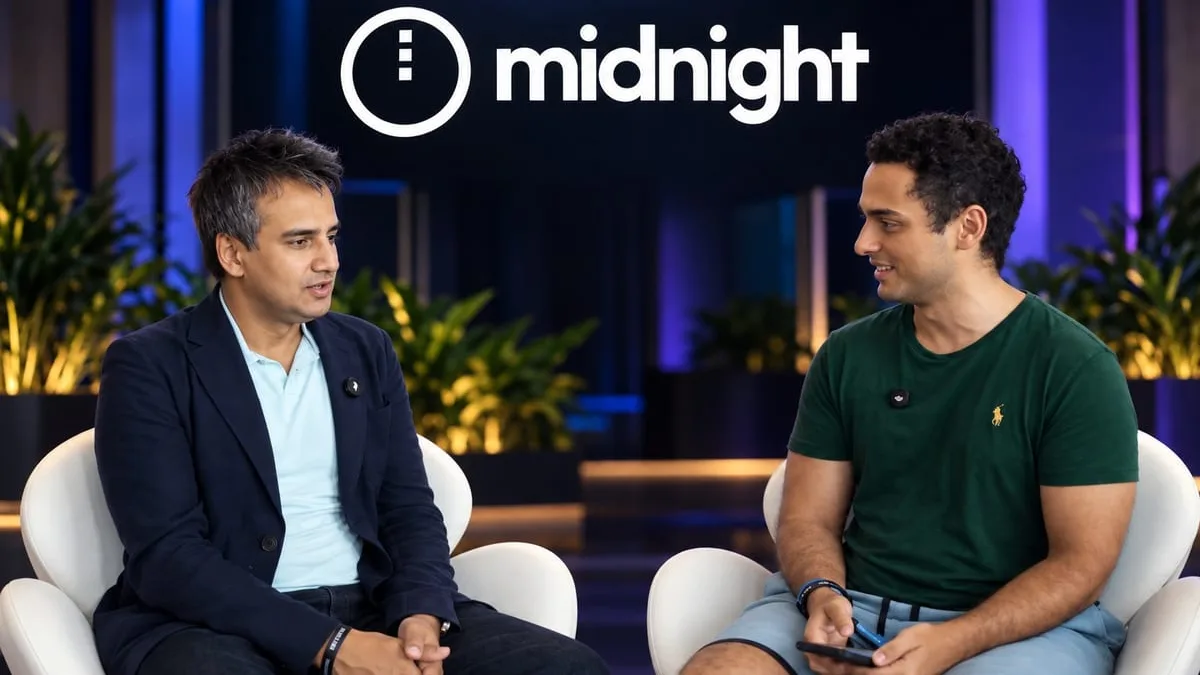
Fahmi Syed, president of the Midnight Foundation, described Midnight as “Zcash on steroids” in an interview with Jesus Martinez, who announced the conversation on October 11. Discussing presentations at TOKEN2049 in Singapore, Syed explained how programmable privacy, Midnight Passport, and private trading tools connect to AI agents, financial services, and the foundation’s partnership with Monument Bank.
Syed’s background includes Marshall Wace, a chief financial officer role at Parity, and work on Midnight within Input Output before leading the foundation.
Midnight, Zcash, and the Network’s Economics
“Midnight is all about privacy, but privacy which is programmable,” Syed explained. His starting point is a shielded environment in which users decide what to disclose publicly, to a counterparty, or to a defined group. A custodian or tax accountant could inspect relevant records without making them public, while a user could prove eligibility within a jurisdiction without exposing a complete financial history.
Permissioned corporate blockchains present a different problem in his account: fragmentation. How does Morgan Stanley’s private network establish trust and communicate with JPMorgan’s? His comparison extended to Monero, whose privacy he associated with difficulties for exchanges and regulators, and Zcash, with its shielded and unshielded options. Aleo and similar approaches prompted his question about private execution involving a publicly visible token.
A house provided the analogy. Someone may remain private indoors, but an observer who sees them leave at four o’clock and return 15 minutes later has a window in which to investigate. Public transaction traces, he argued, can provide similar clues. Midnight’s shielded execution was his equivalent of leaving under an “invisibility cloak.” The network token itself remains public in this explanation, while developers can build shielded or unshielded stablecoins and tokenized assets.
Syed credited Zcash’s pioneering work and their shared use of Halo 2 cryptography, characterizing Midnight as Zcash with smart contracts and selective disclosure. “Zcash on steroids” was his formulation. Asked about competition and Charles Hoskinson’s optimistic comparisons, he responded that he wanted to build “the first Midnight.” “It’s great to be thought of in the same terms as Zcash, but I care about winning.”
The institutional demand, in his view, comes from practical confidentiality requirements. Hedge funds need to protect strategies, banks cannot expose payroll, and companies want to retain commercially sensitive information. Healthcare examples included transferring records between providers, finding clinical trial participants, and sharing research without exposing personal or commercial data. He also called Midnight a potential “VPN of DeFi” for borrowing and lending.
On distribution, Syed outlined how Glacier Drop was designed for holders across eight blockchain ecosystems, with participation subsequently expanded through Scavenger Mine. He reported more than four billion distributed tokens and hundreds of thousands of participants. The original claim process had closed, while existing allocations continued to become available through quarterly installments. A further Lost and Found process remained possible, with full details still unannounced at the time.
His estimate put the community’s allocation at more than 20%, or approximately 25%, through Glacier Drop, Scavenger Mine, and participating exchanges.
Remaining allocations went to the foundation, treasury, and block production rewards. The treasury, he added, would remain locked until the network matured, with governance eventually enabling ecosystem funding. He characterized the March mainnet launch as deliberately guarded, using federated nodes while security reviews supported the gradual removal of restrictions and a path toward more validators and fuller governance.
On network economics, Syed explained that holding NIGHT generates DUST, a renewable resource for transactions. Developers could estimate demand and plan the holdings needed to support their applications, giving them greater predictability around capacity and costs. For holders, he expected staking within six to 12 months of the interview.
Midnight Passport and Control Over AI Agents
The question of control also shaped Syed’s criticism of technology platforms that accumulate data through free or inexpensive services. In his account, the resulting value primarily benefits their operators. Institutional privacy could protect those accumulated records even while customers continued surrendering information. For individuals, he linked privacy to freedom of association, commerce, and expression, citing private communication, newsletters, and political organizing where revealing an identity could have consequences.
Martinez introduced AI through an account of Midnight City agents engaging 20 people to represent the project at TOKEN2049 because they could not attend physically. For Syed, the example raised a practical question: how much access should an agent receive to its owner’s identity, money, and data? Beyond its entertainment component, Midnight City serves in his account as an environment for studying agents’ behavior and interactions before they handle real funds.
Midnight Passport supplies the identity and permissioning component. Syed compared its intended phone and computer experience with Apple ID or Google ID, using cryptographic proofs of identity, ownership, and access rights that can support delegated authority. Referring to a presentation the day before the interview, he outlined connections to Grok, Claude, and other AI systems. An agent could receive authorization to trade and proof of sufficient funds without seeing the user’s wallet, total balance, or transaction history, he claimed.
Martinez asked how this differed from an MCP connection or an exchange API key. Syed’s distinction centered on proving specific requirements, including sufficient funds, adequate margin, and jurisdictional eligibility, while limiting disclosure of broader financial information. “I don’t need to show you everything I own,” he explained. Corporate cards illustrated the proposed boundaries: a chief marketing officer might receive a $10,000 limit, while a junior employee gets $500. Both can act for the company within different permissions.
The same principle, in his vision, would govern trading, healthcare access, wallets, and agents. He mentioned MetaMask and Solana wallets alongside Midnight, with restrictions intended to prevent unauthorized spending and limit information reaching an AI provider. The commercial concern becomes larger when a provider can aggregate financial data from thousands or millions of users.
A conversation at a brokerage event in Singapore supplied his example of how disclosure can affect pricing. A client might allocate 20 million USDT to one broker, while public transactions reveal identical payments to four others. The broker can infer that $100 million is available and that they control one-fifth of the business. Tighter spreads and better execution could help win $25 million or $30 million at the next allocation.
Another client might provide the same amount, while public data suggests it represents their entire holdings. With no apparent competition for the capital, the broker in Syed’s account had less incentive to offer equally competitive terms. The anecdote illustrated his argument for letting users decide what counterparties know about their finances. He applied the same reasoning to trading strategies: public activity can invite copying or trades against an investor’s position, whereas a privately controlled strategy could potentially be made available to others through an agent or leased capability.
Private Markets and Monument Bank’s Roadmap
Martinez also challenged Syed on how research and development translate into value for token holders, citing Near as a network attracting attention through revenue-generating activity. Syed credited Near’s development of intents and praised Ilya and his team. For Midnight, he identified Nightmode, Collateral Warehouse, and Midnight Passport as potential sources of revenue for the network and foundation, alongside opportunities for developers to build businesses.
Private trading intents form part of that financial model. In the dark pool arrangement he outlined, an order remains off-chain until a partial or complete match is found, with settlement protecting the participants’ information. He linked the mechanism to tokenized private equity, hedge funds, and private credit, arguing that fractional ownership and lower operational friction could extend access beyond very wealthy clients.
Redemption periods create a separate problem for those investors. A fund may require 30 or 90 days before returning capital, even when a holder wants to exit immediately. Through Offer Files, Syed explained, that investor could privately offer the holding to another buyer, potentially accepting a 5% or 10% discount. Matching offers could support a secondary market without broadcasting every seller’s intention.
Collateral Warehouse would address financing through a shielded vault for collateral and margin management, allowing participants to negotiate without exposing their positions. Trading commissions have compressed, Syed observed, while financing, securities lending, and leverage remain significant businesses. His ambition is for Midnight’s tools to work together across those activities, expressed as making one plus one equal three.
For Syed, that infrastructure should ultimately operate in the background. “Good technology is invisible,” he remarked, comparing the intended experience with Uber or Grab: customers care that the car arrives and reaches its destination, not about the systems behind it. Intel inside Dell and Hewlett-Packard computers supplied another analogy. He reported conversations with banks, healthcare companies, and clinical trial organizations, allowing for multiple winners and tying Midnight’s growth to the success of partners using its infrastructure.
Monument Bank, the regulated British digital bank, provided his concrete example of that partnership model. Syed outlined three phases, beginning with tokenized retail deposits that he expected to launch in the weeks following the interview. The second would introduce shielded financial products, including money market funds, private equity, and hedge funds. A private “sovereign zone” for Monument and its customers within the public network would support movement between deposits, stablecoins, and investments while restricting access to sensitive information.
The third phase, which he placed in the following year, would introduce Lombard lending against pledged assets. “The wealthiest people in the world don’t sell to buy. They leverage and borrow to buy,” he remarked. He used Elon Musk’s acquisition of Twitter to illustrate his argument about borrowing against existing wealth. For customers otherwise required to sell an investment before making another purchase, asset-backed lending would allow the original holding to remain in the portfolio.
He tied Monument’s lending plans to Collateral Warehouse and financing with controlled disclosure, describing the aim as “using your assets, your wealth, to borrow and create more wealth in a controlled and private way.”