Charles Hoskinson Frames Midnight as Privacy Infrastructure for the Next Wave of Crypto Adoption
In a new interview with Gigi from Genfinity, Charles Hoskinson described Midnight as a privacy focused, cross chain infrastructure layer built for regulated financial use cases, selective disclosure, easier wallet use and future AI agents. The discussion connected Monument Bank’s 250 million pound tokenization initiative with a broader argument, crypto needs privacy and compliance built into the user experience before it can reach the next wave of adoption.
By SongMarketCap
Updated:
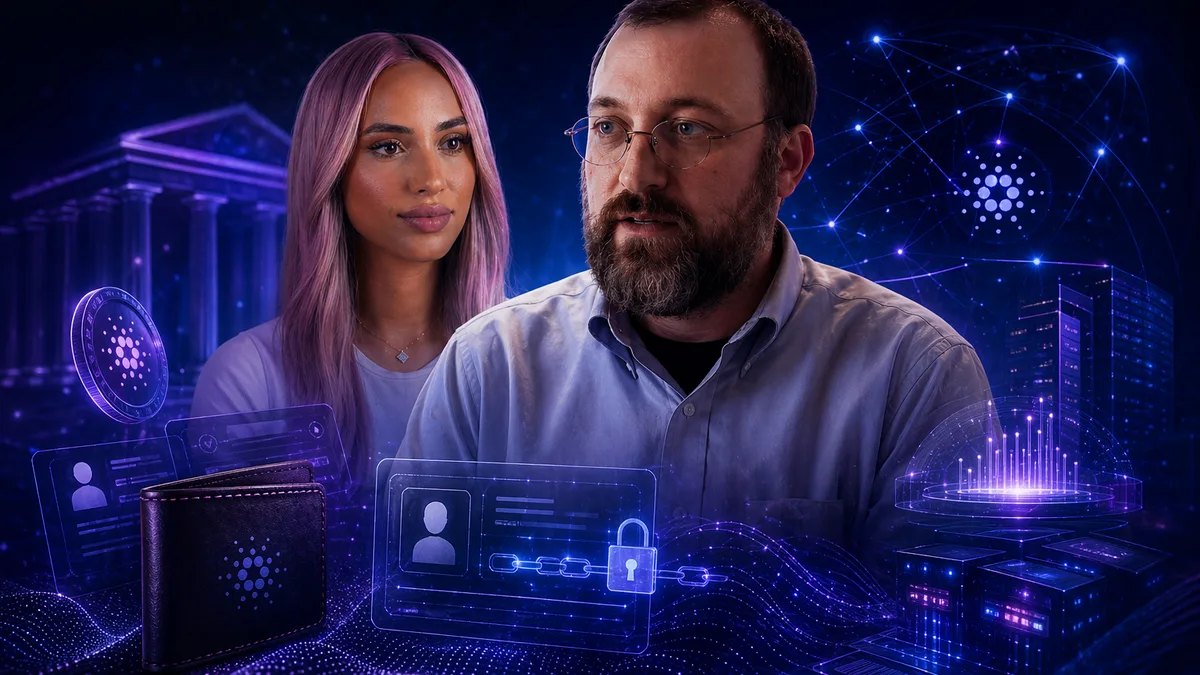
Midnight Connects Privacy With Regulated Asset Tokenization
Charles Hoskinson, who led the creation of Cardano and is CEO of Input Output, used a new interview with Gigi from Genfinity to position Midnight as more than another blockchain launch. His central argument was that the next phase of crypto adoption will not be driven only by faster networks or deeper liquidity, but by systems that can combine privacy, compliance, cross chain access and simple user experience.
The strongest example in the conversation was Monument Bank and the 250 million pounds discussed in connection with its tokenization initiative. Hoskinson described the deal as a practical fit for Midnight because regulated financial use cases need more than public settlement. They need clear rules, controlled data access and compliance logic that can operate without exposing every user and every transaction to the entire internet.
That distinction matters for real world asset tokenization. Public blockchains are powerful because they create transparent, auditable and shared financial infrastructure. But the same transparency becomes a weakness when identity data, financial behavior or commercial activity is permanently visible. Hoskinson warned that crypto users often underestimate the danger of “forever memory”, where blockchain activity remains public, searchable and immutable long after the original transaction.
Midnight’s proposed answer is programmable privacy. The goal is not to hide everything, but to make privacy the default while still allowing users, applications and institutions to prove specific facts when required. For stablecoins, tokenized deposits, real world assets and regulated finance, that could become a critical difference between blockchain as an experimental market and blockchain as usable financial infrastructure.
Selective Disclosure Brings Privacy to Digital Identity
One of the most important ideas in the interview was selective disclosure. Hoskinson explained it through a simple example, a person should be able to prove they are old enough to enter a bar without revealing their full identity, address, exact age or unrelated personal data.
That example is small, but the principle is much larger. In many digital interactions, the other side does not need to know everything about a user. It only needs to verify a relevant condition. Is the user eligible to access a service? Are they allowed to hold a specific asset? Are they authorized to complete a transaction? Are they compliant with a defined rule?
This is where zero knowledge proofs, multi party computation and verifiable credentials become practical infrastructure rather than abstract cryptography. They can support safer commerce, digital identity, KYC, AML, medical records, financial access and potentially voting systems. Hoskinson’s point was that privacy and auditability do not need to be opposites if the system is designed to disclose only what is necessary.
For the wider Cardano ecosystem, the relevance is that Midnight extends the conversation beyond base layer infrastructure into privacy, identity and cross chain usability. It also gives builders a clearer framework for applications that cannot operate responsibly if every data point becomes public by default.
That is why the interview did not frame Midnight simply as a privacy chain. It framed Midnight as a rules based interaction layer, where compliance can be enforced without turning users into permanent public records. If that model works, it could support a new class of applications that need both trust and confidentiality.
$NIGHT, DUST and Midnight Passport Aim to Remove Wallet Friction
Hoskinson also explained why Midnight separates ownership from network usage through its dual token design. In many blockchain systems, one token is expected to do too much. It acts as an investment asset, a governance tool and the fuel required to use the network. That creates a conflict, because investors may want the token price to rise, while users want transaction costs to remain low, stable and predictable.
Midnight attempts to separate those incentives through $NIGHT and DUST. Hoskinson described NIGHT as the ownership and control side of the system, while DUST is designed as a private, non transferable consumptive token used for network activity. In practical terms, this could allow applications or service providers to sponsor transactions for users, removing one of the biggest barriers in crypto onboarding.
That point is important because Hoskinson was direct about today’s wallet experience. Normal users do not want to manage seed phrases, send test transactions, copy long addresses or live with the fear that one mistake could cost them their assets. His vision is closer to a mobile app experience, where a user scans a QR code, uses a fingerprint or PIN, has a clear recovery path and can interact with multiple chains through one interface.
That is where Midnight Passport becomes central. Hoskinson described Passport as a simpler entry point for account creation, recovery, digital credentials, multi chain accounts and decentralized application access. He also discussed a DApp operating system, where crypto apps could be installed and used more naturally, while off chain data remains encrypted by default.
The wider vision connects Midnight to AI agents. Hoskinson expects users over the next five to ten years to delegate more digital activity to agents, including research, financial actions, DeFi activity and crypto transactions. If that shift happens, wallets will no longer be simple storage tools. They will become permission systems, identity layers and rule engines for automated digital actions.
That is where Midnight’s ambition becomes most concrete. The project is not only trying to make blockchain transactions private. It is trying to make them usable for people who do not want to think like blockchain operators. Monument Bank shows the institutional side of that thesis, selective disclosure shows the identity layer, and Midnight Passport shows the user interface problem. Together, they point to the same conclusion, the next serious phase of crypto adoption will depend less on asking users to understand blockchain complexity, and more on building systems that keep that complexity safely behind the product.