Charles Hoskinson at 39: Midnight Is His Final Major Mission as AI Reshapes the World
In a personal birthday address, the Cardano founder reflected on his journey through cryptocurrency, described Midnight as his last major undertaking, and shared his predictions about artificial intelligence, global conflict, and the values he believes will matter most in the years ahead.
By SongMarketCap
Updated:
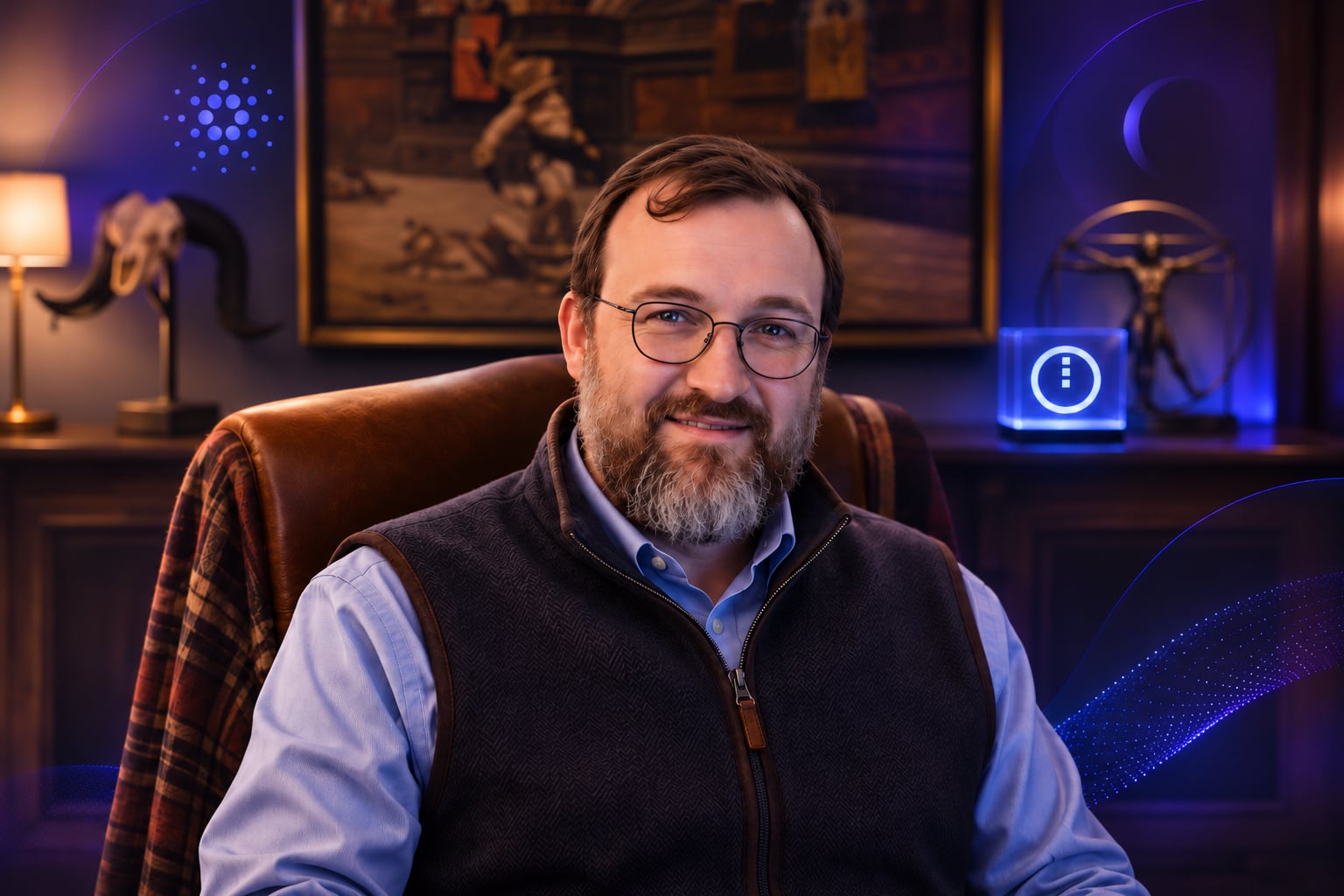
Charles Hoskinson marked his 39th birthday with a video titled Some Birthday Wisdom, reflecting on nearly 15 years in cryptocurrency and the experiences that shaped his views on technology, politics, and personal relationships. The Cardano founder revisited his journey from Bitcoin and Ethereum to Cardano and Midnight, while examining the challenges he believes society faces as artificial intelligence advances.
Among his most personal remarks was his description of Midnight as potentially his final major professional undertaking. Hoskinson also predicted profound technological changes over the next 12 to 24 months, warned about rising geopolitical tensions, and shared the lessons he intends to carry into his forties.
From Bitcoin to Cardano: The Journey That Shaped Hoskinson
Born on November 5, 1987, Hoskinson began by recalling the decisions that led him into cryptocurrency. He graduated from high school at 15 and initially pursued medicine, following a family tradition that included his father, grandfather, uncle, and brother. His interests eventually shifted toward mathematics at the University of Colorado Boulder. Although he enjoyed studying the subject, conversations with professional mathematicians left him questioning whether an academic career suited his ambitions.
Participation in Ron Paul's presidential campaign introduced him to Austrian economics, political organizing, and ideas about individual liberty. These experiences contributed to his decision to leave university and become an entrepreneur. His first major cryptocurrency initiative was the Bitcoin Education Project, through which he developed educational materials for early Bitcoin users. Hoskinson recalled creating a course that attracted approximately 70,000 students and introduced him to industry figures including Andreas Antonopoulos, Erik Voorhees, and Roger Ver.
He later became the founding chairman of the Bitcoin Foundation's Education Committee and worked with Dan Larimer on BitShares. His involvement in Ethereum followed before he established Input Output and Cardano. Over the following years, Hoskinson traveled to approximately 75 countries, met political leaders and business figures, and testified before the U.S. House of Representatives in 2022. Those experiences influenced his understanding of two problems he believes increasingly affect modern society: a lack of authenticity and a crisis of meaning.
Hoskinson acknowledged that his outspoken personality has frequently created controversy. He admitted that emotional reactions, public disagreements, and a lack of diplomacy have sometimes damaged relationships and professional opportunities. Nevertheless, he maintained that expressing his genuine beliefs has remained more important than cultivating a carefully managed public image.
His reflections extended to American politics. Hoskinson criticized the relationship between political power and commercial cryptocurrency ventures, specifically mentioning the Trump meme coin and World Liberty Financial. He objected to the possibility of public officials personally benefiting from financial products associated with their political positions and described distancing himself from political opportunities in Washington because of those concerns.
For Hoskinson, these experiences reinforced the motivations that originally drew him toward decentralized technology: individual freedom, institutional accountability, and the ability to participate in systems without depending entirely on centralized authorities.
Midnight, Artificial Intelligence, and the Future Hoskinson Envisions
Hoskinson described cryptocurrency as the technology that restored his sense of personal agency after earlier political disappointments. He recalled feeling powerless to influence the economic and political systems governing everyday life. Bitcoin introduced the possibility of creating independent monetary systems, while blockchain technology later expanded those possibilities to voting, identity, and other forms of digital infrastructure. He contrasted the industry's early years, when fewer than one million people participated, with his current estimate of approximately 550 million cryptocurrency users worldwide.
Midnight represents the next stage of that ambition. Hoskinson outlined a vision combining digital identity, privacy, regulatory compliance, and autonomous AI agents into a system capable of supporting much broader blockchain adoption. He believes these capabilities could allow individuals and institutions to interact through shared infrastructure while retaining greater control over sensitive information.
His commitment became particularly personal when he declared:
"I got one more rodeo left in me, that's midnight."
He followed that statement by expressing his belief that Midnight could complete the work Satoshi Nakamoto began with Bitcoin. Hoskinson described the project as physically and mentally demanding, acknowledging the exhaustion that comes with continuously developing technology, managing organizations, and pursuing large-scale adoption. Approaching 40 has also changed how he thinks about the time and energy available for future projects. His remarks reflected his determination to dedicate himself to Midnight as what he considers his remaining major professional mission, rather than announcing a retirement date or departure from Cardano.
Artificial intelligence forms a central part of that vision. Hoskinson revisited the Hoskinson Center for Formal Mathematics at Carnegie Mellon University, which he supported with a $20 million commitment. He connected the center's work to Lean, a system for expressing mathematical proofs in a form that computers can verify. He explained that he had anticipated AI becoming increasingly important in mathematical research, although the pace of technological progress exceeded his original expectations.
Using mathematician Terence Tao as an example, Hoskinson argued that AI is changing the value of specialized knowledge by making sophisticated analytical capabilities accessible to a much wider population. He suggested that intelligence and advanced problem-solving abilities may become less exclusive as increasingly capable systems become available. In his assessment, this could fundamentally change the economic and social value of specialized knowledge.
Hoskinson predicted that the next 12 to 24 months could bring some of the most significant technological changes in human history. He expects AI to become deeply integrated into education, research, professional work, and everyday decision-making. Knowing how to use these tools, he argued, could soon be as essential as knowing how to read and write. He compared the emerging divide between effective AI users and those unfamiliar with the technology to the distinction between literate and illiterate populations.
At the same time, he expressed concern that restrictions on advanced AI tools, together with unequal access and pricing, could widen economic and social inequalities. To illustrate how he personally uses artificial intelligence, Hoskinson described investigating aircraft engineering after becoming interested in an aviation accident. Using technical documentation, mathematical calculations, and AI-assisted software, he explored aircraft designs and weather-related flight simulations. What began as a question about aviation safety developed into an extended engineering exercise.
He connected that experience to physicist Richard Feynman's philosophy of curiosity, arguing that the ability to ask questions and investigate problems from first principles will become increasingly valuable as AI expands access to knowledge.
His technological outlook was accompanied by concerns about society's direction. Hoskinson described a growing crisis of meaning in which individuals search for certainty through political leaders, public figures, religion, and technological movements. He criticized the expectation that artificial intelligence could function as an almost divine solution to humanity's problems. While he believes advanced AI could dramatically improve human living conditions, he also warned that it could enable unprecedented forms of surveillance, coercion, and centralized control.
His concerns extended to international relations. Hoskinson discussed the war in Ukraine, tensions involving Iran and Taiwan, and the possibility of major cyberattacks against critical infrastructure. He warned that conflict among major powers could expand through escalating tensions and interconnected alliances, drawing comparisons with the circumstances preceding World War I. He also expressed concern about the possibility of a Chinese military operation against Taiwan in 2027.
In that environment, Hoskinson continues to view cryptocurrency as a means of preserving individual agency. His ambition for Midnight is to combine identity, privacy, compliance, and autonomous agents in infrastructure that could make those capabilities available across global digital services.
[NEWSBREAK]
Friends, Family, Faith, and a Personal Message to the Cardano Community
The final portion of Hoskinson's birthday address moved away from technology and toward the personal lessons he has learned throughout his career. He organized his advice around three principles: friends, family, and faith. Friendship, he explained, requires empathy and a genuine willingness to understand other people's perspectives. He emphasized building relationships in which individuals support each other through uncertainty and difficult circumstances.
Family provides another source of purpose. Hoskinson described family relationships as a reason to continue pursuing meaningful goals even when professional and personal challenges become overwhelming. His discussion of faith extended beyond any particular religion. He described it as a belief that human existence involves something greater than individual understanding and that people benefit from living according to ethical principles.
Alongside those three foundations, Hoskinson emphasized the importance of lifelong learning. He revisited Richard Feynman's autobiography, Surely You're Joking, Mr. Feynman!, describing how the physicist's persistent curiosity influenced his own approach to understanding mathematics, science, and technology. Hoskinson argued that encouraging children to question assumptions and explore how things work is among the most valuable things parents can do.
His reflections also included an acknowledgment of personal mistakes. He discussed difficult relationships and disputed business arrangements involving projects in Gillette, Wyoming, including construction activities and a medical facility. Hoskinson alleged that certain individuals had taken advantage of his trust and financial resources. He also acknowledged that his reactions to perceived betrayal sometimes intensified conflicts. Anger, resentment, and public confrontation had, in his account, limited opportunities and damaged relationships.
Looking back, he identified his most rewarding professional experiences as those involving teaching, intellectual exploration, and helping others learn. He specifically recalled educational whiteboard videos and lectures, a format closely associated with Cardano's early development and one that introduced many viewers to his ideas about blockchain architecture. As he approaches his forties, Hoskinson expressed a desire to preserve his enthusiasm for learning while becoming more deliberate about showing empathy and appreciation toward others.
The address also touched on aging and the impermanence of life. He remembered relatives and friends who had died, reflected on watching his parents grow older, and recalled childhood evenings spent watching Star Trek: The Next Generation on a small television. He referenced the Buddhist practice of creating intricate sand mandalas and then dismantling them, connecting the tradition to the idea that life's experiences acquire meaning partly because they do not last forever.
Those reflections led into his closing message to the community. Hoskinson thanked people who had sent birthday greetings from around the world, including Iran, Russia, Turkey, Japan, Korea, South Africa, Kenya, Argentina, Europe, North America, and even a research station in Antarctica. He acknowledged that the messages had provided encouragement during a demanding period of professional commitments.
Looking toward 2027, he predicted a difficult year but expressed confidence that the people supporting his work would help him navigate the challenges ahead. He thanked the communities that had accompanied him through Bitcoin, Ethereum, Cardano, and Midnight, acknowledging the dedication and exhaustion involved in building technology over many years.
His address ended with a personal message of gratitude rather than a technical announcement. After discussing the uncertainty of the future, Hoskinson returned to the friends, family, and community relationships he had emphasized throughout the video. He closed by raising a toast to his 39th year, hoping it would be as eventful and interesting as the one that had just passed.