Who Builds Cardano Next? Hoskinson Details the Handover
Input Output will keep its Leios team at full capacity until the hard fork as other developers move to independent firms. A December 15 presentation will outline Midnight’s plans for the coming year, including new concepts for institutional users.
By SongMarketCap
Updated:
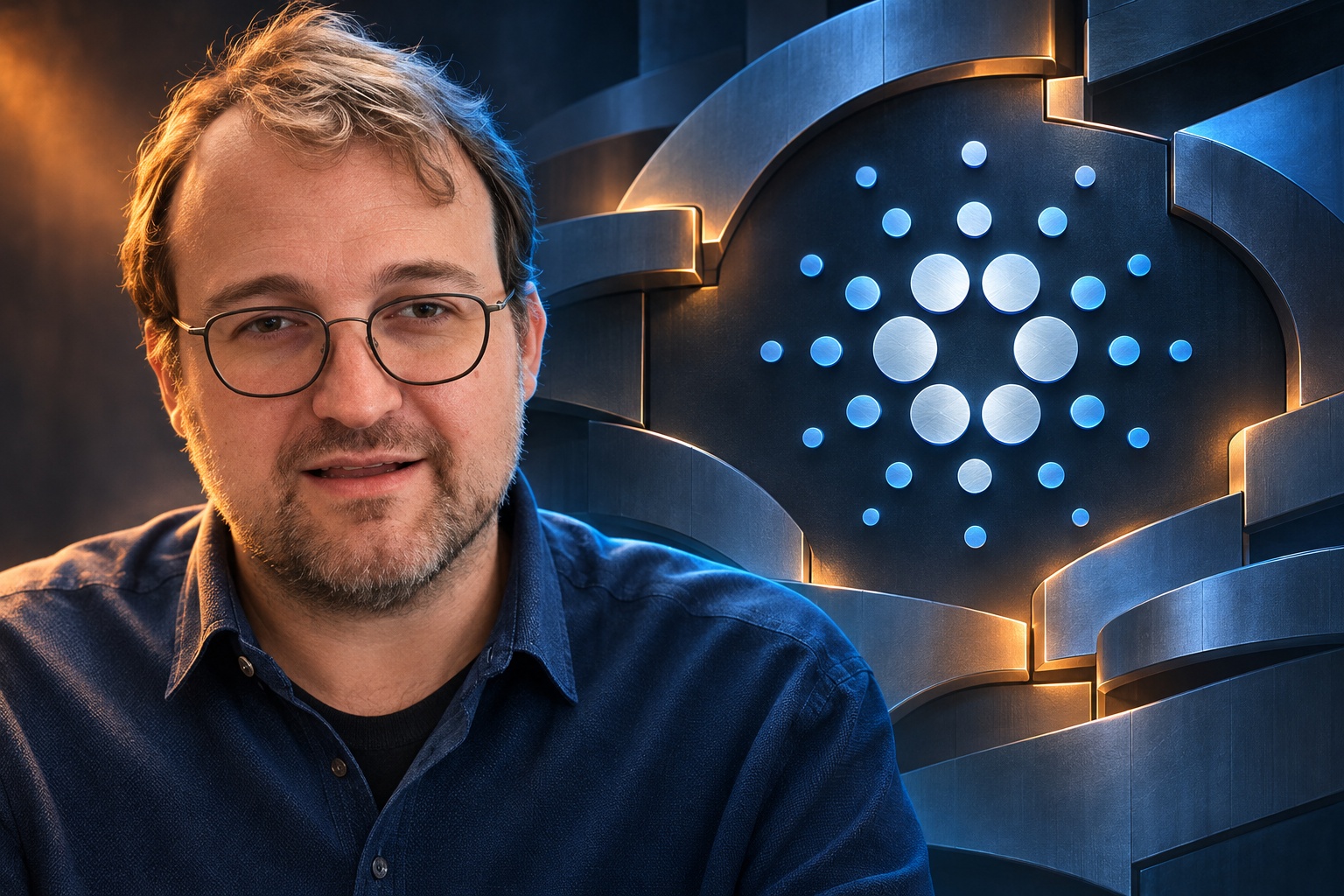
Charles Hoskinson outlined how Input Output is transferring Cardano development teams and contracts to other organizations while preparing Midnight’s next phase. In his November 16 video, December 15th and Closing Out the Year, he described the handover already underway and the coordination needed for Cardano’s next roadmap.
The update also included an acknowledgment of execution problems, renewed criticism of governance institutions, and his reasons for concentrating on products rather than political disputes within the ecosystem.
Cardano Developers Are Moving to Other Firms
According to Hoskinson, groups working on Plutus and other Cardano components have been moving to new firms in batches every two to four weeks. Those organizations are taking over personnel and associated contracts.
A workshop at Input Output’s headquarters in Longmont, Colorado, will address the remaining transition details. Development partners that have worked with the company for years are assuming more formal responsibilities for maintaining and advancing Cardano.
Leios follows a separate timeline. Hoskinson committed to keeping its team at full capacity until the hard fork.
He pointed to Daedalus as an example of the handover producing results. In his assessment, Seven Labs had accomplished more in roughly two months after taking over the wallet than Input Output had in a year. He attributed the improvement to smaller teams with the autonomy to make decisions and execute.
That model also creates a coordination challenge: individual teams can move faster within their areas of responsibility, while changes spanning the protocol require agreement among organizations.
Intersect and the Roadmap After Voltaire
Hoskinson identified coordination through Intersect as a central topic for the transition. Separate development teams need to align their priorities around a coherent post-Voltaire roadmap.
He again rejected the interpretation that completing Input Output’s original roadmap means Cardano itself is finished.
“Obviously, I never said Cardano is finished.”
He was referring to the program Input Output began in 2015, spanning Byron through Voltaire. He described that program as reaching its conclusion, with final implementation and transition work still being completed.
For 2027, he expects the community to develop a new roadmap and vision. Input Output would no longer occupy the same position as the original core developer responsible for delivering the founding plan.

Governance Without a Central Figure
Hoskinson ruled out becoming a delegated representative, or DRep, despite requests from community members. He wants to concentrate on technical problems and product development rather than continue participating in governance disputes.
He emphasized that he remains a substantial ADA holder. His withdrawal concerns active involvement in those disputes and decisions about Cardano’s future direction.
That distinction informed his criticism of the Cardano Foundation and CEO Frederik Gregaard. Hoskinson questioned whether the community has meaningful ways to hold the foundation’s leadership accountable. He argued that accountability should include the ability to replace leadership or withdraw support when results fall short.
He described Input Output as a private development company, rather than a permanent governance institution. His preferred structure gives greater responsibility to membership organizations, community-operated infrastructure, and entities dependent on treasury funding. ADA holders could then use governance decisions to change funding priorities and support different development organizations.
Hoskinson also acknowledged that his personal prominence can dominate discussions. He argued that stepping back would give other leaders more space to make decisions and represent Cardano.
Execution and Adoption Remain Unfinished Work
Alongside his defense of Cardano’s technology, Hoskinson acknowledged that execution had been too slow, that the ecosystem had lacked a commercial function, and that coordination had performed poorly.
He identified transaction activity, protocol revenue, and total value locked in applications as areas where criticism of adoption deserves attention. He linked Input Output’s increasing focus on applications to the need for more users and economic activity.
Other organizations would take greater responsibility for the underlying protocol, while his company pursues products intended to address those adoption gaps.
He continued to defend technical choices including Ouroboros, the extended UTXO model, formal verification, and Hydra. In particular, he argued that AI-assisted programming increases the relevance of precise specifications and methods for checking whether software behaves as intended.
Hoskinson also rejected the idea that current market sentiment determines Cardano’s prospects. He argued that a successful application could substantially change adoption and public perception, while on-chain governance gives the protocol a mechanism for adapting its direction.
Why He Considers Midnight a Cardano Project
Hoskinson challenged the claim that concentrating on Midnight amounts to abandoning Cardano. He cited the issuance of Midnight’s token supply on Cardano, Cardano’s consensus, and stake pool operators’ role in Midnight’s security model as the basis for their connection.
At the same time, he emphasized that Midnight follows a different engineering approach. He pointed to its use of Polkadot technology as an example of pragmatic choices that distinguish its development from Cardano’s original path.
His focus includes privacy, identity, institutional services, and artificial intelligence. He wants users to encounter those capabilities through applications that fit into their existing activities.
He also reiterated that Midnight had not conducted an ICO and had distributed tokens through the Glacier Drop. He presented that approach as part of his preference for broadening access to the ecosystem.
[NEWSBREAK]
AI Agents and Simpler Consumer Experiences
Hoskinson described a user experience that would remove the need to manage separate identities and workflows for every blockchain involved in a transaction.
He connected that ambition to account abstraction and chain abstraction, approaches that let applications handle more of the underlying account and network mechanics. His example was a universal identity that could work across chains, with a fingerprint used to authorize spending.
He presented this as a development goal combining simpler interactions with user control over assets and identity.
Persistent AI agents form another part of that vision. Returning to a concept introduced in Tokyo, he described an agent owned by its user, with protections against surveillance and deception.
He argued that blockchain infrastructure could provide a control layer for AI by helping enforce defined rules. The ambition is to constrain what a system can do, reducing dependence on promises from the organization operating it.
For adoption, he wants those capabilities embedded in useful consumer services. New users should be able to benefit without first joining cryptocurrency communities or following token markets.
Institutional Services and User Control
For institutional users, Hoskinson highlighted custody vaults and additional concepts planned for discussion on December 15. He linked that work to regulatory technology and regulated financial services.
He described Midnight’s direction through privacy-enhancing technology, smart compliance, abstraction, and agents. He also outlined an approach in which users could pay for services through different instruments, including stablecoins, while those maintaining the infrastructure share in the value generated by its use.
His institutional ambitions remain tied to concerns about control. He criticized regulated-asset models that depend on centralized key holders and reiterated his preference for preserving individual control over data and property.
These priorities frame the institutional concepts he intends to present: making services accessible while retaining privacy and limiting intermediaries’ authority.
Midnight’s December 15 Presentation
The December 15 event will review Midnight’s progress during 2026 and outline plans for 2027. Hoskinson named the Midnight Foundation, Shield, and Input Output as contributors to the work behind the presentation.
He promised surprise announcements and connected the date to additional concepts for institutional applications, including work around custody and regulated finance.
Hoskinson plans to use slides for the keynote, presenting Midnight’s year in review and its 2027 plans through a more structured format than his usual livestreams.