When Financial Rails Become Political, Cardano Enters a Larger Global Debate
Frederik Gregaard’s latest remarks point beyond the crypto market, raising a deeper question about whether global trade can continue relying on financial infrastructure whose access is increasingly shaped by geopolitics, sanctions and fragmented payment systems.
By SongMarketCap
Updated:
Why Correspondent Banking Is No Longer Just a Technical Issue
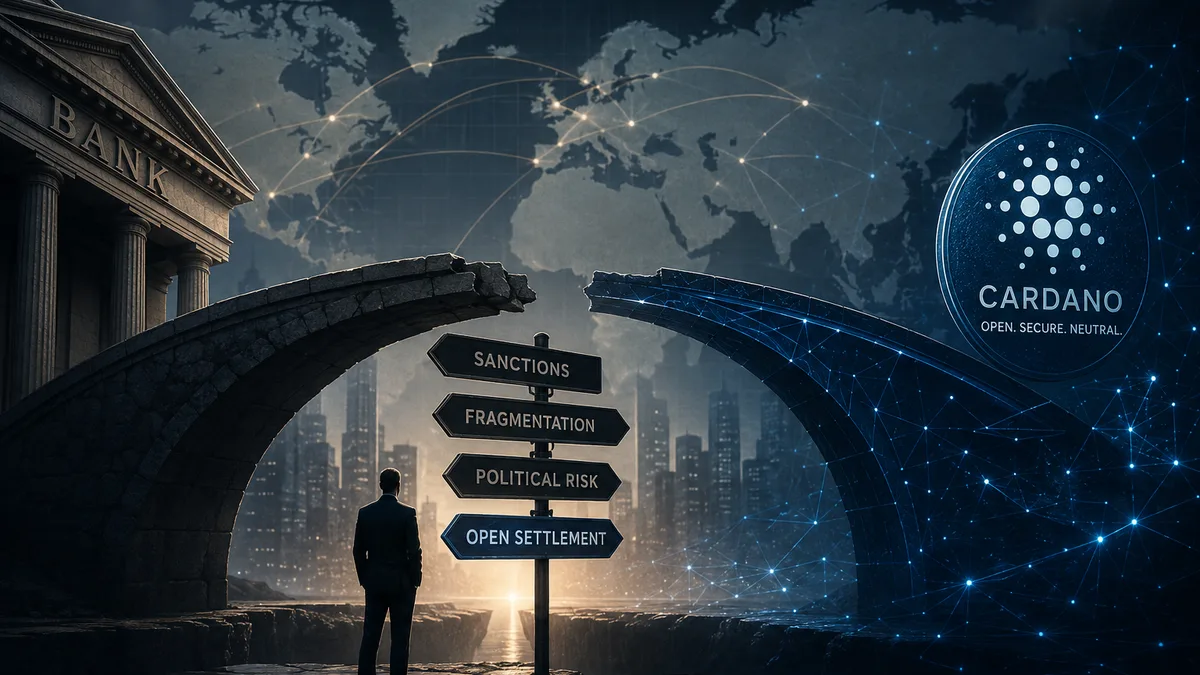
Frederik Gregaard, CEO of the Cardano Foundation, did not publish a typical blockchain comment. His message was an institutional observation about the changing nature of global financial infrastructure. His central point was that correspondent banking, long treated as a neutral layer for international commerce, is increasingly revealing its political dimension.
Correspondent banking underpins a large share of cross-border payments. Banks without direct relationships in another country rely on intermediary banks, currency relationships, compliance rules and institutional trust. That system works when relationships are stable, jurisdictions are aligned and access to financial channels remains predictable.
The problem begins when access to those channels is no longer only a regulatory or operational matter, but a question of geopolitical alignment. When financial rails can be expanded, restricted or revoked because of a political relationship with a state, institution or market, every treasury, company and government has to think differently about the resilience of its financial infrastructure.
That is where Gregaard’s remarks become important. He is not arguing that blockchain replaces banks overnight. His message is more serious. If existing infrastructure becomes increasingly conditional on politics, then open, transparent and verifiable settlement layers become a strategic option, not just a technological experiment.
This discussion already sits at the center of global financial policy. The G20, central banks and international financial institutions have spent years discussing how to modernize cross-border payments, reduce fragmentation and improve interoperability between financial systems.
At the same time, geopolitical fragmentation is becoming harder to ignore. Alternative payment initiatives connected to BRICS discussions, China’s CIPS and other regional settlement systems show that global finance is increasingly tied to sovereignty, sanctions exposure and strategic autonomy.
That does not mean traditional financial infrastructure is disappearing. It does mean the old assumption that global payment rails are politically neutral is becoming less convincing.
Cardano as an Open Settlement Layer, Not a Replacement for Banks
The weakest version of this argument would be the claim that blockchain will simply replace the banking system. That would be superficial and unrealistic. Banks, central banks, regulatory frameworks, currency systems and legal enforcement will not disappear because public blockchains exist.
But that is not the point.
The point is that blockchain settlement introduces an additional layer of resilience. Not as an escape from the existing system, but as parallel infrastructure for value transfer, asset issuance and financial coordination on an open, programmable and publicly verifiable layer.
Gregaard uses terms that matter to an institutional audience: transparent rules, open standards, deterministic execution and credible neutrality. These are not typical crypto phrases. They are the language of market infrastructure, treasury operations, settlement and risk management.
This is also why traditional finance is no longer ignoring blockchain architecture. Major financial infrastructure providers are already experimenting with shared ledgers, tokenized settlement systems and synchronized payment layers designed to improve cross-border coordination while remaining compatible with existing banking systems.
That matters because the debate is no longer whether blockchain concepts are relevant to settlement. The real question is who controls the settlement layer, who sets the rules and who can access it.
Cardano is trying to position itself in this debate as an open settlement layer. Its relevance does not come from short-term market hype, but from the combination of a public ledger system, native asset architecture, governance infrastructure, formal development culture and long-term focus on interoperability.
Precision matters here. Cardano is not currently the dominant institutional settlement network. Private banking ledgers, tokenized deposit experiments and infrastructure built by major financial institutions still hold stronger market positions in several segments.
But Cardano does have a clear institutional argument. If the world is moving toward a multi-layered financial system, where banking systems, public blockchains, tokenized assets and digital forms of money operate in parallel, then credible neutrality becomes a serious infrastructure feature.
In that context, Cardano does not need to prove that it can replace Swift tomorrow. It needs to prove that it can become a serious, open and reliable settlement layer in a world where financial rails are increasingly shaped by politics, jurisdictions and fragmented rules.
Cardano’s Institutional Opportunity Is Large, but Not Automatic
The broader crypto industry has already shown demand for faster, more accessible and more programmable financial rails. Stablecoins have demonstrated that users and institutions want digital forms of value that can move faster than traditional banking channels. Tokenization is also proving that securities, real-world assets, funds and treasury instruments can increasingly exist as programmable digital records.
This is no longer only a crypto-native thesis. Governments, banks and global financial organizations are actively exploring tokenized settlement systems, digital asset infrastructure and programmable financial coordination.
But tokenization alone does not solve neutrality. If dependency simply moves from one closed infrastructure to another, the questions of access, control and political pressure remain. That is why Gregaard’s message matters. Blockchain is not only a tool for greater efficiency. Its institutional value lies in offering an additional option, verifiability and resilience.
For Cardano, this is a major opportunity, but also a serious test.
The opportunity is that Cardano’s long-term narrative fits naturally into this discussion. Public infrastructure, native assets, governance, decentralization, auditability and predictable execution all matter in a world increasingly searching for alternative settlement rails.
Midnight also fits into this broader institutional picture. If global finance becomes more tokenized, the next challenge is not only whether assets can move on-chain, but whether privacy, compliance and selective disclosure can coexist with open infrastructure. That is exactly the type of problem a privacy-focused Cardano partner chain is designed to address.
The test is execution. If Cardano wants to become a serious part of this category, it needs to show more than a strong philosophical argument. It needs deeper liquidity, better stablecoin infrastructure, stronger enterprise onboarding, reliable bridges, improved UX, greater regulatory clarity and more applications solving real problems in cross-border payments, tokenization and treasury operations.
This is where the discussion becomes more demanding. Institutional markets do not adopt infrastructure because it sounds principled. They adopt infrastructure when it reduces risk, improves settlement reliability, lowers operational friction and integrates with existing legal and financial workflows.
That brings the story back to the most important message in Gregaard’s remarks: the significance is not ideological, it is institutional.
If global financial infrastructure becomes increasingly fragmented by politics and geography, open settlement layers will no longer be only a topic for crypto enthusiasts. They will become part of a broader debate about how value moves in a world where trust is no longer evenly distributed.
Cardano does not have an automatic right to win that debate. But it has a credible position inside it. The next phase will depend on whether Cardano can transform its neutrality narrative into infrastructure that institutions, markets and governments are willing to use when access itself becomes the most strategic part of global finance.