What Is the Cardano Pentad and Why Is EMURGO Leaving After the SecondFi Incident?
EMURGO has stepped down from the Cardano Pentad after the SecondFi wallet security incident. The move shifts the story beyond a wallet exploit and into Cardano’s wider governance structure, where founding entities, treasury-funded infrastructure and user protection now meet in the same debate.
By SongMarketCap
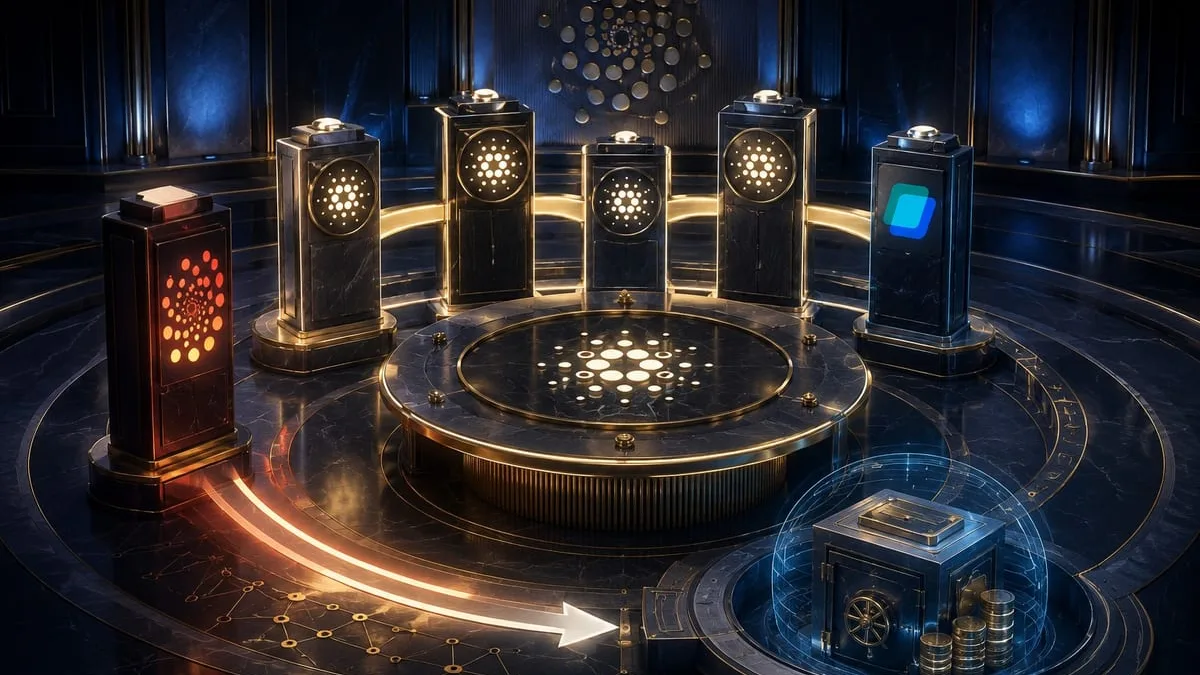
EMURGO, one of Cardano’s founding entities, formally notified the other Pentad members that it is leaving its duties in the coordination group. The company said its immediate priority is the SecondFi recovery process, following an incident that drained roughly 16 million ada from affected wallets.
What Is the Cardano Pentad?
The Cardano Pentad is a coordination group formed around the Cardano Critical Integrations Budget, a treasury-funded program designed to accelerate infrastructure such as stablecoin access, custody, bridges, oracles and analytics. Intersect described the original proposal as a 70 million ada budget involving Input Output, EMURGO, Cardano Foundation, Intersect and Midnight Foundation.
The five members were Input Output Group, Cardano Foundation, EMURGO, Intersect and Midnight Foundation. Input Output carries much of Cardano’s protocol development work. Cardano Foundation focuses on standards, institutional adoption and ecosystem representation. Intersect is a member-based organization involved in governance coordination, technical working groups and administration. Midnight Foundation is connected to Midnight’s privacy-focused ecosystem. EMURGO has served as Cardano’s commercial founding entity, with a focus on adoption, products and Web3 business development.
Pentad does not replace Cardano on-chain governance, DRep voting or treasury approval. Its function is operational coordination between organizations with technical, legal, commercial and administrative capacity. Intersect has described its role in the Critical Integrations framework as administrator of funds, legal contracting and budget operations, while delivery responsibilities are handled through cross-organization workstreams.
Why EMURGO Is Leaving After the SecondFi Exploit
EMURGO said it is stepping down from the Pentad to concentrate resources on the SecondFi recovery process. The decision followed the company’s earlier update that SecondFi will not resume normal operations, even after audits are completed. EMURGO said its future role in SecondFi is limited to a dedicated asset recovery team focused on returning assets to affected users.
SecondFi was introduced in April as the evolution of Yoroi Wallet. EMURGO described it as a self-custody neofinance platform for spending, trading, earning and saving, while keeping users in control of their assets. The transition was intended to move Yoroi beyond a traditional wallet into a broader financial interface for Cardano users.
That product direction changed after the June incident. CoinDesk reported that the exploit affected 374 wallets and drained approximately 16 million ada through a flaw in proprietary wallet generation software, while another 129 million ada was rescued before attackers could reach it. The issue was described as a wallet and software-level incident, not a Cardano protocol failure.
SecondFi’s official security update added that the recovery process includes an Asset Recovery Wallet Checker, warnings against fake support channels and a recovery fund address for affected users. The team said the checker will not ask users to sign transactions and warned users not to share private keys, recovery phrases or wallet credentials.
What EMURGO’s Exit Means for Cardano Governance
EMURGO’s departure separates two issues that are now moving together in public discussion. The first is product responsibility for SecondFi as a user-facing wallet application. The second is ecosystem responsibility, because EMURGO was also part of the Pentad structure tied to Cardano’s infrastructure coordination and treasury-funded delivery.
The Pentad continues with Input Output Group, Cardano Foundation, Intersect and Midnight Foundation. Projects already defined through the Critical Integrations framework do not automatically stop because one member has stepped away, but the exit creates operational questions around delivery responsibility, public reporting and future coordination proposals, including the Pentad V2 work previously described by Intersect.
For SecondFi users, the immediate process is now centered on official recovery tools, secure migration paths and avoidance of fraudulent support channels. For Cardano governance, the case is broader: a founding entity with a major wallet incident has left a coordination body that was designed to help deliver ecosystem infrastructure. That makes the next official updates important for defining where product accountability ends, how user recovery is handled and how the remaining Pentad members continue work without EMURGO.
The practical test now sits in four places: the recovery fund, the external audits, the technical post-mortem and the continuation of Pentad-backed infrastructure work. Those items will determine whether the SecondFi incident remains contained as a wallet failure or becomes a lasting governance case study for how Cardano handles accountability when a founding entity’s product creates ecosystem-level consequences.