Volvo Executive Outlines Enterprise Blockchain Use Cases in Cardano Foundation Interview
In a new Let’s Talk Cardano episode, Volvo Group executive Ivan Branco discussed how distributed ledgers could improve supplier data, country-of-origin compliance and component traceability. He also described an earlier closed-loop token experiment, while confirming that it did not progress into a production deployment.
By SongMarketCap
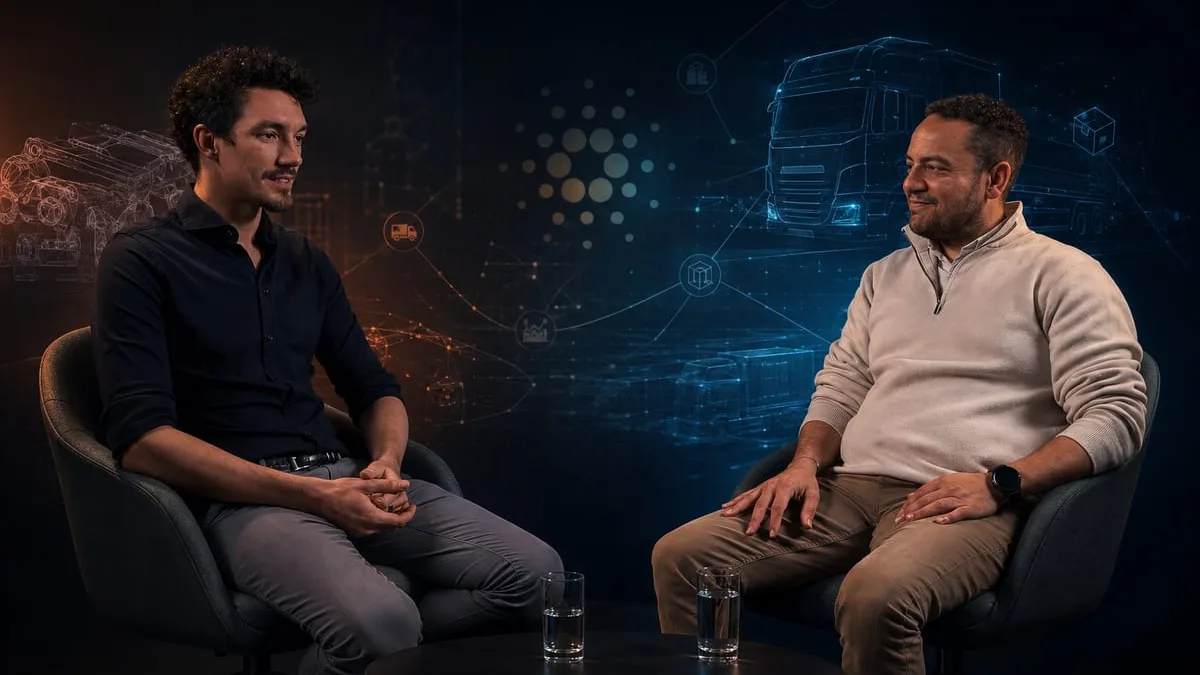
A new Cardano Foundation interview has examined blockchain adoption through the operational requirements of global manufacturing. Ivan Branco, a Volvo Group executive working across information management, artificial intelligence and analytics, discussed how shared ledgers could reduce information gaps between suppliers, transport providers and manufacturers.
The conversation focused on practical enterprise problems rather than a specific Cardano implementation. Neither Volvo nor the Cardano Foundation announced a commercial partnership or confirmed that Cardano is being deployed within Volvo’s production systems.
Blockchain Framed as Enterprise Trust Infrastructure
Branco’s work covers logistics information across supplier data, transportation, warehousing, analytics and artificial intelligence. His team is responsible for turning information received from multiple operational systems into data that can support day-to-day business decisions.
From that perspective, he described blockchain as a potential trust layer between companies that currently maintain separate databases and repeatedly exchange, copy and modify the same information.
A shared ledger could allow manufacturers, suppliers and transport providers to access a consistent record instead of relying on data transferred through several disconnected systems. Blockchain would operate alongside existing enterprise and cloud infrastructure rather than replacing every internal platform.
Branco compared the technology with insurance. Its value may be difficult to quantify while systems are functioning normally, but it becomes clearer when inaccurate information creates regulatory exposure, operational disruption or financial losses.
That creates a difficult investment case inside large organizations. Executives do not approve infrastructure because of its technical design alone. They require measurable benefits covering implementation costs, scalability, maintenance, support and the financial consequences of leaving the problem unresolved.
The discussion positioned blockchain as an underlying business component rather than a product that needs to be visible to the end user. Companies would purchase traceability, data verification or settlement functionality, while the ledger itself would remain largely behind the interface.
Country-of-Origin Data Offers a Clear Manufacturing Use Case
Country-of-origin information was presented as one of the clearest applications for distributed ledger technology in manufacturing.
A vehicle or spare part may contain materials and components produced in several jurisdictions. Those components can pass through multiple suppliers, logistics companies and internal systems before reaching a factory, warehouse or customer.
Branco said country-of-origin data has created difficulties in spare-parts logistics for decades. Information may be incomplete when first supplied, entered manually or altered while moving between enterprise systems.
The issue extends beyond administrative efficiency. Manufacturers need accurate origin records to comply with customs rules, trade restrictions and sanctions. Incorrect information can expose companies to significant penalties when goods or components connected to restricted jurisdictions are shipped into prohibited markets.
A distributed ledger could allow suppliers to register origin information closer to its source. Authorized participants could then access the same record throughout procurement, transportation, manufacturing and distribution, while later changes remain visible without deleting the original data.
Such a system could reduce reconciliation work, data corrections, audit costs and compliance exposure. Branco emphasized that these savings would still need to be confirmed through production use rather than assumed from a proof of concept.
The same infrastructure could support remanufacturing and electric-vehicle operations. Batteries, materials and individual components increasingly need to be followed through maintenance, reuse, recycling and end-of-life processes.
These requirements also overlap with the broader Digital Product Passport model, where physical products are connected to verifiable information about their origin, composition and lifecycle.
Closed-Loop Token Experiment Exposes Adoption Barriers
Branco also described an earlier exploration involving Volvo and selected transport suppliers.
The concept created a closed commercial environment in which suppliers, logistics companies and Volvo could exchange information and settle transactions using a proprietary cryptocurrency developed for the experiment.
A common digital unit was intended to reduce friction created by multiple national currencies, while the associated ledger would retain records covering orders, transportation and payments.
Branco said the concept remained exploratory and was not industrialized. He did not identify the blockchain used, the participating suppliers, the duration of the test or the reasons it did not progress into production.
The experiment nevertheless demonstrated how blockchain could operate behind a conventional enterprise process. Suppliers would interact with orders, payments and verified records without needing to understand the ledger architecture supporting the system.
Branco compared that model with generative AI. Most users care about the function presented through an application, not the technical structure operating behind it. Blockchain adoption could follow the same route, with companies using traceability and verification services while the distributed infrastructure remains invisible.
Enterprise procurement introduces additional requirements. Large organizations expect established support channels, service-level agreements and clearly assigned responsibility when infrastructure fails. Public blockchain networks distribute operation across independent participants, while traditional contracts usually place responsibility on an identifiable provider.
The number of competing blockchain networks creates another layer of complexity. Enterprise decisions must account for scalability, integration, maintenance, provider reputation and compatibility with existing systems rather than attachment to a particular ecosystem.
Branco identified organizational culture as a greater obstacle than technical education. Enterprise teams do not need to understand every protocol-level detail, but shared infrastructure requires companies to reconsider how control, responsibility and trust are distributed across commercial relationships.
For Cardano, the interview defines a specific enterprise threshold without presenting an adoption announcement. A manufacturing deployment would need to preserve supplier data from its source, integrate with existing systems, provide clear operational support and demonstrate measurable reductions in compliance and reconciliation costs.
The commercial value appears when a manufacturer no longer needs to reconstruct a component’s history across separate databases because its origin, movement and transformation are already available through one verifiable record.