Syngenta Foundation India Shows How Cardano Farm Records Are Moving From Registration to Financial Infrastructure
A new Cardano Foundation case study expands the 5am.Earth farmer registration story into a broader verified data infrastructure for credit, insurance, compliance and market access. More than 15,000 farms are already registered on Cardano mainnet, with satellite-verified land boundaries and 12 years of crop, biomass and sustainability data.
By SongMarketCap
Updated:
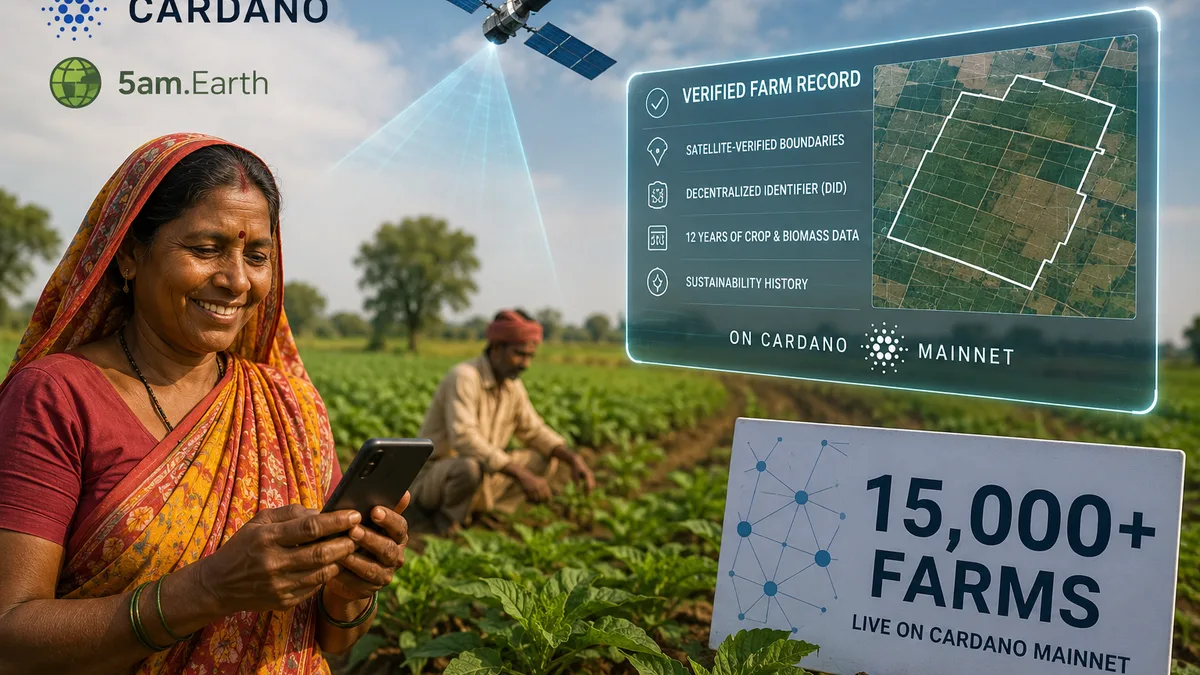
The Cardano Foundation has published a case study on Syngenta Foundation India and 5am.Earth, showing how farm registration on Cardano is being extended into verified agricultural data infrastructure. The system connects smallholder farms in India to reusable on-chain records that can support farmers, Agri-Entrepreneurs, lenders, insurers and supply chain participants.
According to the case study, more than 15,000 farms are now registered on Cardano mainnet, with mainnet deployment and initial field trials completed. Each farm record combines satellite-verified land boundaries, decentralized identifiers and 12 years of biomass, crop and sustainability data, creating a trusted data layer beyond paper records, disconnected databases and manual checks.
Syngenta Foundation India Extends Cardano Farm Registration Into Verified Data
The core issue is not only farmer registration. It is the absence of trusted, verifiable agricultural data across large parts of India’s smallholder farming economy. The Cardano Foundation notes that more than 100 million smallholder farmers in India operate outside formal economic systems because reliable agricultural data is often unavailable, disputed or fragmented.
That gap affects both sides of the market. Farmers struggle to access credit, insurance and premium markets, while lenders, insurers and supply chain participants face higher risk, manual due diligence and limited paths to scale.
Syngenta Foundation India, 5am.Earth, AIQUANT, Anastasia Labs and Andamio implemented a Cardano-based satellite oracle to turn fragmented farm data into persistent, tamper-resistant digital records.
The system uses satellite data and AI-based boundary detection to connect farm parcels with decentralized identifiers linked to verified land boundaries. Those records are designed as shared public infrastructure, meaning verified land, crop and sustainability data can be recorded once and reused across finance, insurance, government programs and agricultural trade.
Cardano Mainnet Now Holds Data for 15,000 Verified Farms
The implementation links physical farm parcels to decentralized identifiers tied to satellite-verified boundaries. It also adds a long-term sustainability assessment layer, including 12 years of biomass and crop data recorded for independent validation on Cardano.
The project has moved beyond a concept stage. The case study states that mainnet deployment and initial field trials are complete, with more than 15,000 farms registered on-chain. The infrastructure is also designed to expand to one million farmers without proportional increases in operating costs.
The partner roles are clearly defined. Syngenta Foundation India leads the field implementation, 5am.Earth is building farmer-owned agricultural data infrastructure for credit, insurance and market access, AIQUANT worked on the smart contract architecture and oracle integration, Anastasia Labs supported the Cardano technical implementation, and Andamio contributed credentials, reputation and training infrastructure for Agri-Entrepreneurs.
Verified Cardano Data Opens Credit, Insurance and Supply Chain Access
The most important output is what verified farm data allows users to do. For farmers, on-chain records can support access to credit, insurance, compliance services and premium markets. The case study states that the goal is to increase farmer income by up to 100% within five years by improving access to services and markets that depend on reliable data.
Agri-Entrepreneurs also gain a larger economic role through facilitation and advisory services. According to the case study, AEs can earn an additional USD 120 to 140 per month by helping farmers use these data-driven services.
For lenders, insurers and supply chain participants, the advantage is lower information cost. Independent verification can reduce due diligence, improve risk assessment and make provenance, sustainability and production history easier to check without rebuilding the same data collection process across multiple institutions.
Deepak Ekka, Key Account Manager at Syngenta Foundation India, said public blockchain infrastructure enables independent verification at a scale traditional systems cannot match, while reducing the cost of information from farm to market and services from market to farm.
This case study changes the weight of the 5am.Earth story on Cardano. Farmer registration remains the entry point, but the larger value appears when registered data can be used for financing, insurance, compliance and trade. If the system scales toward its one million farmer capacity, Cardano’s role in this implementation becomes a shared verification layer between rural data and the institutions that make economic decisions based on that data.