Solana’s New Governance Model Reopens Debate Over Cardano’s DRep Power
In a video published today, Linda compared how Solana and Cardano distribute governance power, highlighting the risk that influence could concentrate around large validators on one network and major DReps on the other.
By SongMarketCap
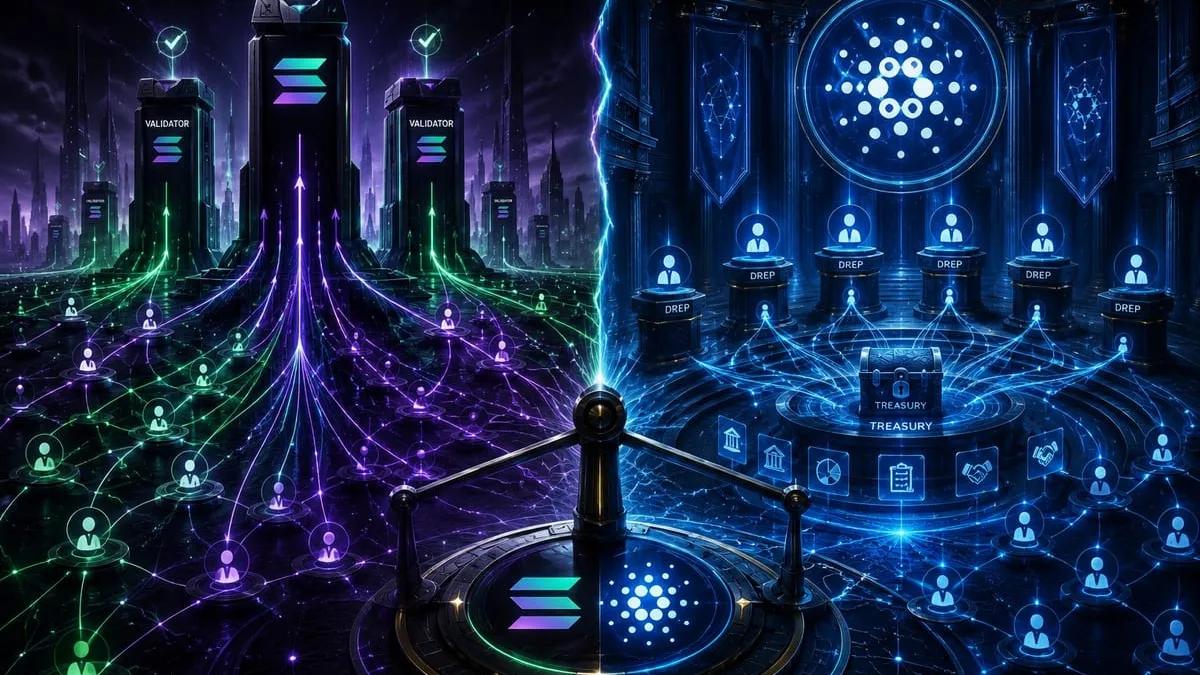
Solana’s new on-chain governance framework has reopened a wider debate over how decentralized networks distribute voting and decision-making power.
In a video published today, Linda compared Solana’s emerging model with Cardano’s more developed governance system. According to her analysis, the two networks use different structures but face a similar risk: influence becoming concentrated among a limited number of powerful participants.
On Solana, that power could gather around validators controlling large amounts of delegated stake. On Cardano, it could accumulate around a small group of prominent DReps.
Solana Gives Validators a Central Governance Role
Solana Governance Proposals, or SGPs, introduce a formal mechanism for putting major strategic decisions before the network.
The model separates decisions about direction from technical implementation.
SGPs determine whether Solana should move in a particular direction, while Solana Improvement Documents, known as SIMDs, define how approved technical changes would be implemented.
Voting power is tied to delegated stake, placing validators at the center of the process. SOL holders can delegate their stake to validators while retaining the ability to vote differently if they disagree with the validator’s position.
Submitting an SGP requires substantial backing. According to Linda’s comparison, a validator needs approximately 100,000 SOL in active stake to introduce a proposal.
That threshold may limit weak or unserious proposals, but it also creates a high barrier for smaller participants. In practice, less influential contributors may need the support of a large validator before their proposal can enter the formal process.
Cardano Separates Governance Power Through DReps
Cardano distributes governance responsibilities across DReps, stake pool operators and the Constitutional Committee.
ADA holders can delegate their governance voting power to a DRep without moving their funds or changing the stake pool they use for staking rewards.
Linda identified this separation as one of the key differences between the two systems.
Running blockchain infrastructure does not automatically mean making decisions on constitutional matters, ecosystem strategy or treasury spending. Cardano therefore separates the technical role of stake pool operators from the political and representative role of DReps.
However, that structure does not remove the risk of concentrated power.
As governance voting power flows toward a limited number of well-known representatives, practical influence may end up in the hands of only a few major DReps.
Linda cited Charles Hoskinson’s DRep as a possible example of how governance power could consolidate around a highly visible figure if enough ADA were delegated to it.
She raised the question of whether a single DRep, including one connected to Cardano’s founder, could accumulate enough delegated voting power to exert significant influence over major governance decisions.
Delegation makes participation easier for ADA holders who do not want to follow every proposal and vote. At the same time, it increases the possibility that governance power becomes concentrated around a small number of prominent and influential DReps.
Treasury Control Exposes the Core Difference
The clearest difference between the two systems is control over ecosystem funding.
Cardano governance can decide how treasury funds are allocated, giving the community direct influence over development priorities.
Solana’s governance system does not control ecosystem funding in the same way. Grants and support programs are managed separately by the Solana Foundation and other organizations.
Cardano’s model gives token holders more authority, but it also creates greater political pressure.
DReps must assess funding requests, infrastructure needs and proposals seeking substantial amounts of ADA. Projects compete publicly for treasury support, while representatives must decide which initiatives deserve funding.
That creates broader participation, but also more conflict over budgets, accountability and strategic priorities.
Solana avoids much of that friction by separating governance from most funding decisions. The trade-off is that financial influence remains within foundations and other organizations rather than being placed directly under token-holder control.
Linda’s comparison does not present Solana’s governance model as superior.
Solana has a simpler structure, but large validators may gain significant influence.
Cardano gives the community broader control, including authority over the treasury, but major DReps may accumulate enough delegated power to shape key decisions.
In both systems, the central question is the same: how widely distributed will governance power remain once delegated votes begin concentrating around the largest and most influential participants?