SnekFun Now Rewards Token Creators: 7 Ways to Put Those ADA Fees to Work
Snek.fun recently launched a major new feature that could become one of the most important tools for token creators on Cardano: creator fees paid directly in ADA.
By SongMarketCap
Updated:
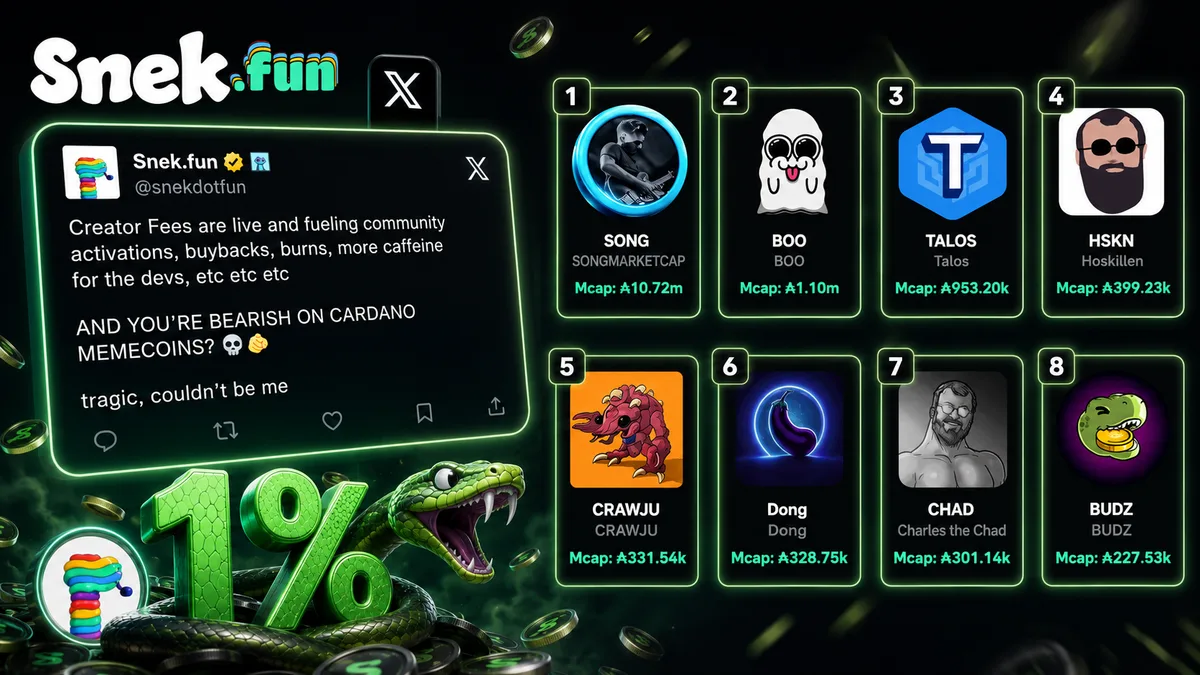
Snek.fun’s New 1% Creator Fee Could Open a New Era for Cardano Projects
Snek.fun recently launched a major new feature that could become one of the most important tools for token creators on Cardano: creator fees paid directly in ADA.
With this new model, token creators can earn from the trading activity generated by their own communities. According to recent reports, creators can earn 0.3% of trading volume before token graduation and 1% after graduation, with rewards accumulated directly on Snek.fun and available to claim in ADA.
This may sound like a small percentage at first, but in practice, it could become a powerful new engine for projects, communities, and builders across the Cardano ecosystem.
Until now, many token projects have depended heavily on initial hype, mint income, donations, or treasury reserves. But with creator fees, every transaction can now become part of a larger project economy. Every swap can help fund development, marketing, liquidity, rewards, transparency reports, or community growth.
That is a big deal.
Snek.fun is already one of the most important meme coin launchpads on Cardano. The platform allows anyone to create and trade tokens, with projects starting through a fair-launch model and later graduating once they reach the required market cap. Its official documentation describes Snek.fun as a Cardano-based fair-launch token launchpad with no coding required, no pre-mines, and no insider allocations.
Now, with creator fees added to the model, Snek.fun is not just a launchpad. It is also becoming a monetization layer for Cardano creators.

Here are seven ways projects can use that 1% creator fee in ADA.
1. Buyback and Burn
One of the strongest and most transparent ways to use creator fees is through a regular buyback and burn model.
A project could collect ADA from creator fees, use part of it to buy its own token from the market, and then burn those tokens. This creates a direct connection between trading volume and token scarcity.
The message is simple:
More volume means more ADA.
More ADA means more buybacks.
More buybacks mean more tokens burned.
This can become a powerful weekly or monthly transparency event. Projects can publish every transaction, every buyback, and every burn, giving the community a clear reason to stay engaged.
2. Strengthening Liquidity
Another smart use of creator fees is adding liquidity.
Many small tokens struggle with weak liquidity, high slippage, and unstable charts. If a project regularly uses part of its ADA creator fees to support liquidity, it can create a healthier trading environment for both new and existing holders.
A stronger liquidity pool can make the project look more serious, reduce volatility caused by smaller trades, and help larger buyers enter with more confidence.
For example, a project could allocate:
25% of all creator fee income to liquidity additions.
This turns volume into infrastructure.
3. Community Rewards
Creator fees can also be used to reward loyal holders.
Instead of simply keeping all ADA in a team wallet, projects can build reward systems around their most active and loyal communities. These rewards do not always have to be direct ADA payments. They can also include NFT drops, whitelist access, bonus mints, private community access, raffles, merch, or special recognition inside the ecosystem.
A simple model could be:
Every week, a percentage of creator fees goes into a holder reward pool.
This gives people another reason to hold, participate, and promote the project.

4. Project Treasury and Development
For serious builders, this may be the most important use case.
A project treasury funded by creator fees can pay for real development. Websites, dashboards, smart contract work, tools, design, audits, content, analytics, partnerships, and infrastructure all cost money.
With creator fees, projects can slowly build a sustainable treasury from real market activity.
This is especially important because many crypto projects fail after the first wave of hype disappears. A creator fee model gives teams a potential long-term source of ADA, assuming their community continues to trade and stay active.
In other words, volume can help fund survival.
5. Marketing and Content Creation
Marketing is one of the biggest challenges for small Cardano projects.
Creator fees could help solve that.
Projects can use part of their ADA income to fund community content, social media campaigns, video creators, meme contests, educational threads, articles, spaces, interviews, graphics, and ecosystem collaborations.
But this must be done carefully. The goal should not be to pay random influencers for empty promotion. The goal should be to build a real content machine around the project.
A strong model could look like this:
20% of creator fee income goes to community creators who produce valuable content.
This rewards the people who are already helping the project grow.
6. Long-Term Holder Perks
Projects can also use creator fees to create long-term holder systems.
For example, they can take snapshots of wallets and reward holders who keep their tokens for 30, 60, or 90 days. Those holders could receive special NFTs, bonus access, extra raffle entries, discounts, early access to future launches, or membership in private groups.
This kind of model encourages loyalty instead of short-term speculation.
It also helps create different levels inside the community. Casual buyers, loyal holders, active promoters, and long-term believers can all have different roles and benefits.
The creator fee becomes the fuel behind those benefits.
7. A Transparent “Volume Creates Value” Model
This may be the most powerful narrative of all.
With creator fees, projects can now tell their communities:
Every transaction helps the project.
Every swap creates ADA income.
Every trade can support burns, liquidity, marketing, rewards, or development.
That changes the psychology of trading.
Volume is no longer just volume. It becomes a funding mechanism.
A project that communicates this clearly can build a strong and simple message:
Trade volume creates value for the ecosystem.
But transparency is everything. If teams collect ADA and say nothing, the community may see it as a cash grab. If teams publish regular reports showing exactly how the ADA was used, the same mechanism can become a trust-building machine.
A Possible Allocation Model
Every project will have different needs, but one balanced model could look like this:
40% buyback and burn
25% liquidity additions
20% marketing and content creators
10% community rewards
5% project treasury
This kind of split gives the community multiple reasons to care. It supports the chart, supports holders, supports builders, supports content, and supports long-term growth.
Why This Matters for Cardano
The bigger picture is not only about one token or one project.
This feature could help create a new type of creator economy on Cardano. Snek.fun has already shown that meme coin platforms can bring attention, activity, and trading volume to the ecosystem. During its early launch period in 2024, Snek.fun attracted major attention, with reports saying more than 20,000 users accessed the platform within seconds and over 2,000 tokens were created in the first 24 hours.
Now, with creator fees, projects have a stronger reason to keep building after launch.
The best teams will not treat this 1% as free money. They will treat it as responsibility.
They will use it to build, burn, reward, support liquidity, fund marketing, and prove transparency.
If used correctly, Snek.fun’s creator fee model could become one of the most important tools for project sustainability on Cardano.
Because from now on, every transaction can be more than just a trade.
It can be fuel for the project’s future.
Do you like the article? Share it further. It’s time for a positive vibe in the Cardano market.