Quinelings: Hoskinson Unveils Reproducible Programs for AI Agents
The Cardano founder’s open-source project gives computational tasks animated mathematical bodies. Users can inspect individual operations, run a task, and reproduce its complete source, bringing a visual interface to experiments with agent software.
By SongMarketCap
Updated:
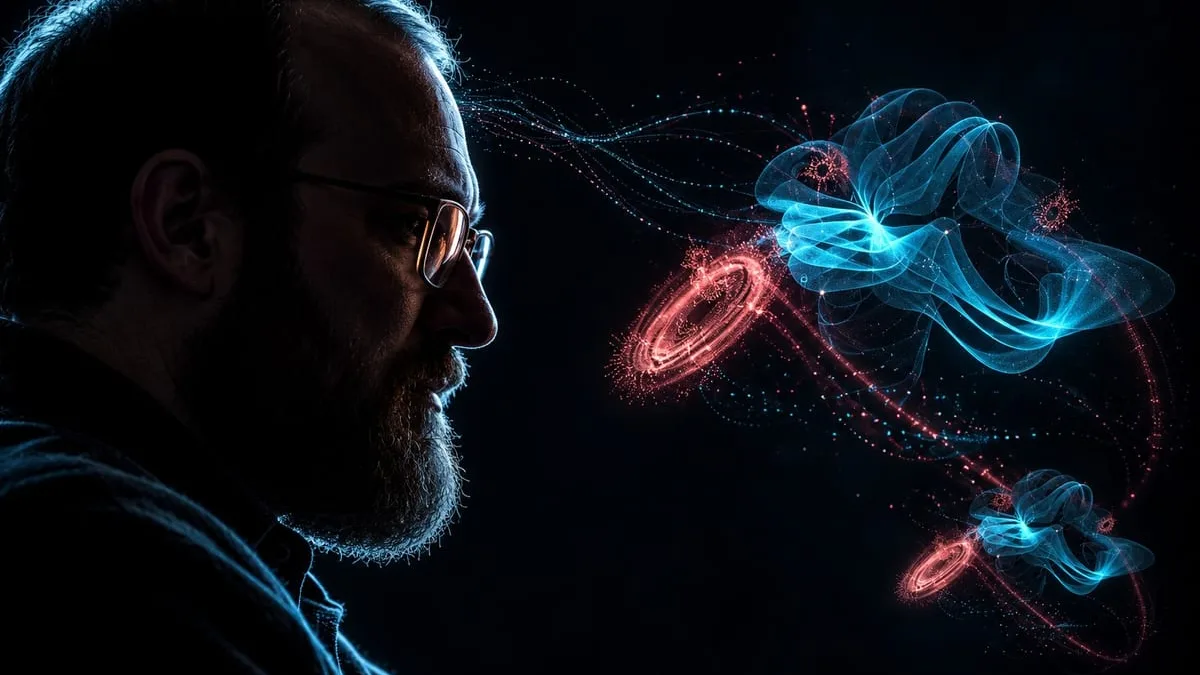
Charles Hoskinson introduced Quinelings on October 19, describing them as self-replicating digital lifeforms made entirely of code. The project combines executable tasks with mathematical creatures whose structures users can explore. Released under the Apache-2.0 license, it arrives alongside Hoskinson’s Nightframes vision for private, always-on AI agents.
How Quinelings Make Program Operations Visible
A Quineling contains a defined task, the instructions that execute it, and a mathematical description of its body. Individual operations correspond to parts of the creature, creating a visual index of the program.
Selecting an operation reveals its connections and, after execution, its recorded inputs and outputs. Users can follow how supplied data moves through a calculation and contributes to the result.
The name draws on a quine, a program that outputs its own source code. Quinelings reproduce the complete source containing both their task and visual design. That source can be loaded into a fresh execution environment, run again, and checked against the original.
The project calls these objects Living Thoughts. The term refers to explicitly declared, executable tasks. Their visible structure lets users inspect the instructions and execution record, rather than uncover a language model’s private reasoning.
Appearance and identity are separate. Two programs can look similar, while their exact identities depend on their source. Dedicated mathematical and RGB encodings provide additional ways to recover that source.
Route Planning, Task Libraries, and Program Offspring
The homepage demonstrates a route planner responding to a bridge closure. Users can compare the resulting route, inspect the relevant operations, and reproduce a separately runnable copy.
The demonstration connects a visible change in circumstances to a traceable calculation. Moving through the animation or selecting part of the body does not execute the task again.
Other available examples include adding water measurements, scheduling jobs with dependencies, evaluating offers, and reconciling partially confirmed outcomes. Each defines the inputs it accepts and the calculation it performs.
The experimental Ranch adds composition: two programs can contribute logic to a new “offspring” under specified rules. One documented example connects an average-water calculation to a resource-budgeting task. The resulting program calculates how much can be allocated and what remains, with the combined logic retained in its source.
Developers can work with these capabilities through a TypeScript SDK. MCP and A2A adapters provide interfaces for connecting AI systems with the project’s tools and exchanging agent requests. Supported operations include compiling, inspecting, verifying, running, and reproducing tasks.
The repository also includes Lean proofs, Quint models, and implementation tests. Its documentation distinguishes verified properties from work that remains unproven.
Where Quinelings Fit in the Nightframes Vision
At Midnight City Tokyo on October 10, Hoskinson presented Nightframes as a vision for private programs that remain active and work toward their owners’ goals. Input Output’s account emphasized user control over personal data, identity, and money, with Midnight City providing an environment for exploring agent interactions.
Quinelings address a narrower question within that direction: how to package a computational task so its instructions, structure, and results can be examined and reproduced. Their potential role as components of larger agent systems remains conceptual.
The current prototype runs locally, without a connection to Midnight City or the ability to reproduce a live City agent. Its simulated actions cannot move funds or perform external work, and it provides no automatic access to midnight’s network privacy protections. Persistent operation and private execution require separate infrastructure.
For developers in the Cardano and midnight ecosystems, the available starting point is a reproducible task with an inspectable execution record. In the bridge-closure example, another developer can take the emitted source, supply the same map and closure data, and check whether a fresh copy produces the same route. The calculation can travel with the code needed to examine it.