Petrobras Uses Cardano to Trace Renewable Fuels
Two applications developed with Brazil’s PUC-Rio university use Cardano to verify sustainable aviation fuel claims and connect supply chain records for Petrobras’ Diesel R.
By SongMarketCap
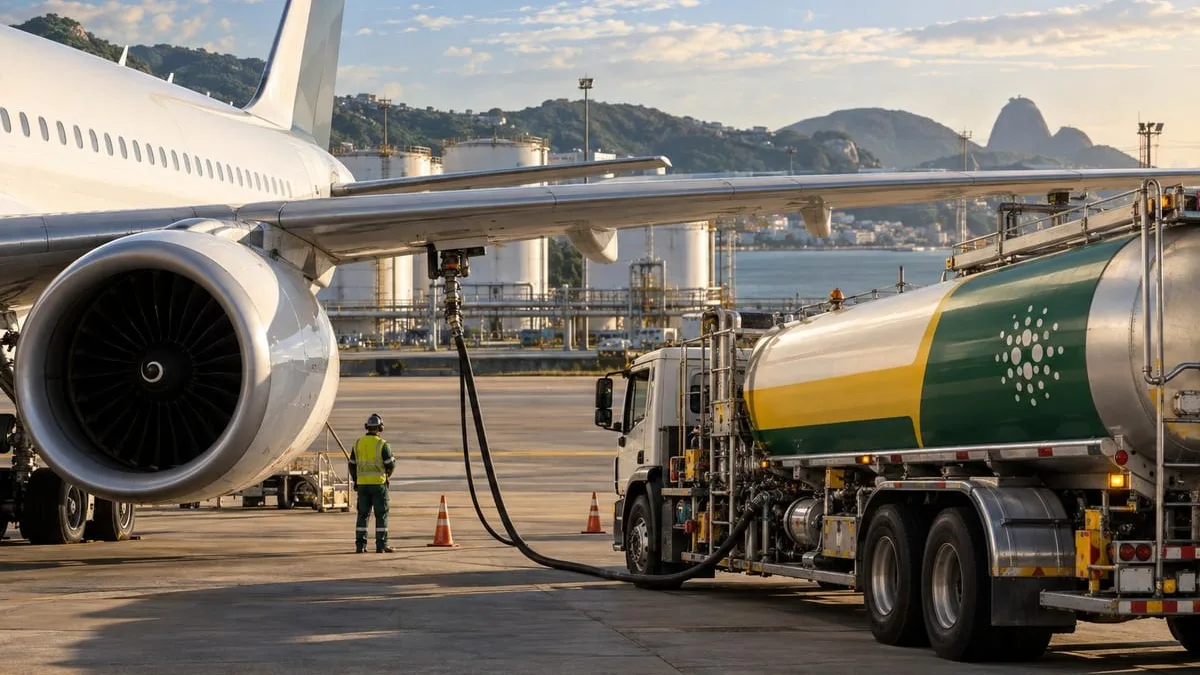
Petrobras, Brazil’s state-controlled energy company, has developed two blockchain applications through an ongoing research and development collaboration, the Cardano Foundation announced on September 30. The projects address separate challenges: tracking who receives the environmental benefit associated with sustainable aviation fuel, or SAF, and connecting production, transportation, and use data for Diesel R, Petrobras’ renewable fuel brand.
Cardano Tracks SAF Environmental Claims
The SAF project brings together Petrobras, the Cardano Foundation, and Ledger Labs, the blockchain research center at the Pontifical Catholic University of Rio de Janeiro, known as PUC-Rio.
Sustainable aviation fuel is a lower-carbon alternative to conventional jet fuel that can be used within existing aviation infrastructure. The application records the environmental benefit associated with its use and tracks its allocation.
It uses a Book-and-Claim model, which separates the physical movement of fuel from the right to claim that benefit. An airline, company, or passenger can receive an allocation even when the SAF is produced or consumed elsewhere.
Cardano connects the original fuel certificate to a digital record showing where the benefit originated, who received it, and whether it has been claimed. The system is designed to prevent duplicate claims while preserving the history needed for verification.
For example, a passenger could receive a certificate linked to SAF used elsewhere in the aviation system. The claim would refer to that documented fuel use, without requiring the passenger’s own aircraft to consume the same fuel.
Passengers Receive Certificates for Individual Journeys
The application includes a workflow for individual travelers. Passengers enter their departure and destination airports, and the system calculates the corresponding amount of CS-SAF, the digital token representing the SAF environmental benefit.
The resulting certificate records the route, distance traveled, and allocation. Each CS-SAF allocation links the passenger’s claim back to the original fuel certificate, allowing its source to be checked.
This gives the passenger-facing process a defined sequence: select a journey, calculate the allocation, and receive a certificate backed by a traceable record.
Diesel R Connects Supply Chain Emissions Data
The second project, developed by Petrobras with PUC-Rio, applies Cardano to Diesel R. Its proposed model creates digital checkpoints across production, transportation, and use, combining information from those stages into a continuous fuel lifecycle record.
The approach supports Scope 3 emissions reporting, which covers indirect greenhouse gas emissions across a company’s wider value chain. Gathering that information often requires records from suppliers, logistics providers, and other organizations using separate systems.
The Diesel R model is intended to connect those records so their origins and use in emissions accounting can be checked. Cardano provides a shared verification layer for information that otherwise sits across different companies and databases.
Rafael Fraga, LATAM Business Development Lead at the Cardano Foundation, described trust in environmental data as a requirement for the energy transition.
He emphasized the need to establish where information comes from, how it moves, and who can rely on it as supply chains become more complex.
For Diesel R, the intended result is a traceable basis for emissions audits. An auditor could follow a reported figure back to the relevant production, transportation, or use record, even when the supporting information comes from different companies.