Peter Bui Builds Cardano Escrow Infrastructure After Draper University
Peter Bui entered the first Cardano Genesis program with an idea for a Web3 bounty platform. Four weeks of customer research, investor feedback and pitch development at Draper University expanded that concept into Hokan, a noncustodial escrow layer being developed for digital commerce, stablecoin payments and future transactions involving AI agents.
By SongMarketCap
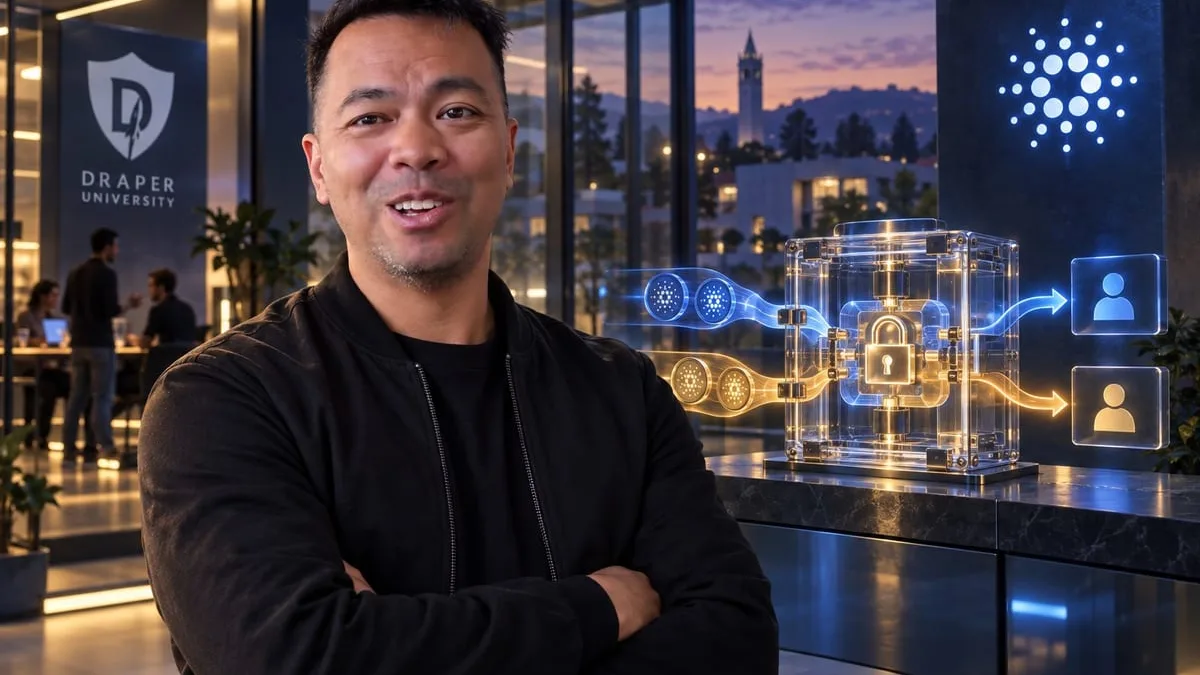
Bui is now building Hokan through Moshi Concepts, using Cardano smart contracts to enforce payment conditions while users retain control of their funds. The change did not begin with a new technical capability. It came from questioning the size of the market, the behavior of potential customers and the reasons anyone would trust the product with real money.
From Cardano Developer to Startup Founder
Bui has spent several years working within the Cardano ecosystem. He created Learn Cardano, operates the ADAOZ stake pool and developed CardanoPress, a WordPress integration that allows projects to connect websites with Cardano wallets and blockchain data.
That experience provided a technical foundation for building products, but the Genesis program introduced a different question: can a technically capable product reach a market large enough to support a scalable company?
CardanoPress connected two areas Bui already understood. Cardano NFT projects needed websites that could interact with wallets and onchain data, while WordPress provided established infrastructure for building and managing those sites.
The market analysis conducted at Draper University divided that opportunity into progressively smaller segments. Crypto represents one part of the technology market. Cardano is one part of crypto. Cardano projects using WordPress form a narrower category, and only a portion of those projects require a specialized blockchain integration and are willing to pay for it.
A narrow market can still support a sustainable business, but its potential depends on the number of customers, the value of each relationship and the cost of reaching them. Bui described the resulting shift as moving from asking what he could build to asking what was worth building.
The first Cardano Genesis preaccelerator brought together 13 publicly named teams. Participants developed their pitches, interviewed potential users and tested business assumptions from the opening days of the program. Pitch week concluded with presentations to a panel that included Tim Draper and Cardano Foundation CFO Stephen Wood.
Bui arrived with a concept for a Web3 job and bounty platform. A customer would create a task and lock funds in a smart contract. A contributor would complete the agreed work and receive payment after approval.
Instead of spending months building the entire marketplace, he began interviewing freelancers and the people who hire them. The conversations examined previous payment experiences, disputes, costs, existing workarounds and the conditions under which users trusted or rejected current platforms.
Bui also created test bounties on a Cardano test network. The objective went beyond confirming that a smart contract could lock and release funds. The tests explored where friction appeared, who became responsible when work did not meet the agreed conditions and which parts of the process delivered enough value for customers to pay for them.
The same process changed how he communicated the idea. During the final pitch preparations, Bui walked through the streets of San Mateo repeating his presentation, recording approximately 17,000 steps on one day and 20,000 on another. When he eventually presented to Tim Draper, he included a joke about buying and selling an island, knowing Draper was selling one at the time. The reference landed with Draper even though much of the room initially missed it.
The more consequential exchange came during the questions. Draper asked whether escrow infrastructure alone could become a sufficiently strong business. Bui’s answer was that infrastructure without applications, users, distribution and revenue would probably not be enough.
Customer interviews had already challenged the original product boundary. A bounty marketplace could remain one application, but the escrow mechanism underneath it could serve many other platforms.
Hokan Turns a Bounty Concept Into Cardano Escrow Infrastructure
Moshi Concepts now presents Hokan as noncustodial escrow infrastructure being built first for Cardano. Instead of taking possession of customer money, the system places funds at a smart contract address and releases them according to previously defined conditions.
Hokan is not designed to hold private keys or sign transactions for users. The system prepares an unsigned transaction, which the user approves through a personal wallet. According to the published architecture, the contract has no administrative function that allows Hokan to redirect escrowed funds to an arbitrary address.
An escrow can involve a depositor, a receiver and a separate dispute resolver. The resolver may determine how funds are divided between the two previously identified parties, but cannot redirect the money to itself or to a newly introduced address. Fallback paths based on time limits are intended to prevent funds from remaining permanently locked when one participant becomes inactive.
The published model lists support for ADA, USDM and USDCx. Hokan plans to charge a protocol fee of 0.5 percent on released funds, capped at $1,000 per escrow. No protocol fee is charged when an escrow is canceled or expires without releasing funds.
The product is designed as infrastructure that other companies and applications can integrate through an API and developer tools. Moshi Concepts identifies freelance work, marketplaces, digital services, milestone payments, international trade and dispute resolution among its potential applications.
A bounty platform remains part of the plan, but it now also serves as a reference application built on the same public infrastructure intended for external developers. Moshi Concepts states that its own application will use the same API without private endpoints or capabilities unavailable to other integrators.
That approach connects the infrastructure with a product people can use. It also gives Moshi Concepts a way to test whether escrow demand exists before expanding the underlying platform across multiple industries.
Hokan’s planned scope extends to transactions involving AI agents. An agent could prepare escrow terms, calculate costs and assemble an unsigned transaction, but it would not hold a key or independently move the funds. Final authorization would remain with a human wallet owner.
This separates business process automation from control of the money. An AI agent could propose an escrow for work that takes several days, monitor the agreed conditions and prepare settlement, while a person decides whether to sign the resulting transaction.
Moshi Concepts has also outlined two ways to access the infrastructure. Companies could use conventional subscription plans, while individual API calls could be paid through the x402 standard without creating a user account. The second route is intended for software agents that need to purchase access to a specific function at the moment it is required.
The broader product direction reflects another lesson Bui took from the program. Users outside crypto are more likely to evaluate whether a payment is reliable, predictable and recoverable than to select a service because of its underlying ledger model.
In that model, Cardano operates as the settlement infrastructure rather than the visible product. The customer experiences an escrow agreement and a payment workflow, while the blockchain enforces the conditions underneath it.
Trust Defines Hokan’s Next Stage
Expanding from a bounty platform into a general escrow layer increases the responsibility carried by the product. A system that locks funds must explain who controls the money, how disputes are resolved, what happens if the operator disappears and which security claims have been independently verified.
Andy Tang of Draper Associates and Draper Dragon raised the issue of credibility during the program. A developer can deploy a smart contract and describe it as secure, but users still need a reason to trust it with real economic value.
Traditional escrow depends on an institution, legal agreements, insurance and established dispute procedures. A smart contract can reduce administrative costs and automate settlement, but it moves trust to the contract code, the security review, the transaction builder, the interface and the dispute mechanism.
Hokan’s published design attempts to place several restrictions directly inside the validator. The platform should not be able to take user funds, fees become fixed when an escrow is funded, and a dispute resolver can distribute money only between the designated participants. Each contract state is also intended to include an exit path that does not depend on Moshi Concepts continuing to operate.
The company has outlined an audit scope covering the validator, minting policies, configuration mechanism and the offchain component that builds transactions. Including the transaction builder expands the review beyond the onchain contract to the software responsible for assembling what a user ultimately signs.
Hokan is still moving from its published architecture toward broader developer availability. At the time of publication, its documentation, API reference, sandbox, contracts and status page were marked as coming soon. A completed independent audit report was not yet linked from the product website.
Moshi Concepts lists Draper Dragon as a backer without disclosing the financial terms of that relationship. The company is incorporated in Delaware, while its research and engineering work is carried out in Australia.
Bui has also discussed funding tied to completed milestones as a possible Cardano application. In existing grant systems, approval of completed work and the resulting payment can occur through separate processes. A smart contract could release funds after an authorized reviewer approves a milestone, while the judgment over whether the work meets the agreed standard remains with a person or designated organization.
That model could support grants, Project Catalyst or future Cardano Treasury workflows, although Moshi Concepts has not announced an integration or formal agreement with those systems. They represent possible markets to test after the product, security review and customer demand have been established.
Draper University did not provide Bui with a final answer on whether escrow is the right market. It changed the order in which Moshi Concepts plans to answer that question. As Bui summarized it, “Being busy building something isn’t the same as building the right thing.”
The company now plans to release a limited MVP, continue customer interviews and expand around the segments that demonstrate actual demand. Public documentation, an accessible sandbox, published contracts, completed security work and initial integrations form the next defined stage of that process.
The concrete change brought back from San Mateo is therefore not only a larger product idea. Hokan is being developed as infrastructure that must prove its role through applications, customer use and escrow transactions completed under the rules Moshi Concepts has published.