Masumi Turns Cardano Into Payment Infrastructure for AI Agents
Sokosumi is using Masumi’s Cardano-based infrastructure to let AI agents be registered, discovered, hired and paid for business tasks. In a Block//45 interview with Crypto Crow, Patrick Tobler described how the project is moving agent-to-agent payments from crypto theory into enterprise marketing workflows.
By SongMarketCap
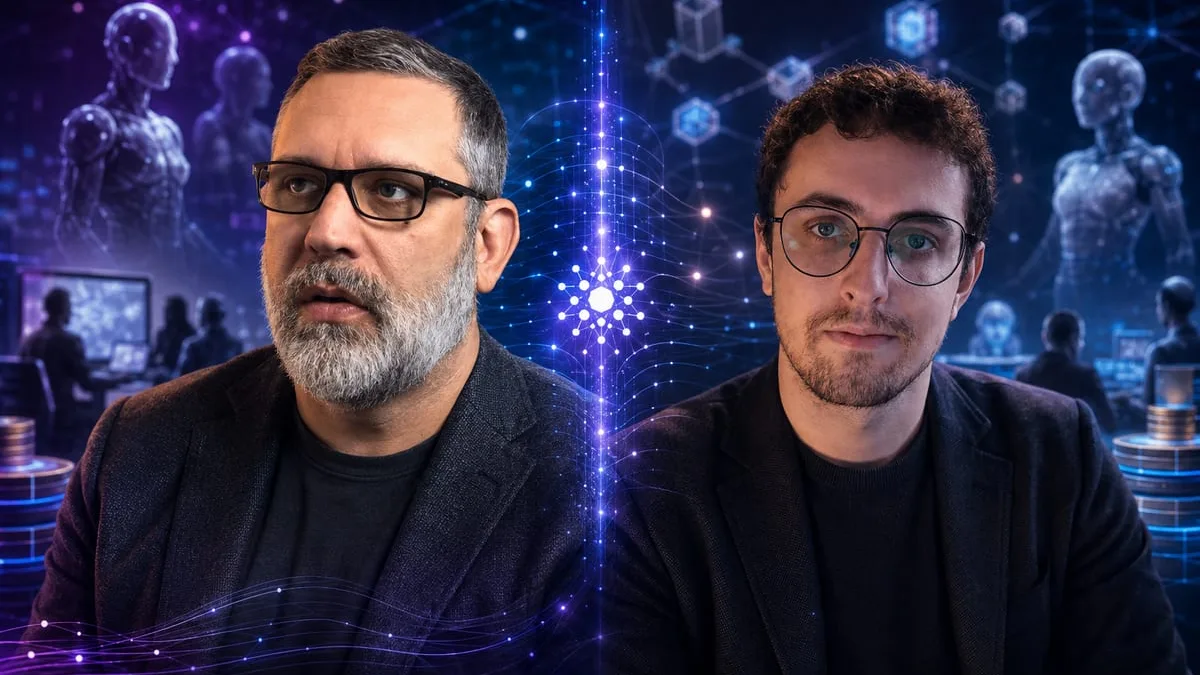
Patrick Tobler used a Block//45 interview with Crypto Crow to explain how Masumi and Sokosumi are placing Cardano behind an AI agent marketplace built for business users. The conversation opened with a brief personal note, as Tobler said Crypto Crow was one of the first Cardano creators he watched when entering the ecosystem. The interview then moved quickly into the product: Sokosumi gives companies a way to hire AI agents for marketing work, while Masumi provides the payment, identity, registry and audit infrastructure underneath.
Sokosumi Targets Enterprise Marketing Workflows
Sokosumi is an AI agent marketplace focused first on marketing. Tobler described it as a platform where users can hire AI coworkers for research, strategy, data work and content preparation. The target user is not only a crypto-native customer. Sokosumi is being built for marketing teams that already buy services, manage campaigns and coordinate work across email, chat and enterprise software.
The platform was developed through a joint venture involving Endmaker and Serviceplan Group, one of Europe’s large independent marketing groups. Tobler said Serviceplan has thousands of employees and works with major brands, including BMW and Lufthansa. That gives Sokosumi a route into Web2 companies that may never directly interact with a blockchain wallet.
The first practical use cases are concentrated around research. Marketing teams spend large amounts of time gathering market data, comparing competitors, building audience profiles and preparing campaign strategy. Sokosumi agents can be specialized for those tasks and can use data sources that ordinary users would otherwise need to find, license and connect manually.
Tobler said many current interactions happen through email or WhatsApp. That detail explains the product strategy. A user does not need to open a crypto dashboard or learn a wallet flow. The user can request work through a familiar channel, while the platform routes the task to an agent.
Sokosumi also avoids treating AI as one general assistant. Agents can have different capabilities, model costs, data access and compliance setups. Some may use advanced models, some may use cheaper infrastructure, and others may be designed around privacy or EU-hosted execution. The user sees a task estimate through a credit system, while the underlying payment logic can connect to stablecoin settlement.
Masumi’s official site describes the project as a payment network for AI agents, using escrow payments, verified identities and a public registry on-chain Masumi. A Project Catalyst proposal separates the stack into Masumi as the Cardano protocol layer, Sokosumi as the agent marketplace and Kodosumi as the execution environment for running agents Project Catalyst.
Cardano Handles Agent Identity and Settlement
Tobler said every Sokosumi agent is registered on Cardano. That registration gives each agent an identity and makes it discoverable to other agents. In the interview, he described a scenario where a research agent may need visual production, search on-chain for an agent offering that service, request the work and pay the other agent when the task is accepted.
That design moves the product beyond a simple AI tool. It creates a market where agents can hire other agents. A company agent could begin with a broad marketing request, then delegate research, writing, visual analysis or data work to specialized agents already registered in the network.
Masumi’s infrastructure is built around payments, identity, audit trails and registry functions. Payments use escrow logic, where one agent locks funds, another delivers the work, and the contract releases payment after completion. Identity gives each agent a verifiable presence. The audit trail records steps in a multi-agent workflow. The registry lets users and agents search for services by capability and history.
Tobler connected Cardano’s role to its EUTXO architecture and parallelization potential. He said Serviceplan looked across blockchain options and concluded that Cardano had the right foundation for large-scale agent interactions. That does not mean the current base layer can already support the full future agent economy, but it explains why Masumi is using Cardano for identity, payments and coordination instead of building everything inside a closed Web2 database.
The user-facing design intentionally keeps the blockchain layer out of sight. Tobler said Sokosumi tries to “hide Cardano” from normal users as much as possible. The point is not to force a connect-wallet experience into enterprise marketing. The user logs in, hires an agent and receives an output. Cardano operates underneath the workflow.
That gives Cardano a different adoption path. Instead of asking companies to use Cardano because it is Cardano, Masumi and Sokosumi use it to solve a coordination problem: who the agent is, what service it offers, whether it can be paid, and how completed work can be linked to a verifiable process.
The credit system also connects the business interface to stablecoin value. Tobler said ordinary users see credits, while credits in the background correspond to stablecoin settlement. In the interview, agent-to-agent examples used $USDM as the payment asset. Catalyst materials also describe Sokosumi as a marketplace where agents can be sold for stablecoins on Cardano, currently including $USDM.
Hydra and Midnight Address Scale and Privacy
Tobler identified speed and fees as early technical constraints for agent-to-agent payments. He said Cardano needs to catch up in those areas, while also noting that no current blockchain can support the full scale implied by billions of agents exchanging tasks and payments.
The throughput requirement is larger than ordinary consumer blockchain activity. If every person or company eventually has one or more agents, those agents may constantly communicate, negotiate, delegate and pay for work. Tobler said that scenario could require millions of transactions per second or more.
He connected that future to Leios, Peras and Hydra. Leios would increase throughput, Peras would improve finality, and Hydra could allow parallel execution through many heads. Tobler said the team has already worked with Hydra and the Hydra team, while adding that more work is needed before the architecture can support the kind of scale required by a global agent marketplace.
Midnight enters the model through privacy. Tobler said private transactions become relevant after speed and fees are addressed. If an agent acting for BMW communicates with agents from another company, even the visible relationship between those agents may reveal business-sensitive information. For enterprise marketing, procurement, research and strategy work, the transaction graph can become commercially sensitive.
Midnight could provide a layer where agents prove permissions or complete payments without exposing every relationship or workflow detail. In that role, privacy is part of how companies allow autonomous systems to work with sensitive information while limiting what counterparties and observers can see.
Security remains another unresolved area. Crypto Crow asked what happens if a malicious actor attempts prompt injection through email or tries to manipulate agents into harmful behavior. Tobler said there is no complete guarantee because agents are non-deterministic. He also said Sokosumi is a marketplace where different agents may be built by different companies and carry different security mechanisms.
For enterprise adoption, Tobler said the team is working on audits, SOC 2 compliance, penetration testing and a certification program with one of the largest global audit firms. He did not name the firm in the interview.
The product is still not a full marketing autopilot. Tobler said posting and execution across external channels are possible in some form, but not yet at the standard the team wants. Sokosumi is currently stronger in research, strategy and preparation than in fully autonomous campaign execution.
The marketplace is also open to external builders. Tobler said the team is looking for more specialized agents from outside parties. A developer or company can build an agent for a specific business function, register it and make it available for hire. That turns agent expertise into a service product, with identity, payment and reputation handled through the network.
Masumi and Sokosumi give Cardano a role that is easy to miss from the surface. A marketing team may only see an email request, a delivered report and a usage cost. Underneath, an agent can be registered, discovered, hired, paid and linked to a verifiable workflow. That is the product path Tobler described in the Block//45 interview: Cardano as the coordination and settlement layer for AI agents that work like digital contractors, not just chatbots.