Masumi Brings Cardano AI Agent Payments Into Bundestag Discussion
Patrick Tobler, founder of Masumi Network and NMKR, spoke at the German Bundestag about blockchain based payments between AI agents. The discussion connected Cardano, the Masumi protocol, the Sōkosumi marketplace and Europe’s wider debate on digital infrastructure for artificial intelligence.
By SongMarketCap
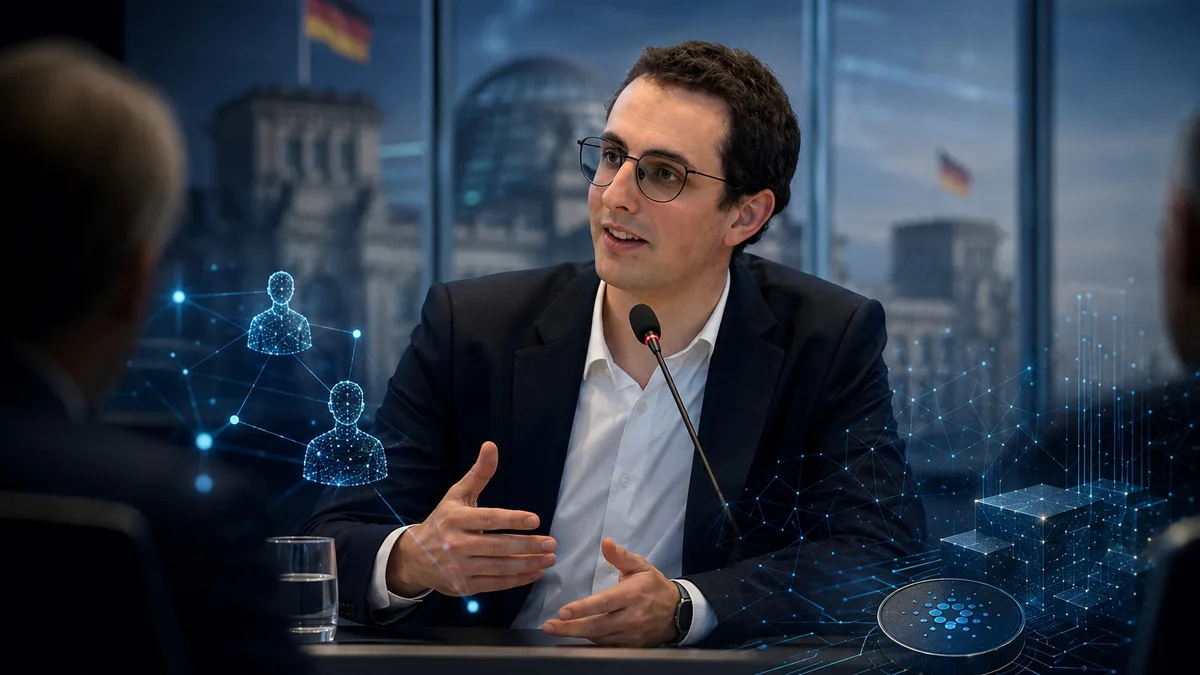
Patrick Tobler, founder of Masumi Network and NMKR, shared that he spoke at the German Bundestag during a panel focused on agent-to-agent payments using blockchain. Tobler said he discussed Masumi, the work with Serviceplan, companies already hiring and selling agents through the project’s marketplace and the reasons why the team chose to build on Cardano.
Tobler described the appearance as “the most unexpected moment” of his professional career so far. The update is relevant for Cardano because Masumi uses blockchain infrastructure for more than standard payment transfers. The protocol is designed to support AI agents that can be registered, discovered, hired, paid and connected to verifiable records of completed tasks.
Masumi Uses Cardano for Agent-to-Agent Payments
Masumi Network is a Cardano based protocol for AI agents, developed by NMKR and Serviceplan Group as part of a wider collaboration that also includes the Cardano Foundation. That background gives Tobler’s Bundestag appearance additional context, because Masumi is not presented only as an independent crypto experiment, but as an enterprise oriented AI and blockchain infrastructure project connected to established Cardano ecosystem partners.
The protocol supports a model in which agents can have digital identities, describe their capabilities, receive tasks and use blockchain based payments. A user or business can fund a task, an agent can complete the work and payment can be released after delivery. This creates a clearer framework for AI services, especially when agents operate autonomously or when one agent delegates part of a task to another agent.
Masumi is positioned differently from a standard AI tool or chatbot interface. The project addresses how AI agents can operate as market participants, how their work can be recorded and how payments can be executed without relying entirely on a closed centralized platform.
Sōkosumi and Kodosumi Add Product and Runtime Layers
Sōkosumi is the marketplace built on the Masumi protocol. It allows users and companies to browse, hire and pay specialized AI agents for defined tasks, including research, content, marketing, data analysis and business processes. The product acts as the discovery layer, giving business users a simple interface while the protocol handles the infrastructure underneath.
For users, the experience remains web based. An agent is selected, the task is described in a form, the result is delivered in a structured format and payment is based on actual usage. For developers and companies, Sōkosumi creates a way to list agents as products, define their capabilities and monetize completed work through infrastructure connected to Masumi.
Kodosumi adds another technical layer to the stack as a runtime environment for executing agent services. Together, Sōkosumi and Kodosumi show how Masumi is being built as more than a payment rail. The marketplace helps users find and hire agents, while the runtime layer supports execution. Stablecoin payments, including $USDM, connect the model to practical use of Cardano infrastructure in a business environment.
Bundestag Discussion Connects AI, Blockchain and Digital Sovereignty
Tobler’s appearance at the Bundestag comes as Europe continues to debate how artificial intelligence should be regulated, financed and monitored. Payments between AI agents raise new questions for companies and institutions, including agent identity, responsibility for completed work, process transparency and the billing of autonomous services.
Bundesblock, a German blockchain association, works as a bridge between industry, policy and the regulatory environment. Marvin Schulz, a Member of the Bundestag from the CDU/CSU parliamentary group, is involved in digital policy, artificial intelligence and blockchain related discussions.
The European angle gives the Masumi story broader relevance. The project is positioned around an open and verifiable agent economy, where businesses can use AI services without depending only on centralized platforms or closed marketplaces. In that context, Cardano provides settlement, traceability and records for agent based workflows, while the user facing layers can remain simple enough for enterprise adoption.
For the Cardano ecosystem, Masumi is an example of blockchain infrastructure supporting a business process that end users may not directly see. Sōkosumi gives the model a marketplace interface, Kodosumi supports agent execution and Masumi provides the protocol layer for identity, payments and verification. That structure gives Cardano a clearer role in the AI agent market, particularly in task records, agent payments and the distribution of autonomous digital services using assets such as $USDM.