IO’s 2026 Treasury Proposals Put Cardano Governance on the Spot
Input Output has opened its 2026 treasury campaign with nine proposals spanning Leios, maintenance, Plutus, Layer 2 scaling, developer tooling, Blockfrost, and Pogun. The bigger issue is not only what IO wants to build, but whether Cardano governance is still willing to fund large technical roadmaps before delivery is proven.
By SongMarketCap
Updated:
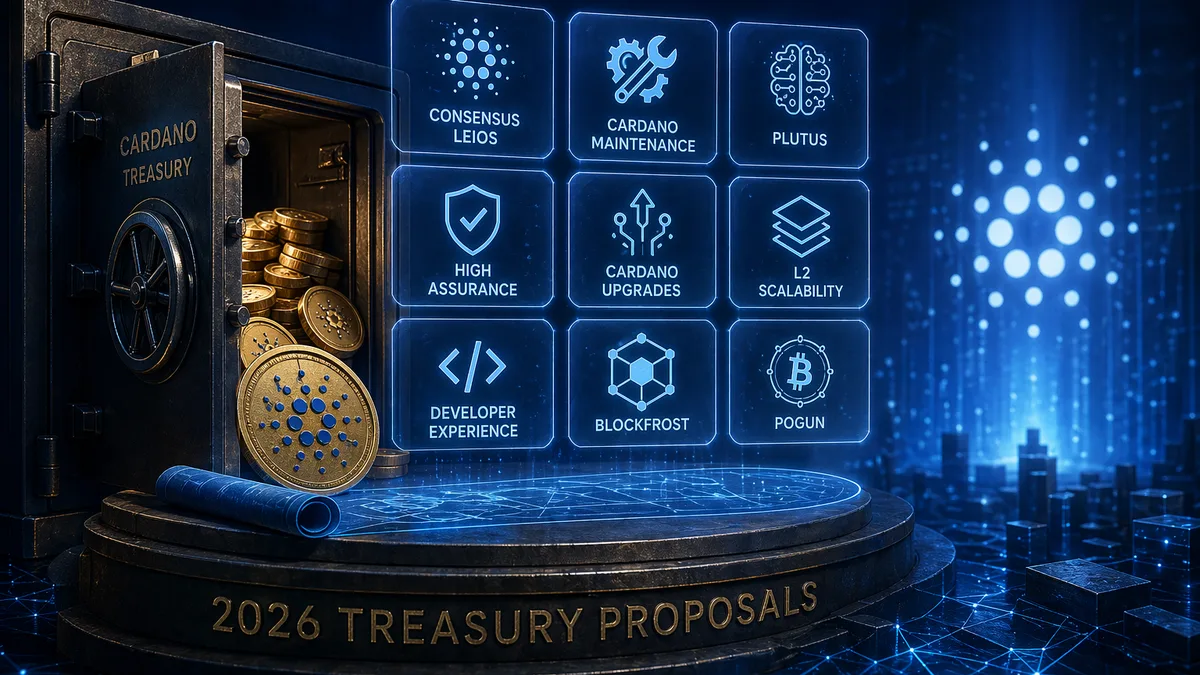
IO is not just asking for funding, it is asking for renewed trust
Input Output has formally launched nine treasury proposals for the 2026 Cardano budget cycle through its Momentum portal, presenting them as a coordinated package tied to performance, security, and capability goals for the network’s longer term 2030 direction. IO says the total ask is down by nearly 50 percent versus last year, but the number that matters now is still large, roughly 162.15 million ADA across the full package.
That matters because this is not a routine ecosystem update and it is not just another polished campaign page. Each proposal must pass through Cardano’s treasury governance process, where IO itself states that treasury withdrawals require a 67 percent supermajority of active DRep voting stake plus Constitutional Committee approval. In practice, that means the company is not simply pitching technology, it is asking the governance system to extend a fresh mandate at a time when parts of the community are openly less willing to fund ambition on reputation alone.
The package covers Consensus, Cardano Maintenance, Plutus, Cardano High Assurance, Cardano Upgrades, L2 Scalability, Developer Experience, Blockfrost, and Pogun. On paper, it is one of the most comprehensive treasury pushes Cardano has seen. Politically, it is more delicate than that. The community response around recent treasury debates has shown that the center of gravity has shifted. Big asks now face sharper scrutiny around milestones, reporting discipline, and evidence that previous spending actually translated into usable network progress.
The biggest proposals are exactly where DReps will push hardest
The largest proposal in the portfolio is Cardano Maintenance, with a published ask of 62.1 million ADA. IO frames it as the operational backbone for everything else, covering bug fixes, infrastructure support, monitoring, QA, release management, documentation, and security reviews. That case is logically strong, because serious networks do not run on feature launches alone. But it is also politically exposed, because maintenance is the easiest category to describe as essential and the hardest one to defend if voters do not get very clear proof of what changed, what improved, and what would break without it.
The second major pillar is Consensus, centered on Leios, with an ask of 27.7 million ADA. IO presents Leios as the path toward major throughput expansion and references a potential 10x to 65x increase in throughput. The important detail is that the proposal does not promise a guaranteed mainnet hard fork within the budget window. Instead, it defines success as completing the work needed to move Leios from prototype stage toward a mainnet ready release candidate. That is a fair and technically credible framing, but it also means DReps are being asked to fund readiness, not guaranteed activation.
The L2 Scalability proposal reinforces the same pattern. IO says it would support shared Layer 2 infrastructure, Hydra production hardening, and a Midgard mainnet launch targeted for the end of 2026. The strategic logic is obvious. If Cardano wants to compete more seriously on latency, throughput, and application performance, base layer improvements alone are not enough. But again, the treasury question is not whether this direction sounds smart. It is whether the governance system believes the execution plan is concrete enough to deserve funding now.
Plutus, Blockfrost, and Pogun show where IO wants Cardano to expand next
The proposals around Plutus, Developer Experience, and High Assurance are easier to defend in product terms because they connect directly to a long standing Cardano problem, building on the stack is still harder than many developers want it to be. IO positions Plutus as a way to make smart contracts cheaper, more capable, and more rigorously verified, while Developer Experience is framed as a focused push on tooling, onboarding, documentation, and builder growth. If Cardano wants more real applications, faster iteration, and less friction for teams entering the ecosystem, this part of the package is central, not optional.
Blockfrost and Pogun point to something else, IO is not only defending core protocol spending, it is also trying to shape where Cardano grows next. Blockfrost is positioned as critical data infrastructure, while Pogun is presented as an end to end Bitcoin DeFi stack on Cardano with a treasury return model attached to future earnings. That makes Pogun one of the most politically interesting proposals in the entire set. Supporters can argue it is closer to an ecosystem investment thesis than a plain grant. Critics can argue it is still a high execution bet dressed in more attractive financial language.
That is why this story matters. IO has not merely published nine proposals. It has forced Cardano governance to answer a harder question about its own maturity. Can the ecosystem still back large technical programs before results are fully visible, or has treasury politics moved into a stricter phase where trust must be earned line by line, milestone by milestone, and release by release. This is what makes the 2026 IO treasury push more than a roadmap story. It is a live test of how Cardano now decides who gets capital, on what terms, and with how much patience left.