IOR Defends Cardano Vision 2026 Research Proposal as No Votes Lead DRep Scrutiny
The ₳32.9 million IO Research treasury proposal is facing strong resistance in DRep voting, while Fergie Miller argues that Cardano’s long term research pipeline depends on bundled funding, conversion discipline and early stage exploration.
By SongMarketCap
Updated:
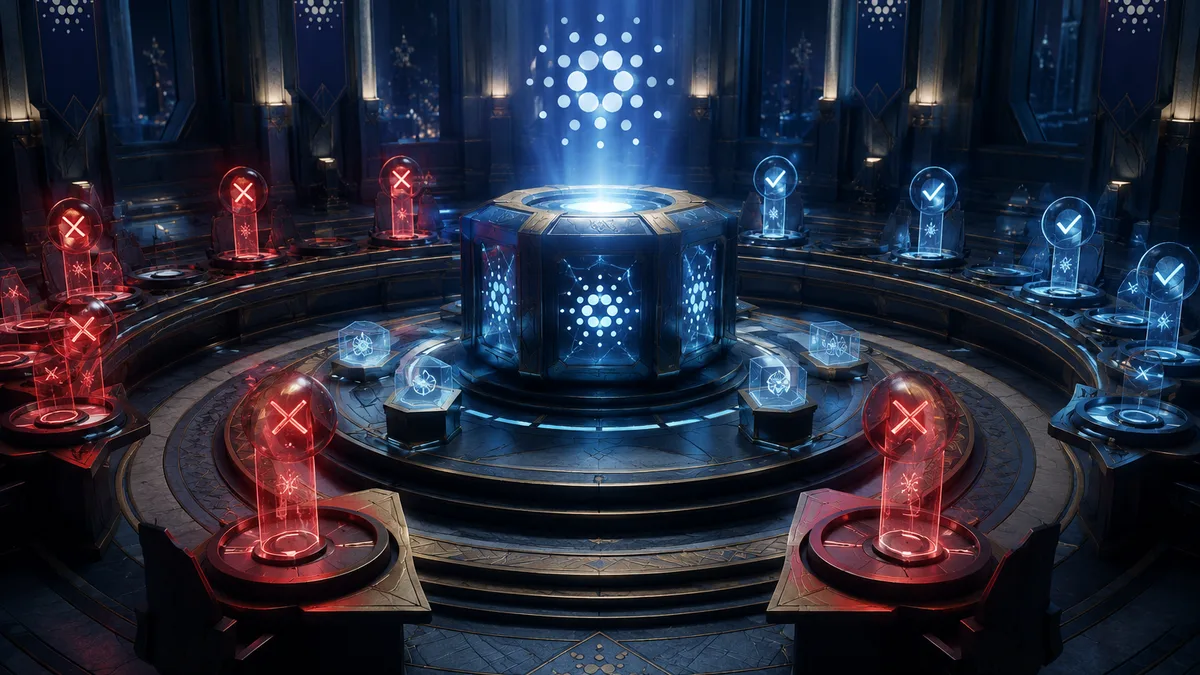
Input Output Research is facing a major Voltaire era test as its Cardano Vision 2026 treasury proposal struggles to win DRep support. The proposal, titled “Cardano Vision 2026: Human Centred, Scalable, Post Quantum Secure, IO Research,” requests ₳32,916,667, with voting open until June 8, 2026.
According to a June 1 snapshot, No votes currently lead with about 63.67% of voting power, while Yes stands near 36.33%. That makes the proposal one of the clearest current examples of how Cardano governance is applying public scrutiny to large, long term treasury requests.
Fergie Miller, Director of Research Partnerships at IO Group Research and an active participant in the Intersect Research Working Group, addressed three recurring questions from the Cardano community. The debate now centers on why the IOR proposal is bundled, how research conversion should be measured and whether the treasury should fund early stage research before it becomes implementation ready.
Cardano DReps Question IOR’s Bundled Research Proposal
The first issue is the structure of the proposal. IOR argues that the request should not be viewed as a list of separate projects, but as a connected research network. According to Miller, areas such as scalability, consensus, cryptography, governance and identity are closely linked, and separating them into smaller proposals could create fragmentation, duplicated work and higher governance overhead.
Supporters frame the bundled model as a practical requirement for foundational research. DReps such as @hix_coffeepool have supported the request with caveats, pointing to the value of long term research, the separation between research and implementation, milestone logic and the need for stricter evaluation in future funding cycles. @SIPO_Tokyo has also described the proposal as an upstream research engine for areas such as Leios, Peras, Layer 2 development and zero knowledge technology, while highlighting escrow, milestone payments and on chain safeguards.
The No side sees the structure as the central weakness. Critics argue that a large bundled proposal makes accountability, prioritization and outcome measurement more difficult. @MrEdgarcross voted No and described the proposal as an example of treasury extraction, arguing that ordinary users, DeFi activity and TVL have not yet seen enough visible results from previous research funding. Other critics have called for unbundling and resubmission through smaller, more precise proposals so DReps can evaluate the cost, risk and value of each research stream more clearly.
The debate is therefore not only about whether Cardano should support research. The deeper question is how broad a mandate treasury governance should give to one research network, and how much detail DReps need before approving long term funding.
IOR Conversion Rate Enters the Cardano Governance Debate
The second issue is research conversion. Miller says IOR has produced more than 250 peer reviewed papers, with more than 50 translated into the Cardano ecosystem, which IOR presents as a conversion rate of about 20%.
That wording matters. In this context, “implemented” does not necessarily mean that every paper became a standalone mainnet feature. Based on available explanations, the term covers a broader path from research into protocols, formal proofs, CIPs, prototypes, libraries or development tracks that later contribute to Cardano infrastructure.
IOR and its supporters use that figure to argue that Cardano’s research first model is not just academic output, but a pipeline that has already influenced real technology. Common examples include Ouroboros, Hydra, Mithril and Leios, all of which began as research driven work before becoming recognizable parts of the Cardano roadmap.
Critics are focused on the next step in that pipeline. Their concern is the bridge between papers, prototypes and visible outcomes for users. They want clearer milestones, more measurable deliverables and a stronger distinction between foundational research and applied engineering. In the Voltaire era, those questions now shape how the Cardano treasury funds long term technical bets.
Miller also compared IOR’s conversion rate with early stage startups, saying startups convert at below 1%, while IOR is around 20 times more efficient by that metric. That comparison should be treated as Miller’s and IOR’s framing, because there is no independent standard metric that directly compares the path from research paper to implementation with startup conversion rates.
Early Stage Research Becomes a Treasury Governance Test
The third issue is early stage exploratory research. Miller’s argument is that Cardano cannot have new implementation ready technologies in two or three years if it does not fund the research pipeline today. Before engineering can begin, new ideas often need feasibility studies, formal analysis and technical validation.
In that frame, Cardano Vision 2026 is not only a request for current research work. It is also an attempt to preserve long term capacity for future upgrades. The program is tied to areas such as post quantum security, scalable architecture and human centred design, with the goal of keeping Cardano capable of producing new protocol level solutions over several years.
For DReps, the decision is practical. Early stage research carries uncertain outcomes, while the treasury vote requires a concrete decision now, on a specific amount, under public accountability. If funding is approved, the community accepts the risk of a long term research portfolio. If funding is rejected, Cardano may be sending a signal that large research packages need to become more granular, more clearly justified or more closely connected to implementation outcomes.
The current lead for No votes shows that a significant share of voting power is not yet convinced by the proposal’s structure, amount or accountability model. At the same time, Yes reactions show that some DReps believe Cardano risks losing part of its technical depth if it weakens the upstream research engine that has shaped its protocol history.
This is what gives the vote its wider importance. Cardano is not only deciding whether to fund one research proposal. It is defining how long term technical work must earn trust under treasury governance, and how research organizations will need to present cost, progress and accountability in the Voltaire era.