Hydra 2.0 Simplifies Cardano Layer 2 by Removing Commit Phase and Redefining Head Lifecycle
The new Hydra alpha release introduces a structural change to Cardano’s Layer 2 scaling stack, making Hydra Heads simpler to open, easier to fund, and more practical for real-world application design.
By SongMarketCap
Updated:
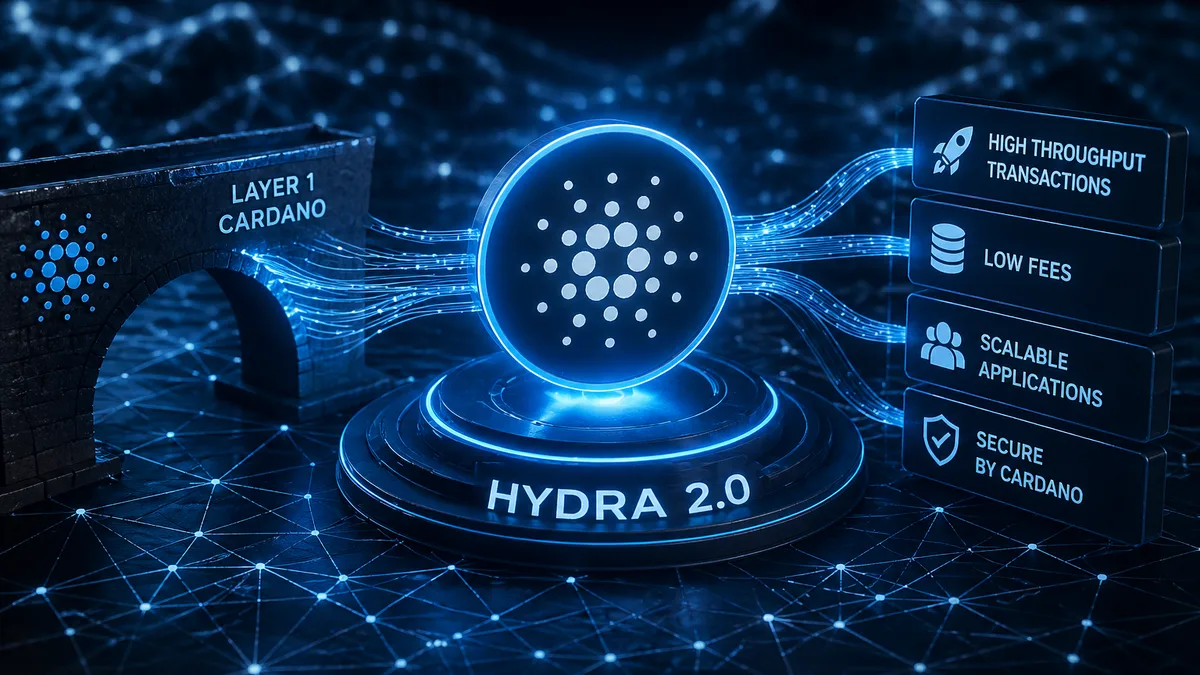
Hydra 2.0 alpha marks one of the most important updates to Cardano’s scaling infrastructure this year. The release removes the commit phase entirely, allowing Hydra Heads to open directly while funds are added later through deposit transactions. That change may sound technical, but it targets one of Hydra’s biggest practical barriers, the friction of managing liquidity before a Head could become usable.
Cardano Hydra 2.0 changes how Heads open
In earlier Hydra versions, participants had to commit funds before a Head could move into operation. That model made sense from a protocol perspective, but it created complexity for developers and a less natural experience for users.
Hydra 2.0 changes that lifecycle. Heads now open directly, and funds are added incrementally through deposits. This removes the need for collectCom and abort transactions, simplifies the protocol flow, and reduces lifecycle costs for most use cases.
For builders, the important point is not only that Hydra becomes cheaper in some scenarios. The bigger change is flexibility. Applications no longer need to force all liquidity decisions into the opening stage of a Head. That makes Hydra better aligned with use cases where users join, fund, interact, and exit in more dynamic ways.
Why incremental deposits matter for Cardano builders
The move to incremental deposits gives developers a cleaner path toward application logic that feels closer to normal user behavior. Instead of designing around a rigid upfront funding step, builders can structure applications around ongoing participation.
That matters for areas such as micropayments, gaming, high frequency user interactions, payment channels, and app specific transaction flows. These are precisely the kinds of environments where Cardano needs Layer 2 infrastructure to feel invisible to the user, not like a separate technical process that must be understood before an application can function.
Hydra 2.0 also resolves the long standing “non abortable head” issue, which could occur when a participant committed a UTxO that was too large. Removing that failure mode improves the operational reliability of the protocol and makes the Head lifecycle easier to reason about.
Hydra 2.0 remains alpha, but the direction is clearer
This release is also a breaking change. All on chain scripts are affected, several API endpoints have changed, and the token name has moved from HydraHeadV1 to HydraHeadV2. That means existing implementations will need review and adaptation before using the new version.
The release also includes fixes beyond the lifecycle redesign, including Plutus script evaluation on mainnet and testnet,
snapshot liveness, and deposit handling correctness across multi head deployments. These details matter because Hydra is not only about speed, it is about predictable execution under real network conditions.
Hydra 2.0 is not a mass adoption moment by itself, and presenting it that way would be premature. Its importance is more specific. Cardano’s Layer 2 stack now has a simpler operating model, fewer lifecycle transactions, and a clearer foundation for applications that need fast, repeated, low friction interaction. For Hydra, that is the kind of upgrade that matters most, not because it creates a headline, but because it removes machinery builders previously had to work around.