Hoskinson Outlines Post-Election Crypto Risks, Bitcoin’s Role and AI Opportunities
Midnight’s Monument Bank relationship and Hoskinson’s work with more than 50 AI agents featured in a nearly three-hour X Space. The discussion also covered U.S. crypto legislation, Bitcoin’s monetary role and the economic risks of automation.
By SongMarketCap
Updated:
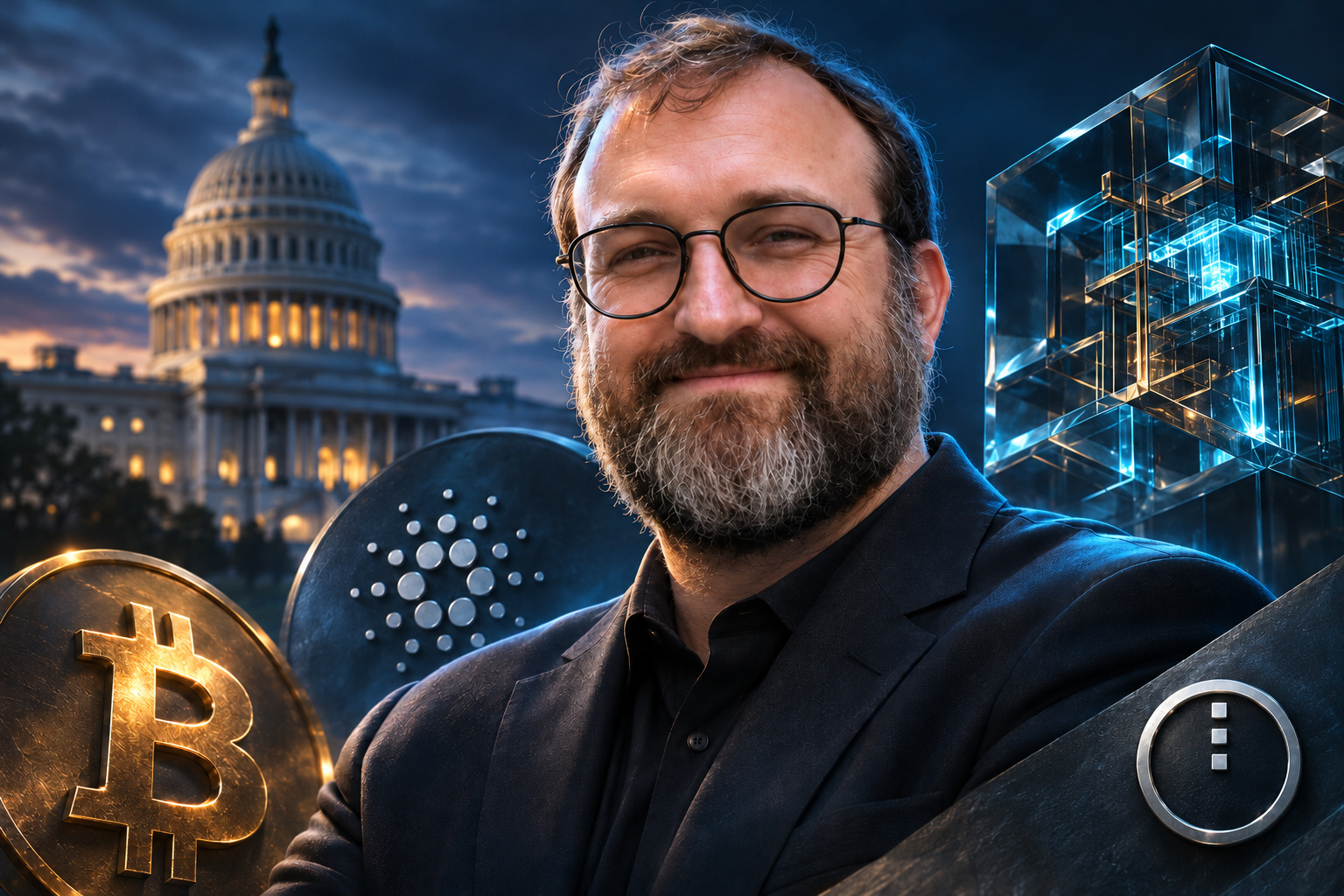
Charles Hoskinson reaffirmed Input Output’s development work on Cardano and Midnight following the U.S. congressional elections, despite predicting a more difficult political environment for cryptocurrency. During the X Space titled “election post-mortem and what it means for crypto,” the Cardano founder outlined continuing priorities in global adoption, privacy, identity and AI while calling for the industry to demonstrate practical uses and rebuild relationships across party lines.
Hoskinson Reaffirms Work on Cardano and Midnight
The political outlook would not materially alter day-to-day work on either network, in his assessment. Input Output would continue pursuing its existing development priorities and opportunities outside the United States, keeping international adoption central to its work.
Cardano’s decentralization formed the basis of his assessment of its regulatory resilience. Comparing the network with Bitcoin, he expressed confidence that its structure provides a strong argument against treating ADA as a security.
That discussion also addressed the relationship between a decentralized protocol and its founder. A network’s value proposition should depend on its properties and functions, in his view. Disagreement with his personal political positions therefore should not determine whether someone uses Cardano.
For Midnight, the focus was on applications that protect information while operating in highly regulated environments. He maintained that privacy and compliance can coexist, allowing financial institutions to use public blockchain infrastructure while protecting confidential customer and commercial data.
Monument Bank as a Model for Further Midnight Integrations
Midnight’s relationship with Monument Bank is intended to provide a template for additional neobanks, Hoskinson explained. The aim is to establish an approach that other institutions can adapt to their own products and business requirements.
The previously announced Monument and Midnight Foundation program targets up to £250 million in tokenized deposits in its first phase. The tokens would represent corresponding funds held at the bank, remain redeemable in pounds sterling and retain applicable deposit protections. Subsequent planned phases include tokenized investment products and lending against investments. The £250 million figure remains the announced first-phase target.
A participant asked about a hypothetical collaboration involving Cardano, Midnight and Erebor Bank. The response was an expression of openness to discussions with neobanks that see business value in the infrastructure; no agreement with Erebor was announced.
The criteria for such relationships centered on protections embedded in the product. His stated aim is for infrastructure to constrain how a bank can act toward its customers, reducing reliance on personal trust in founders or executives. On that basis, he would support adoption by institutions whose leadership holds different personal or political views from his own.
For concrete business discussions, the participant was directed to Scott Collins at the Midnight Foundation. Hoskinson identified Collins and Fahmi Syed as people involved in the Monument Bank relationship and outlined plans for a sales team to find further neobank integrations, gather business requirements and manage the commercial process.
CLARITY and the Prospect of Greater Congressional Scrutiny
On U.S. policy, Hoskinson’s forecast was considerably more pessimistic. Sherrod Brown’s return to the Senate and the possibility of Brown succeeding Tim Scott as chair of the Senate Banking Committee featured prominently in his assessment. He characterized Brown and Elizabeth Warren as particularly hostile to crypto and expected a change in committee leadership to complicate legislative efforts.
CLARITY, the proposal to establish a U.S. digital asset market structure framework, had lost its political prospects in his view. He predicted that no meaningful new cryptocurrency legislation would pass in 2027 or 2028.
The Securities and Exchange Commission could continue developing rules addressing some of the objectives behind that legislation, according to his assessment. Political pressure, however, could limit the scope of those efforts as Washington’s attention shifts toward oversight of the Trump administration.
Potential congressional investigations were another concern. He expects scrutiny involving Trump’s memecoin, World Liberty Financial, donations and financial relationships between cryptocurrency businesses and the administration. In the scenario he outlined, committees would collect documents and examine connections that could also draw industry executives into investigations.
Crypto’s Political Ties and Cardano’s Governance Experience
That outlook informed his criticism of the industry’s close association with Trump. Identifying crypto with a single political movement, Hoskinson contended, had made it easier for opponents to link the sector with corruption and politicians’ personal enrichment. Questions about the president’s token had repeatedly displaced discussion of technology and business applications in his own interviews.
Rebuilding relationships with both major U.S. political parties was his proposed response. The cryptocurrency market’s growth in 2021, during the Biden administration, provided an example of the sector expanding under Democratic leadership. His case for bipartisan engagement rested on demonstrating what cryptocurrency products accomplish beyond trading and speculation.
Cardano’s governance experience supplied a separate contribution to the political discussion. The community’s work on a modern constitution and voting system gives its participants a basis for engaging in debates about representation and institutional accountability, he maintained.
Among the reforms he supported examining were term limits, changes to voting methods and greater political diversity. Simply increasing the size of the U.S. House of Representatives would be insufficient in his assessment. Without changes to electoral incentives, a larger chamber could preserve the same concentration of influence within the two major parties and their committees.
Bitcoin as Digital Gold and the Debate Over Purchasing Power
Purchasing power was the central concern in Hoskinson’s discussion of Bitcoin. Calling it “digital gold,” he connected its appeal to resistance to monetary debasement and to ideas he supported during Ron Paul’s 2008 presidential campaign.
Persistent inflation, in his account, disadvantages people whose income and savings fail to keep pace with prices. Wealthier participants can use earlier access to capital to acquire assets that protect their purchasing power, while workers face rising costs for housing and everyday goods.
Government-backed investment accounts for children provided another example. Allocating financial assets would not resolve the underlying problem if the currency continued losing value, he contended. His preferred policy objective was to protect the value of savings over time.
Economists’ objections about the risk of a deflationary spiral also drew criticism. Hoskinson challenged those objections to deflationary money while emphasizing the dangers of debasement and hyperinflation. Bitcoin featured in that exchange as an alternative monetary model.
More Than 50 AI Agents and a Different Organization of Work
During the Space, more than 50 software agents were writing code, analyzing material and refining documents on Hoskinson’s behalf, according to his account. Their assignments had been set several hours earlier, allowing work to continue while he participated in the conversation.
The workflow involves preparing context, connecting tasks and optimizing how much information the models process. Approximately a year of learning and experimentation went into building that system. Its agents can continue carrying out assignments while he works on other activities or sleeps.
His suggested adoption path for businesses begins with individuals expanding their own capabilities. Coordination would then extend to two or three colleagues before the approach spreads to larger teams. Under that model, he predicted that companies with 10 or 20 employees could handle workloads previously associated with organizations employing hundreds of people.
Curiosity and initiative were central to the employee example he shared. A lawyer in his policy office had independently begun building AI-assisted legal workflows without waiting for instructions. Independent learning, delegation and the ability to coordinate work across disciplines were qualities he emphasized throughout that discussion.
Education was another application. AI can provide a personalized tutor and learning materials adapted to a particular skill, in his view. As access to tailored instruction becomes easier, time becomes the primary constraint on learning. Making use of that access requires the self-discipline and curiosity to invest the necessary hours.
The same work has influenced his communication with human colleagues. Preparing an assignment for an agent requires clear information, definitions and constraints. He now applies that approach to researchers and other collaborators, using AI to prepare more specific supporting material before their work begins.
[NEWSBREAK]
Open Models, Infrastructure Dependence and Access to Expertise
Hoskinson’s technical approach includes combining commercial AI services with models he can operate locally. Models that outside researchers can inspect and adapt benefit from a wider community investigating problems and developing improvements, he explained. Access to model weights enables that participation.
The continued availability of capable open models was less certain in his assessment. Broad adoption could create dependence on particular suppliers of chips, data centers and related services. Alongside that warning, he predicted that some open models would continue narrowing the capability gap with leading closed systems.
Access to expertise formed the other side of his economic assessment. Under a new economic model, he called AI “the greatest equalizer in human history,” pointing to individuals gaining coding and analytical capabilities comparable to those of wealthy founders backed by specialist teams.
That prospect could support the creation of many new businesses, in his view. It also raised a question about how the resulting wealth would be distributed, with wider access to technical capabilities existing alongside his concern about economic gains becoming concentrated at the top.
Taiwan, AI Displacement and the Risk of a Global Downturn
Hoskinson expects three developments to converge in 2027: a Chinese invasion of Taiwan, substantial labor displacement from AI and humanoid robotics, and a severe economic downturn. He characterized an invasion as very likely and put the probability of a major recession potentially developing into a global depression above 50%.
His economic scenario focused on countries heavily dependent on outsourced services. AI could reduce demand for call centers, software development and related work in markets such as India and the Philippines, he warned. A sharp contraction in those activities could destabilize local economies before spreading to wealthier countries.
Wider geopolitical conflict could compound those pressures through disruptions to infrastructure and supply chains. The discussion also addressed electricity networks’ vulnerability to cyberattacks and the difficulty of restoring service after coordinated failures across multiple locations.
Asked how economic growth could benefit the wider population through that transition, Hoskinson acknowledged that he did not have a complete answer. Earlier shifts from agriculture to manufacturing and then knowledge work had created new places for people to work. Where displaced workers would move in an AI-driven economy, and how quickly replacement industries could grow, remained unresolved in his assessment.
Being “Directionally Right” in Frontier Technology
A closing exchange about nuclear energy extended the discussion to investment in emerging technologies. Hoskinson used the phrase “directionally right” for backing capabilities that become valuable as an industry develops, connecting that judgment with specialist knowledge and the ability to assess competing research paths.
A company could build expertise, products and a team valuable enough to attract an acquisition even if it never became the dominant business in its field, he explained. Rapidly expanding companies may acquire competitors to accelerate development and recruit people already familiar with the same technical problems.
Choosing the wrong technological approach remained a central risk. Exposure to a growing sector would not prevent losses if a competing architecture prevailed. His examples included alternative routes to fusion and quantum computing, where the eventual direction of adoption can determine the value of particular capabilities.
Many of the businesses under discussion occupy specific positions in a supply chain. To illustrate the different requirements, he contrasted laser-based fusion with magnetic-confinement approaches, pointing to the roles of optics, magnets and component durability in those systems.