Hoskinson: CLARITY Act Was Never Crypto’s Salvation
After the CLARITY Act failed to advance in the U.S. Senate, Charles Hoskinson sharply criticized the legislation, the Trump administration and the crypto industry’s handling of the process. He proposed replacing the comprehensive bill with separate laws covering digital securities, digital commodities, compliance and technical standards.
By SongMarketCap
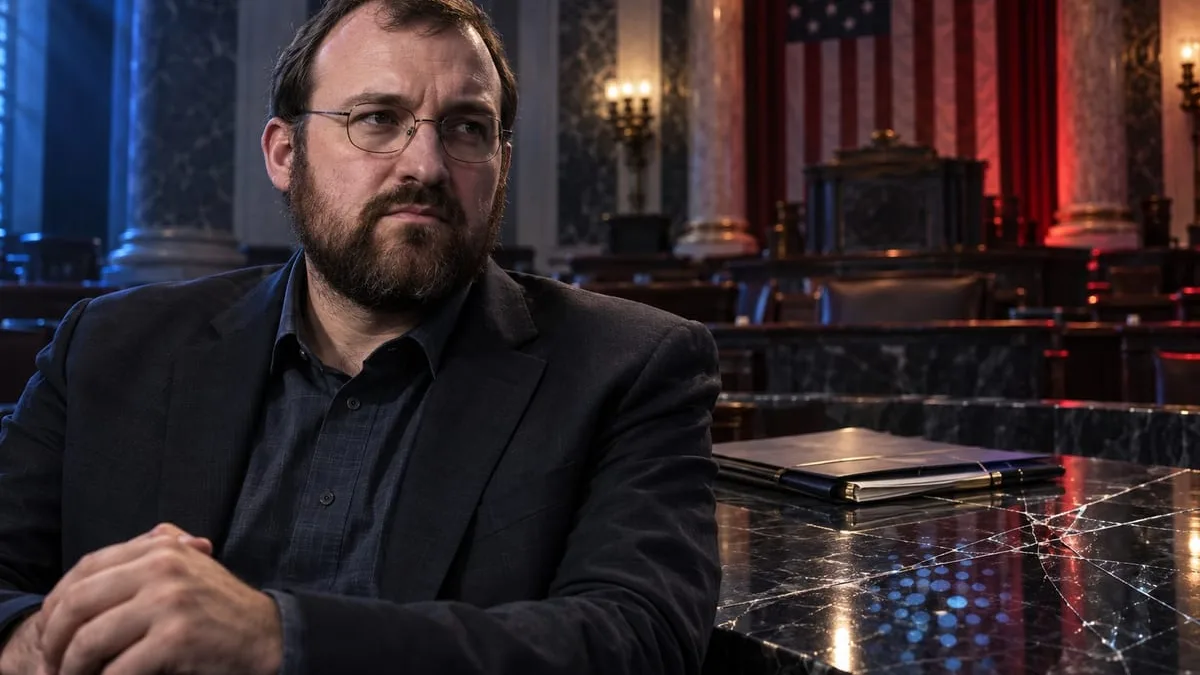
The U.S. Senate rejected a motion to proceed with the CLARITY Act after the legislation received 49 votes in favor and 50 against, falling short of the required 60 vote threshold. Charles Hoskinson responded in a new video, saying he had warned for more than a year that the legislation had no realistic path to approval.
The Cardano founder argued that the failure was caused by more than the final vote. He criticized the attempt to regulate a broad industry through one bill, the political conflict surrounding President Donald Trump’s crypto businesses and plans to expand the CFTC’s responsibilities without providing the agency with sufficient resources. The outcome leaves the regulatory environment surrounding ADA, wallets, DeFi protocols and other digital asset infrastructure without a lasting congressional framework.
Hoskinson Says the Legislation Was Built on the Wrong Model
Hoskinson described the CLARITY Act as an overly broad attempt to regulate different forms of digital assets, market intermediaries and regulatory responsibilities within a single legislative package.
He argued that the administration failed to study regulatory systems already operating in the European Union, Japan, South Korea, the United Arab Emirates, Switzerland and other jurisdictions. He specifically criticized David Sacks, calling him “probably the worst czar in the history of czars” and claiming that the White House crypto adviser showed little interest in lessons from other global markets.
According to Hoskinson, different regulatory issues should not have been combined into one political package. He cited the GENIUS Act, which addressed stablecoins separately, as the correct approach. The next step, he said, should have been modernizing the definition of a security and creating a dedicated category for digital securities.
Such a framework could cover ICOs, tokenized assets and platforms issuing digital securities through updated SEC rules. Assets that Hoskinson considers digital commodities, including Bitcoin, Cardano and XRP, would instead fall under a separate framework supported by a modernized CFTC.
Hoskinson’s description of Cardano as a commodity represents his regulatory position, not an official congressional determination of ADA’s legal status.
Trump’s Crypto Businesses Became a Political Obstacle
A substantial part of Hoskinson’s criticism focused on the political environment surrounding the legislation. He said Trump’s crypto businesses allowed Democrats to connect the entire bill with the president’s personal financial interests.
Hoskinson agreed with the argument that a U.S. president should not actively participate in markets that can be affected by presidential statements, regulatory appointments and government decisions. He said the restriction should apply to every president, regardless of political affiliation.
He also criticized crypto executives who, in his view, used political donations to secure access to the White House and then promoted photographs with government officials without delivering a durable legislative outcome. He described the process as political theater in which short term business interests replaced work on legislation intended to govern a multitrillion dollar industry for decades.
His criticism was not limited to one political party. Hoskinson connected Democratic demands for stronger transaction monitoring with attempts to introduce back doors into cryptocurrencies. He accused the Republican administration of turning crypto regulation into a partisan project while ignoring predictable objections involving ethics, enforcement, regulator funding and national security.
He argued that Democrats had little reason to compromise before the midterm elections if they believed they could gain control of Congress and rewrite the legislation under more favorable political conditions.
Hoskinson Proposes Separate Laws and Technical Standards
Instead of one comprehensive bill, Hoskinson proposed a sequence of narrower and connected regulatory packages.
The first would define digital securities and modernize existing SEC rules. A second would regulate digital commodities while providing the CFTC with additional staffing, funding and legal authority. A third would update KYC, anti money laundering and counterterrorism financing rules so compliance could be implemented through smart contracts, zero knowledge proofs and selective disclosure.
Hoskinson also proposed involving the National Institute of Standards and Technology in developing technical standards for decentralization, throughput, digital asset classification, interoperability and government procurement of blockchain systems.
Under that model, industry participants would receive measurable technical requirements, while government agencies would gain a common foundation for evaluating and purchasing blockchain infrastructure. He also called for reciprocal regulatory agreements with other jurisdictions, reflecting the cross border nature of digital asset transfers and blockchain markets.
The final part of the video moved beyond legislation and returned to the original purpose Hoskinson assigns to cryptocurrency. He said crypto was not created to make governments increase token prices, but to allow individuals to control their money, identity, data and privacy.
Hoskinson urged the industry to stop looking to Washington for salvation, close the CLARITY Act chapter and return to building products, privacy infrastructure and decentralized networks that cannot be shut down by a single institution.
“CLARITY was never salvation,” Hoskinson said. “Close the chapter. Close the page. Get back to work.”