Crypto Crow Votes Against Cardano Foundation’s 2027 Events Plan
Jason Appleton wants clearer evidence of results from the Foundation’s spending. He also rejects the idea that his support for Midnight means he has turned against Cardano.
By SongMarketCap
Updated:
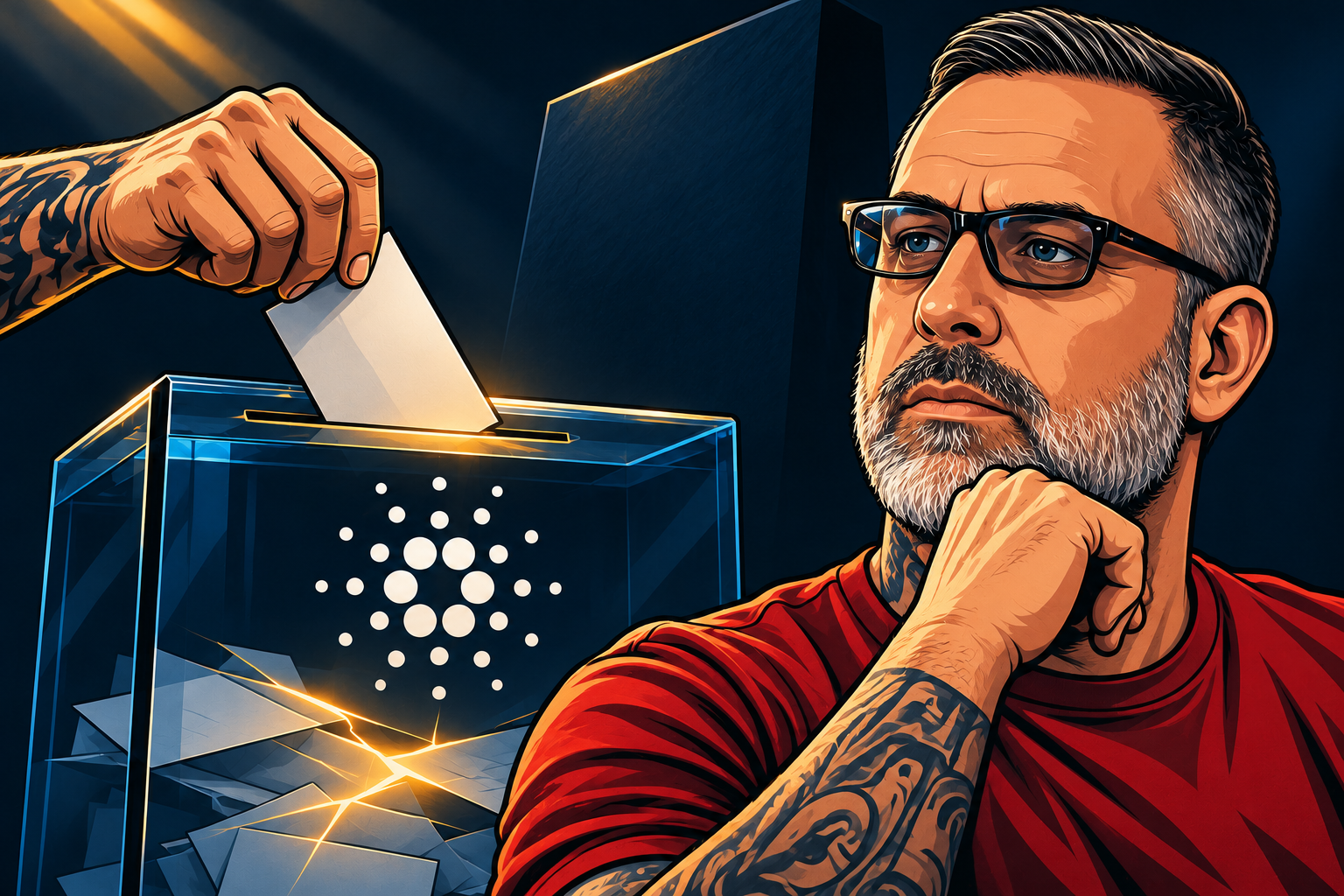
Jason Appleton, known as Crypto Crow, has voted against the Cardano Foundation’s request for treasury funding for international events in 2027. The delegated representative, or DRep, wants the Foundation to show what its previous spending has achieved before receiving more ADA from the treasury.
During his November 23 livestream, Appleton also discussed the relationship between Cardano and Midnight, his NIGHT trading positions and Bitcoin’s market cycle. He disclosed that Charles Hoskinson had asked to appear on his channel on December 15 to make several announcements.
Why Crypto Crow Rejected the Events Proposal
The Cardano Foundation has requested 24,995,775 ADA for its Global Events 2027 program. The proposal covers a Cardano presence at 12 conferences, side events, four hackathons and travel support for selected ecosystem projects.
The Foundation’s budget values ADA at $0.20, putting the planned cost at approximately $5 million. Appleton referred to a $3.6 million value during his livestream. The request is denominated in ADA, so its dollar value changes with the token’s market price.
Appleton’s objection goes beyond the choice of conferences. He wants the Foundation to demonstrate what its existing budget and past event spending have produced for Cardano.
He acknowledged that a presence at conferences can be useful. In his view, however, booths, photographs and meetings do not by themselves establish whether the expenditure delivered meaningful results.
Appleton contrasted his vote with his earlier approach to treasury decisions. He recalled wanting to support projects and give teams a chance to obtain funding and build useful products. Over time, he argued, he had not seen enough progress from some spending to justify continuing in the same way, particularly when assessing the Foundation’s work.
During the stream, he referred to a discussion about the Foundation having approximately 109 employees and an estimate calculated by dividing a budget by the number of staff. He acknowledged that the calculation did not mean each employee received that amount as a salary. His broader question was how an organization of that size allocates its resources and measures its contribution.
Appleton argued that the Foundation should change how it operates. He also suggested that, if it considers the events important enough, it could pay for them with its own resources. He did not present a restructuring proposal or identify a process for implementing one.
He emphasized that he wants the Cardano Foundation to succeed. He would welcome the opportunity to support its work, he explained, if he saw changes and results he considered more concrete.
The Foundation’s proposal includes figures from its previous events program. It reports 20 activities, participation by 79 ecosystem projects and engagement with 1,169 developers. The new treasury request still requires the necessary support through Cardano’s governance process before funds can be withdrawn.
Appleton also raised a concern about the distribution of voting power in connection with changes involving EMURGO and SecondFi Wallet. He described a scenario in which voting power could end up with the Cardano Foundation and argued that this would concentrate governance further. He presented it as a concern; he did not establish that such a transfer had been agreed or carried out.
Crypto Crow on Cardano, Midnight and Hoskinson’s Visit
A viewer asked Appleton whether he had changed his position on Cardano. He rejected the suggestion and drew a distinction between the blockchain and the Foundation.
“I am still bullish on Cardano, folks.”
Appleton also rejected the idea that his support for Midnight puts the two ecosystems in competition. He believes growth in Midnight applications and transactions could also benefit Cardano because of the networks’ relationship.
He referred to a recent X Space in which Hoskinson, in Appleton’s account, discussed their connected futures. Appleton disclosed that he holds more NIGHT than ADA, but argued that his holdings do not make the two ecosystems rivals.
To illustrate their relationship, Appleton read through a community post listing ways Midnight is connected to Cardano. The post described Midnight blocks referencing Cardano blocks, the use of Cardano infrastructure and a role for Cardano smart contracts in parts of Midnight’s governance.
It also identified NIGHT as a Cardano native asset and referenced Cardano’s Hydra technology in the Glacier Drop distribution. Appleton went on to mention the planned role of Cardano stake pool operators and ADA stake in Midnight block production after the federation phase.
He introduced the list as a way to help newcomers understand the connection. The role he described for stake pool operators concerns a planned phase after Midnight’s current federated model.
Appleton’s interest in Midnight also came up when he discussed a message from Hoskinson. According to Appleton, the Cardano founder contacted him on X and asked to appear on his channel on December 15 to make several announcements.
Appleton agreed to the proposed appearance. He told viewers that Hoskinson had not disclosed the contents of the announcements to him.
He also referred to a recent X Space where, in his account, Hoskinson compared one forthcoming announcement to the introduction of the iPhone. Appleton called that a bold comparison but did not identify a product or technology behind it.
From Hoskinson’s remarks, Appleton formed the impression that some announcements could concern work that is further along than the public knows. He described that as his own reading of Hoskinson’s tone, not as information shared with him privately.
[NEWSBREAK]
NIGHT Trading, Bitcoin’s Cycle and Regulation
Appleton also showed viewers an hourly NIGHT chart and discussed the positions he was holding as he watched the market.
At the time of recording, he expected the possibility of a move toward approximately $0.045. He described a long position alongside a smaller short position intended to hedge against a decline. He disclosed that one position had an unrealized loss during the stream.
Despite anticipating possible short-term weakness, Appleton was encouraged by how NIGHT had held within the range he was watching. His comments described his interpretation of the chart at the time of the broadcast.
A viewer also challenged Appleton’s view of Bitcoin’s four-year market cycle, arguing that the cycle had broken and that institutions would determine the timing of the next rally.
Appleton disagreed that the cycle had already broken. He considered it possible that Bitcoin’s recent decline toward $55,000 aligned with the timing of a cycle low, while acknowledging that he did not know whether it was the final bottom. He also discussed the possibility of a further decline.
His broader point was that market participants can construct a case for either direction at almost any price. He acknowledged that he could not determine with certainty where Bitcoin would reverse.
Appleton also discussed the changing relationship between financial institutions and cryptocurrency. In his interpretation, some institutions that once dismissed the industry later began building investment products around it. He voiced concern about the direction of future US regulation, including how legislation might address blockchain privacy.