Charles Hoskinson Links Crypto Regulation, AI Alignment, Midnight Privacy, XRP DeFi and Ethereum Developer Shifts in Wide-Ranging Interview
Charles Hoskinson discussed U.S. crypto regulation, retail investor access, AI model bias, Midnight’s privacy architecture, tokenized deposits, $XRP DeFi and developer movement inside major blockchain ecosystems during a new interview with Wendy O.
By SongMarketCap
Updated:
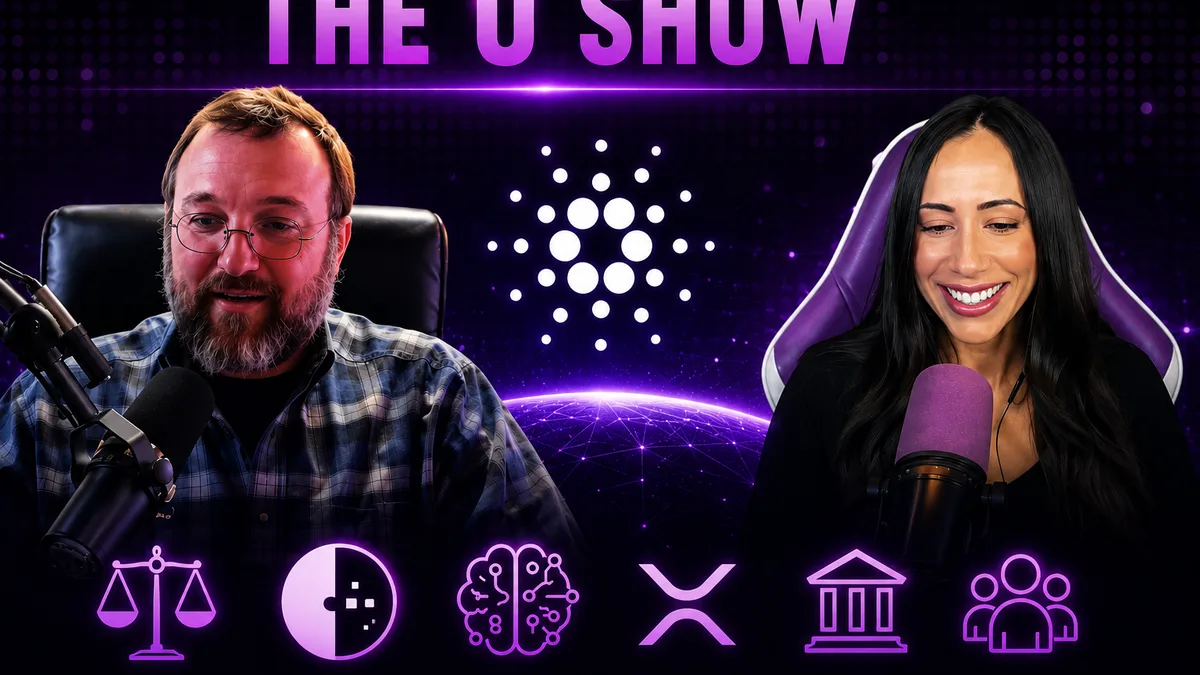
Charles Hoskinson used a new interview on The O Show with Wendy O to connect several of the most active debates in crypto, from U.S. regulation and retail investor access to AI alignment, Midnight, privacy infrastructure, institutional blockchain networks, $XRP DeFi and Ethereum’s developer landscape.
The conversation began with social media and the difficulty of communicating on X, but quickly moved into the regulatory, technical and market structure issues now shaping digital assets. Across the interview, Hoskinson described how open blockchain systems, privacy tools, compliance requirements and AI agents could intersect as crypto infrastructure moves beyond single-chain use cases.
Cardano, U.S. Crypto Regulation and Retail Investor Access
Hoskinson first addressed his attempt to reduce direct activity on X, saying the platform’s rules around AI-managed accounts create a difficult tradeoff for public figures. He said an account can face penalties if AI is used without declaring it as a bot, while declaring an account as a bot can reduce the reach of its posts.
Wendy O then raised the issue of Cardano marketing outside the usual crypto audience, including the possibility of submitting a proposal focused on Facebook and Instagram distribution. She said content distribution requires production support, editing, team overhead and ongoing coordination, while community reactions can become negative even when the stated goal is broader visibility for Cardano and Midnight.
The interview then shifted to U.S. crypto regulation. Hoskinson criticized the current direction of regulatory policy, especially the idea of moving broad crypto oversight toward the CFTC without giving the agency enough budget, personnel or transition time. He said the CFTC is much smaller than the SEC and operates with a different regulatory culture, which could create delays and uncertainty if it receives expanded authority over digital assets.
Wendy O focused on the gap between retail investors and accredited investors, arguing that current rules still create barriers for ordinary users. Hoskinson said investor protections could be redesigned around clearer default protections, while still allowing informed users to access certain assets under a different legal framework when they understand and accept the risks.
The discussion also covered crypto political action committees. Hoskinson said crypto companies have the right to organize politically, just as other industries do. Wendy O said she has not seen enough organized advocacy for retail investors, and Hoskinson responded that current crypto PACs largely represent large companies and their interests, while a retail-focused structure would need to be built separately.
Midnight Privacy, AI Alignment and Open Blockchain Infrastructure
AI became one of the central themes of the interview. Wendy O asked why governments appear more focused on regulating crypto while AI systems are being adopted quickly by the public. Hoskinson said the challenge with AI is not only potential harm, but the lack of a clear regulatory layer for systems that are nondeterministic, can hallucinate and do not consistently apply higher-order reasoning.
Hoskinson said one possible path is to combine modern AI with older symbolic AI concepts, creating a reasoning layer that can help constrain behavior. He connected that point to blockchain, saying zero-knowledge proofs could be used when AI systems perform sensitive actions involving money, permissions or irreversible outcomes.
He also discussed bias in large AI models, saying users often do not understand the political or value assumptions embedded in different systems. Hoskinson referred to differences between models such as Grok, ChatGPT, Claude and Microsoft products, and said users need better ways to understand how a model behaves under challenge-and-response testing.
That AI discussion led directly into Midnight. Hoskinson described Midnight around four main areas, rational privacy, unified privacy tools, abstraction and agents. He said rational privacy is focused on selective disclosure and enhanced compliance, especially for real-world assets and Web 2.5 finance. He also said developers should not have to manage a fragmented privacy stack filled with separate technologies such as multi-party computation, homomorphic encryption, network anonymization and zero-knowledge systems.
Hoskinson named Midnight City and Midnight Passport as two products designed to show those ideas in practice. He described Midnight Passport as a technology that could allow users to interact across ecosystems such as Bitcoin, Ethereum, Solana and Cardano, while paying transaction fees in different cryptocurrencies and using Midnight as a privacy and coordination layer.
The interview also touched on closed institutional blockchain networks, including Canton. Hoskinson criticized permissioned systems that rely on invitation-only access or closed institutional groups. He contrasted those systems with open standards, saying open networks are better positioned for global use because outside banks, regional institutions and independent participants are not dependent on a central gatekeeper.
XRP DeFi, Tokenized Deposits and Ethereum Developer Movement
Hoskinson also discussed regulated financial products coming to Midnight. He mentioned Monument Bank and said the bank is tokenizing 250 million pounds of deposits through Midnight. He connected that to Web 2.5 finance, where regulated institutions want blockchain infrastructure with privacy, compliance and selective disclosure.
Wendy O asked whether Midnight could become a competitor to Ripple. Hoskinson said he does not primarily view Ripple as a competitor and described the Ripple ecosystem as a potential area of growth. He said Ripple does not have a native smart contract system and raised the question of how the value held in $XRP could be used for DeFi and yield opportunities.
According to Hoskinson, Midnight could support XRP DeFi by allowing users to interact with DeFi applications, use privacy infrastructure, pay fees in the assets they already hold and return to the asset they prefer. He described Midnight’s broader role as a decentralized middle layer rather than a system that forces users or institutions to migrate fully into one ecosystem.
AI agents were another central technical topic. Hoskinson said most cryptocurrency activity and transactions could become agentic by 2035, meaning software agents would execute many actions on behalf of users. He said agents will need to prove that they are satisfying user intent before performing sensitive actions. In his words, the language of agents is proofs, because an agent needs to demonstrate that it is doing what the user asked it to do.
The final part of the interview moved to Ethereum and developer departures from the Ethereum Foundation. Hoskinson said the same pattern exists in AI, where early research groups and foundations attract strong talent, but that talent later becomes highly valuable to startups and venture-backed companies. He said nonprofit foundations often cannot match the compensation packages offered by private companies.
Hoskinson did not describe Ethereum as a failed ecosystem. He said Ethereum still has major market value, strong brand recognition, large total value locked, a significant roadmap and serious work in zero-knowledge technology. He also noted that Cardano and Ethereum differ on staking, governance, UTXO versus account models and development processes.
The interview closed with a discussion about social media polarization, public attacks and short clips being used to create hostile narratives. Hoskinson said online platforms amplify a lack of empathy and often reduce public figures to isolated moments. He ended by directing viewers to Midnight City and said he plans to publish a whiteboard video about agentic civilizations, bringing the interview back to its main technical throughline, AI systems, blockchain proofs, privacy infrastructure and financial networks designed to operate across multiple ecosystems.