Charles Hoskinson Details Cardano Governance Discord Plan, Constitution v2 and Treasury Reform
Charles Hoskinson used the third part of his Discord series to describe a broader Cardano governance framework involving moderated discussion spaces, anonymous participation, AI supported coordination, political organization, growth metrics, Constitution v2 and a proposed annual treasury budget model.
By SongMarketCap
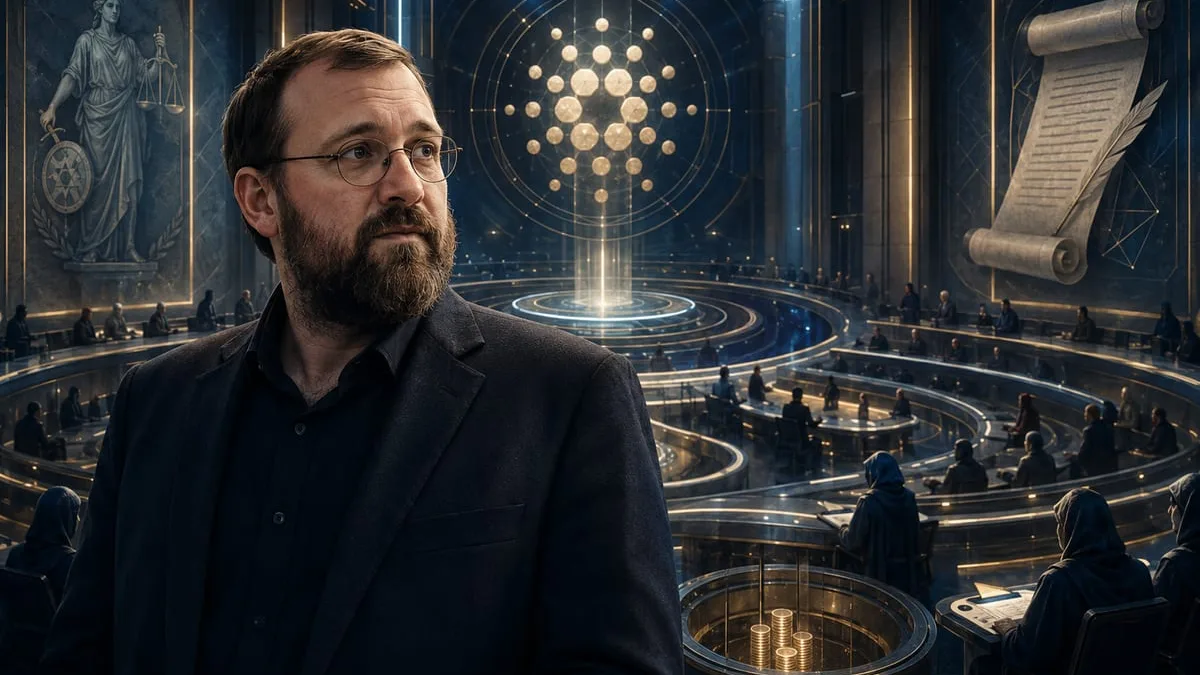
Charles Hoskinson published the third part of his Discord series on June 15, 2026, expanding the discussion from a dedicated Cardano Discord into a wider governance reform proposal. The video covered how a governance Discord could operate, why Hoskinson wants structured and moderated conversations, how anonymity and zero knowledge tools could be used, and how the process could connect to political organization, treasury funding, Constitution v2 and executive function inside Cardano.
Cardano Governance Discord Would Use Rules, Moderation and Anonymous Participation
Hoskinson said the initiative is currently in stage one, which he described as the ideation phase. According to the video, Input Output, Virgo and selected participants are working on the purpose of the initiative, staffing, moderators, tooling and the RACI structure. He described RACI as the framework for defining who is responsible, accountable, consulted and informed.
The proposed Discord is not intended to operate as a general purpose community chat. Hoskinson described it as a dedicated space for Cardano governance conversations, designed to move early governance discussions out of unmoderated channels and into a setting with rules, structure and defined outcomes.
He said one of the problems with current public discussion is that unformed ideas can be taken from a private or semi structured conversation, leaked to X and presented as if they are already decided. To illustrate the problem, he used a hypothetical example in which someone raises the idea of issuing more ada.
Hoskinson repeatedly said this was only an example and not a proposal, using it to explain how a controversial comment can be turned into a public scandal before any real governance process has taken place.
Hoskinson said this is why some governance conversations need a form of Chatham House Rules. Under that model, information from a discussion can be used, but the identity or affiliation of the speaker cannot be revealed. He said Cardano governance needs a space where participants can discuss options without being personally targeted for early, controversial or incomplete ideas.
He connected that model with zero knowledge technology. In the structure he described, Discord would serve as a larger pool of approved participants, while individual governance events could allow people to prove they belong to that pool without revealing who they are inside a specific conversation. According to Hoskinson, this would reduce attribution attacks, retaliation and selective leaking.
The same anonymity layer could also support voting. Hoskinson mentioned Semaphore, an open source anonymous voting framework from the Ethereum ecosystem, and said similar systems could be ported to Midnight and used in Cardano. He said such tools may work better on Midnight than on Ethereum, linking the Discord plan to privacy infrastructure and zero knowledge based participation.
Hoskinson also described how conversations would be structured. He referred to Holacracy and governance circles, where people participate based on relevant expertise and defined goals. Before a governance conversation begins, the process would identify what information is needed, which personas should be present and what the ideal outcome should be. During the conversation, a facilitator would guide the process, and Hoskinson said an AI facilitator could also help keep the discussion aligned with the defined goal.
After each conversation, the system would produce an output. Hoskinson referred to a newsletter, journal or event log as possible ways to broadcast the results of governance discussions. He also said the process could create a governance knowledge graph, forming a structured record of Cardano governance conversations, topics, decisions and status.
From that data, Hoskinson proposed the possibility of a Cardano LLM, a tuned open model with knowledge of governance discussions and ecosystem status. He said such a model could become a public good and could be integrated into wallets and social infrastructure, giving users a single source of truth for governance status and accountability.
The video also covered token gated access. Hoskinson mentioned tools such as Collab Land from the Ethereum ecosystem and said Cardano could build an equivalent system to verify that participants are actual ada holders. He also described merit based incentives, including NFTs, badges and other recognition mechanisms for service inside the governance process.
Political Organization, Funding Rules and Constitution v2 Were Presented as One Framework
Hoskinson said the proposed system needs “teeth” if it is going to attract serious participation. He connected that point to the possible creation of a political party inside Cardano governance.
Addressing the question of whether he would become a DRep, Hoskinson said he would only do it if there was a political party. One condition he gave for such a party was that it would automatically vote no on all funding proposals unless the applicants joined and participated in the governance Discord. He described this as an example of how enforcement power could be added to the system.
Hoskinson tied that position to accountability. He said that if a project wants to receive public funds from the Cardano treasury to improve and grow Cardano, then it should also be part of the accountability process. He said governance conversations should address the budget of Cardano, the strategy of Cardano, ecosystem verticals, infrastructure priorities and which dApps should be prioritized.
The video then moved from Discord operations to broader constitutional governance. Hoskinson said one of the first uses of the system should be to define Cardano growth metrics. He said Cardano does not have a good definition of growth and that outside voices, X arguments, rage bait and podcasters are filling that gap. In his framing, Cardano cannot market itself effectively without a shared definition of what the ecosystem wants to become over five, ten or fifteen years.
He used Leios as an example. Hoskinson said it is not enough to market Leios as a technology in isolation. He said it must be connected to a growth philosophy, such as solving the blockchain trilemma while preserving decentralization. He said that kind of target should be reflected in the preamble of the Cardano Constitution.
Hoskinson then introduced executive function as another required element. He said Cardano needs structures that are accountable and responsible for execution. He connected growth metrics and executive function to what he called Constitution v2, describing it as the next major version of Cardano’s constitutional framework.
The third part of the proposed structure was strategy, accountability and budget. Hoskinson said he wants Cardano to move toward one treasury withdrawal per year. Under that model, the annual withdrawal would function as the budget, while dedicated funding organizations would operate inside that budget with their own processes.
He referred to Catalyst like mechanisms, dedicated grant agencies, the Orion Fund and a sovereign wealth fund as possible examples of funding organizations. His argument was that DReps should have one major annual budget decision instead of many separate debates over individual proposals.
Hoskinson criticized the current direct democracy model, saying that anyone can propose anything at any time and that the ecosystem has seen more than 600 million ada in proposals. He said every rejected proposal can create an enemy because applicants may view DReps who vote against them as adversaries. He described the result as an “adversarial, toxic hellscape of a culture.”
He also anticipated criticism of his proposal. Hoskinson said some people would claim he wants total control over the money, but he said that was not what he stated. He argued that broadcast platforms are not suitable for these discussions because they are built for rage, algorithms, clickbait and winners and losers. By contrast, he described the proposed Discord process as a structure designed for discussion, compromise and documented outcomes.
Strict Moderation, DRep Exhaustion and Hoskinson’s Return to Leadership Framed the Closing Message
Hoskinson said the proposed Discord would not be a general purpose communication channel. He said everyone who holds ada would be welcome, but only under rules. Participants would be bound by a code of conduct, and violations could lead to removal from the Discord.
He described three stages for the rollout. Stage one is the current ideation phase. Stage two would be a closed beta with core entities and selected participants, focused on testing tools, building systems and possibly running a hackathon for community tooling. Stage three would open the system to broader participation, but inside a tightly moderated channel.
Hoskinson said the space would not be used for general attacks on him, EMURGO, the Cardano Foundation or other entities. He said people who want to ask those kinds of “tough questions” can use X, Reddit or other channels. The proposed Discord, in his words, would be a specialized space for achieving governance goals and creating outcomes. He also said people would not be allowed to “shitpost” in the Discord.
To explain the model, he used the analogy of a surgical theater and a library. In his comparison, a surgical theater is not designed for unrestricted speech, but for surgery. A library is not designed for clanging pots and pans, but for focused work. He said the governance Discord would serve a similarly specific function, supporting conversations that increase the chance of successful Cardano governance outcomes.
Hoskinson also said Discord does not need to be the permanent end state. He called it a minimum viable product because it is always on, scalable, usable on phones, easy to moderate and practical to launch without turning the effort into an academic experiment. He said Cardano has often started with perfection and failed to finish, while the proposed approach would begin with something usable and later move toward more decentralized infrastructure, open source tools or Cardano native systems.
The final part of the video focused on the condition of current governance participation. Hoskinson said people are exhausted and that some DReps and contributors are leaving. He mentioned Pete and Cash as examples of people who have expressed frustration. He said Cardano is losing people who care about the ecosystem because the process beats them down repeatedly.
He described the current process as an “energy vampire,” saying it takes people’s time, energy and morale without giving anything back. He said Cardano has strong people, strong technology and the capacity for vision, but that the current participation environment is damaging the ecosystem.
Hoskinson used direct language to describe the urgency of the situation. He said participation is no longer optional, that Cardano is in a “do or die” moment and that the wider industry is asking whether Cardano will “get its shit together or not.” He pointed to falling price, falling adoption, weaker metrics and the shutdown of projects such as TapTools as part of his argument that the current process is not working.
During the livestream, Hoskinson also responded to comments from live chat. One comment, as he described it, suggested that Charles should leave and that things would then improve. He responded by asking where the conversation would then happen, who would build it, how people would be brought together, how consensus would be reached, how the ecosystem would get to 67 percent support and how the Constitution would be changed. He said that kind of voice, in aggregate, is holding the ecosystem hostage.
He also referred to the 2025 audit process. Hoskinson said he had tried to provide transparency, spent 2 million dollars on an audit report, brought in auditors and that the report, in his view, showed Input Output had tried to do the right thing over a ten year period. He said some critics responded by calling the auditors corrupt instead of debating the report’s contents.
Hoskinson said this is why he wants to move to a channel where outcomes matter more than personalities. He said he will push forward with the process regardless of how many people join. If enough people come along, he said the process can help save Cardano. If not enough people join, he said he will still be at peace because he tried.
He closed by saying he does not want to be a king, president or the sole face of the ecosystem, but that he needs to lead. He said the first step is correcting the process of participation, followed by upgrading Cardano governance, creating an executive function, defining growth metrics, preparing Constitution v2 and building a structure for strategy and budget execution. Hoskinson ended the video by saying he is back, that it is time to lead again and that the next stages will test whether Cardano can move from public conflict toward a governance process built around strategy, accountability and execution.