Cardano’s CIP-113 Pushes Native Assets Toward Regulated Tokenization
CIP-113 is still moving through the standardization process, but it shows how Cardano could give native assets programmable rules for stablecoins, RWA tokens and compliance-aware transfers without changing its core ledger model
By SongMarketCap
Updated:
Cardano Native Assets Need a Programmability Layer
Cardano’s native asset model has always been one of its clearest architectural strengths. Tokens are not treated as isolated smart contract objects inside individual applications, they are part of the ledger itself. That gives Cardano assets simplicity, efficiency and a security profile that many account-based systems must recreate through additional contracts.
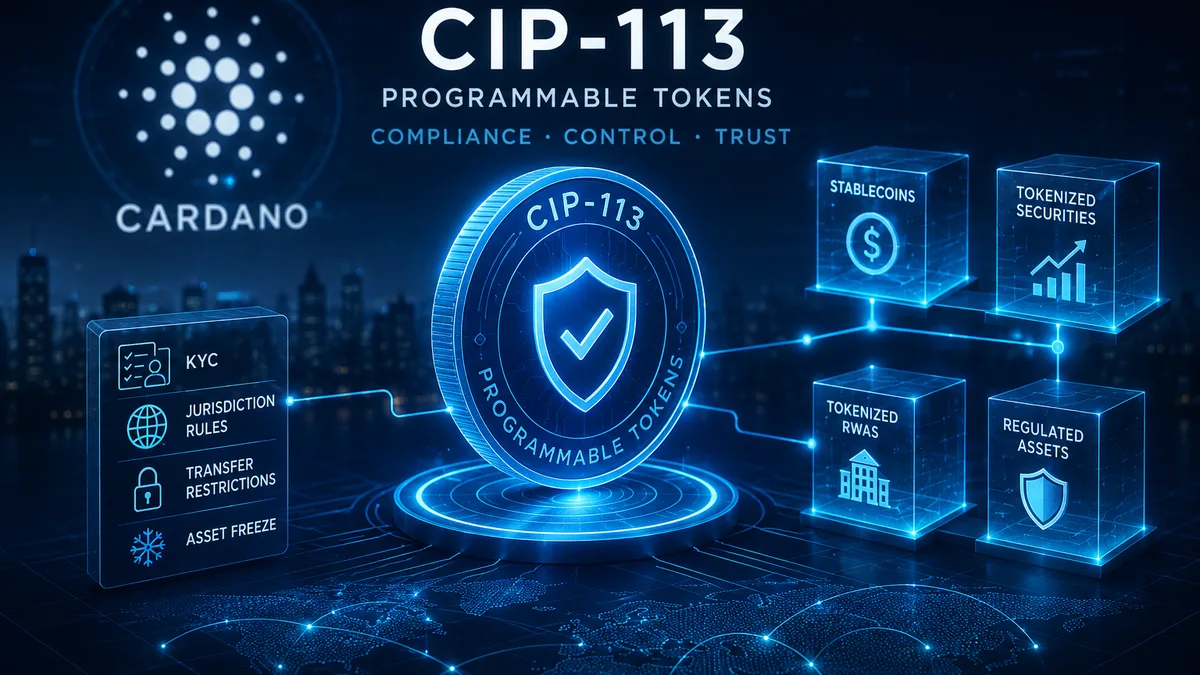
That same strength creates a limitation. A classic native asset can move freely, which works well for open tokens, NFTs and decentralized applications. It is less suited for institutional stablecoins, tokenized securities, commodities, funds or regulated assets, where issuers may need transfer rules, jurisdictional restrictions, KYC or AML logic, asset freezes or responses to legal orders.
CIP-113, also referred to as CIP-0113, is Cardano’s attempt to address that gap.
The Cardano Foundation describes it as a framework that allows tokenized assets to support customizable on-chain compliance rules, including transfer restrictions and asset freezes, while remaining Cardano native assets. The standard has been presented as a modular framework for regulated equities, commodities, stablecoins and other tokenized assets that need more than unrestricted token movement.
CIP-113 is not finalized. Pull request #444 in the official Cardano CIPs repository remains open, while the implementation repository describes the standard as being under active development, with the specification still subject to change.
That makes the current work important as a direction of travel, showing how the Cardano Foundation is trying to standardize programmable rules before broader production use.
The timing matters. The crypto market is moving deeper into stablecoin infrastructure, tokenized assets and regulated financial products. Those segments cannot rely only on unrestricted token transfers. If Cardano wants a serious role in that market, its native asset model needs a way to support regulated tokens without losing the architectural advantages that make it different.
CIP-113 Adds Rules Without a Hard Fork
The key technical point is that CIP-113 does not change Cardano’s L1 model. Programmable tokens remain Cardano native assets, but receive an additional validation layer for transfers, minting and burning. The implementation uses existing Cardano infrastructure, Aiken smart contracts and a modular design, instead of requiring a hard fork or changes to ledger rules.
That distinction matters. Cardano is not trying to copy compliance token designs from account-based networks. It is trying to preserve native assets while adding programmable rules through a shared validation framework. The goal is not to replace Cardano’s token model, but to extend it for use cases where free transferability is not enough.
The core framework defines shared infrastructure, including a shared custody model, an on-chain registry and validation coordination. The specific rules come through substandards. CIP-113 is therefore not simply a KYC standard. It is a broader programmable token framework where KYC flows, denylists, allowlists, freeze-and-seize logic or permissioned transfers can be attached as rule sets.
During a recent Cardano developer showcase, the Cardano Foundation’s Ecosystem Engineering team demonstrated how a KYC-aware flow could work in practice. The model uses trusted entities, off-chain credential verification and a signed payload that is then used in the transaction. Sensitive identity checks do not need to live entirely on-chain, while the smart contract can still verify whether a transfer is allowed under the defined rules.
That approach targets a real institutional requirement. A bank, stablecoin issuer or tokenization platform does not only need an asset that exists on-chain. It needs an asset that can follow rules, prove control, restrict invalid transfers and remain readable to wallets, explorers, exchanges and users.
Regulated Tokenization Will Depend on Integrations
CIP-113 matters because regulated tokenization is becoming one of crypto’s largest infrastructure debates. Stablecoins, tokenized securities, real world assets and regulated assets will not grow only because transactions are fast or fees are low. They need standards that can connect open blockchain infrastructure with the rule-based environment of traditional finance.
The same logic can extend beyond finance. A tokenized music or media asset, for example, may need more than proof of collectible ownership. If a token represents licensing access, revenue participation or restricted distribution rights, the issuer may need rules around who can hold it, how it can move and when those rights remain valid. That makes CIP-113 relevant not only for financial assets, but also for media, digital rights and the creator economy.
The Cardano Foundation lists stablecoins, tokenized securities, regulated assets and tokenized RWAs as key use cases for programmable tokens. The implementation documentation also points to permissioned transfers, on-chain registries, composable logic, optional issuer controls and extensible support for denylists, allowlists, time-locks and custom policies.
The risk is integration. The shared script address model and stake credential ownership mean that wallets, explorers and DEXs need additional support to display and process programmable tokens correctly. A wallet has to identify the real asset owner, an explorer has to show the relationship between an address, stake credential and asset, and a DEX has to recognize when a transfer is blocked by additional rules.
Rosetta support shows why this is not only a smart contract issue. The Cardano Foundation already has an open issue for CIP-113 support in cardano-rosetta-java, including transfer, balance and construction models. That matters for exchanges and institutional integrators that need predictable infrastructure before supporting a new class of programmable assets.
The core story is standardization. Cardano is building a framework that could give native assets programmable rules for regulated use cases, but the value will depend on adoption by wallets, explorers, indexers, Rosetta integrations, exchanges, DEXs, auditors and actual issuers.
The test is simple: programmable assets must feel like Cardano assets, not a separate class of tokens that only specialists understand. If CIP-113 matures, passes audit and gains real integrations, it could give Cardano a standardized path into regulated tokenization while preserving the native asset architecture that made the model valuable in the first place.