Cardano’s ₳62.1M Maintenance Proposal Turns Network Reliability Into a Treasury Test
Input Output Group is asking the Cardano treasury to fund core maintenance from Q3 2026 to Q1 2027, making one of the ecosystem’s least visible jobs one of its most important governance decisions.
By SongMarketCap
Updated:
Cardano Maintenance Moves Into the Treasury Spotlight
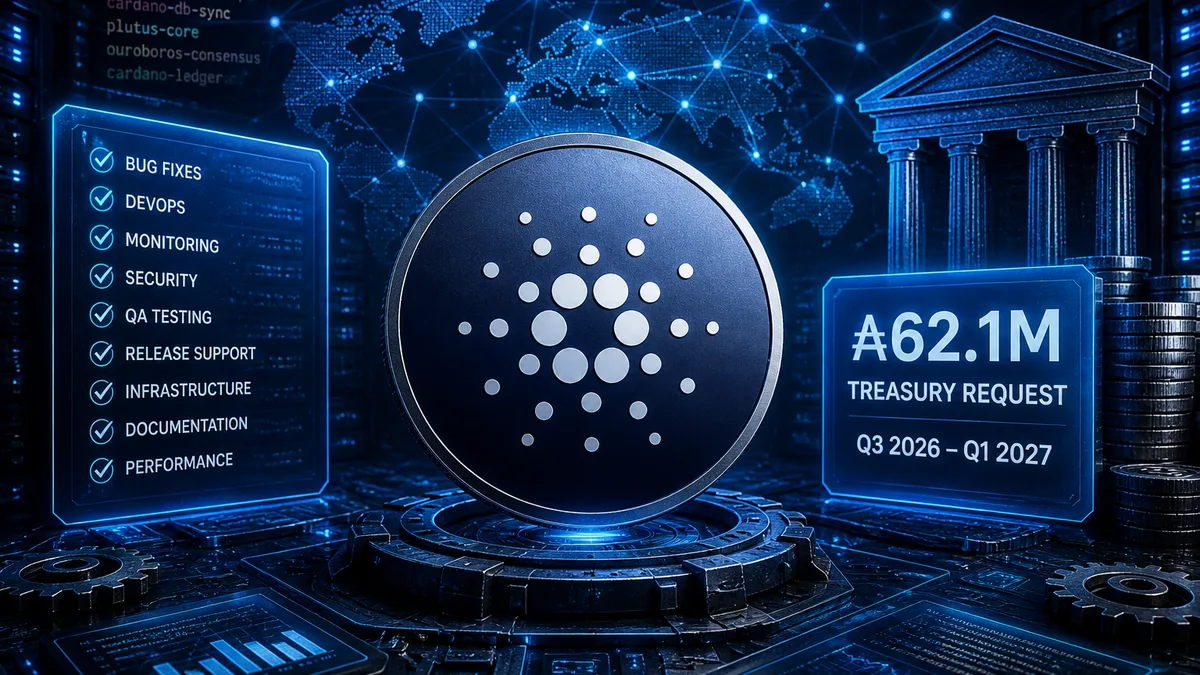
Input Output Group has submitted a Cardano Maintenance proposal through the Momentum platform, requesting ₳62,134,630 from the treasury to support the network’s core technical infrastructure from Q3 2026 through Q1 2027.
The proposal is significant because it does not promise a new wallet, application, bridge or user-facing product. Instead, it focuses on the work that keeps Cardano operational, secure and usable, bug fixing, monitoring, DevOps, testing, release support and maintenance of critical components across the stack.
That makes the proposal politically sensitive. Maintenance is essential, but it is also difficult to market. Users notice when a network fails, but they rarely see the engineering work that prevents failure. For Cardano governance, this creates a serious test, how much should the community pay for infrastructure work that is mostly invisible when it is done well?
What the Cardano Maintenance Proposal Actually Funds
The proposal covers nine functional areas across the Cardano ecosystem, including node bug fixing and architecture, DevOps and infrastructure, monitoring, documentation, open source support, performance optimization, quality assurance, release support, security and maintenance of key components.
The listed work includes CI/CD systems, operating system and platform compatibility, Haskell compiler support, disaster recovery planning under CIP-135, testnet maintenance, mainnet monitoring, global mempool monitoring, Cardano Blueprint documentation, GitHub issue triage, performance benchmarking, Plutus Core interpreter updates, DB-Sync consistency and Cardano API and CLI support.
This is not structured like a one-time product build with a single launch moment. It is continuous operational work across the funded period. In practical terms, the proposal is about preserving the base layer that stake pool operators, developers, exchanges, wallets, DApps and users rely on every day.
Why ₳62.1M Demands More Than Automatic Approval
The case for maintenance is strong. Cardano cannot support governance, DeFi, tokenization, partner chains or institutional use cases if the core network is not actively maintained. A serious blockchain needs disciplined engineering behind the scenes, not only visible ecosystem expansion.
But essential work should not mean automatic approval. A ₳62.1M treasury request requires clear scrutiny from DReps and the wider community. The question is not whether Cardano needs maintenance. It does. The real question is whether the proposal gives enough clarity on cost structure, team allocation, measurable deliverables, accountability and expected outcomes.
That distinction matters. Supporting Cardano infrastructure is not the same as writing a blank check. If approved, this proposal would fund the quiet technical work that keeps the network stable. If challenged, it should be challenged on budget discipline and transparency, not on the false idea that maintenance is optional. This is why the Cardano Maintenance proposal is one of the clearest tests yet of whether on-chain governance can responsibly fund the work users only notice when it stops.