Cardano V11 “Van Rossem” Hard Fork Goes Live on Preview as Plutus Expands Cryptographic Capabilities
Cardano V11 introduces new Plutus primitives for advanced cryptography and multi-asset logic, while becoming the first governance-driven intra-era hard fork activated through the Voltaire process.
By SongMarketCap
Updated:
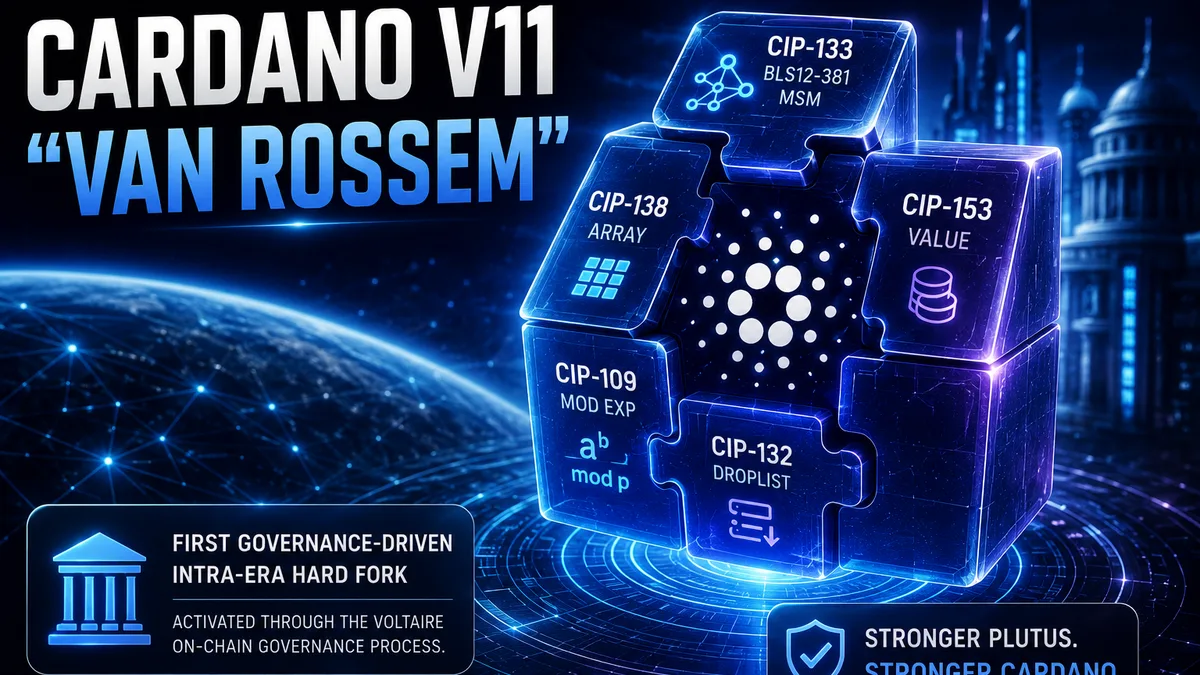
Cardano V11 Brings New Plutus Primitives to Preview
Cardano V11 “Van Rossem” is now active on the Preview testnet, marking one of the most important technical upgrades in Cardano’s current roadmap. The upgrade does not introduce a new ledger era. Instead, it moves Cardano forward through an intra-era hard fork, extending the existing Conway infrastructure without
changing the basic shape of the network.
According to Intersect’s upgrade documentation, V11 introduces several new Plutus capabilities through CIP-138, CIP-153, CIP-109, CIP-132 and CIP-133. These include native array handling, optimized multi-asset value operations, modular exponentiation, efficient list dropping and multi-scalar multiplication over BLS12-381 cryptography.
The practical value is not that Cardano is adding more functions to Plutus. The larger point is that operations which were previously expensive, complex or impractical can now move closer to the Plutus execution layer. For developers, that means a stronger base for writing validators that work with structured data, Cardano native assets, cryptographic proofs and more complex transaction logic.
Plutus Gets a Stronger Base for ZK and Advanced Cryptography
The most important technical signal in V11 comes from CIP-133 and CIP-109. CIP-133 introduces multi-scalar multiplication over BLS12-381, a key operation for pairing-based cryptography, ZK proof systems, BLS signature aggregation and advanced on-chain verification models.
This does not mean Cardano instantly becomes a ZK blockchain. It also does not mean bridges, identity systems or proof-based applications are automatically ready for production. The confirmed change is more precise: Plutus now has better primitives for workloads that were previously difficult or too costly to verify on-chain.
Official CIP-133 benchmarks show that optimized multi-scalar multiplication can become more than 25 times faster at larger input sizes compared with naive implementations previously used in Plutus scripts. That matters because some larger verification workloads were not only expensive before V11, they were close to impractical within transaction limits.
CIP-109 adds modular exponentiation, which matters for finite-field arithmetic, modular inverses and cryptographic protocols used in ZK and signature systems. Together with CIP-153, which introduces a native MaryEraValue type for multi-asset operations, V11 gives Cardano developers a cleaner and more efficient foundation for DeFi, token logic, NFT infrastructure and advanced proof-based applications.
In practical terms, V11 reduces the computational friction around proof verification and complex multi-asset validation, two areas that previously pushed Plutus developers toward expensive workarounds or off-chain computation. That makes the upgrade especially relevant for teams building more advanced validators, proof systems, partner chain tooling and applications that depend on precise native asset accounting.
Van Rossem Tests Voltaire Governance in Practice
V11 is also important because of how it is being delivered. Intersect describes Van Rossem as a governance-driven intra-era hard fork, meaning the upgrade is coordinated through the Voltaire-era on-chain governance process. Intersect’s Hard Fork Working Group coordinates technical readiness, while activation depends on formal governance actions and the required on-chain approvals.
That makes V11 more than a Plutus upgrade. It is also a test of whether Cardano governance can coordinate real protocol evolution through a transparent, community-facing process. Previous major upgrades were strongly coordinated by development entities with community input. Van Rossem moves that
responsibility closer to the governance system itself.
The rollout still has operational dependencies. SPOs must upgrade to cardano-node v11.0.1 before mainnet activation, and ecosystem tools such as indexers, wallets, DB-Sync, Ogmios and other infrastructure components need readiness checks. Existing dApps do not require automatic redeployment because the upgrade is additive, but developers who want to use the new primitives must test them properly on testnets.
That is why Van Rossem matters beyond its release notes. It expands what Plutus can efficiently verify on-chain, while putting Voltaire governance in charge of a real technical upgrade path. If Preview, PreProd and mainnet activation move through the process cleanly, V11 will stand as one of the first concrete tests of whether Cardano’s governance system can function not only as a voting layer, but as the operating process for protocol evolution.