Cardano Summit 2026 Falls Short by 1.46 Percent as Voltaire Gets Its First Major Treasury Test
The revised Cardano Summit 2026 proposal failed to reach the required treasury withdrawal threshold, while responses from the Cardano Foundation, Charles Hoskinson, DReps and the wider community showed how governance looks when a decision has real consequences.
By SongMarketCap
Updated:
June 1, 2026
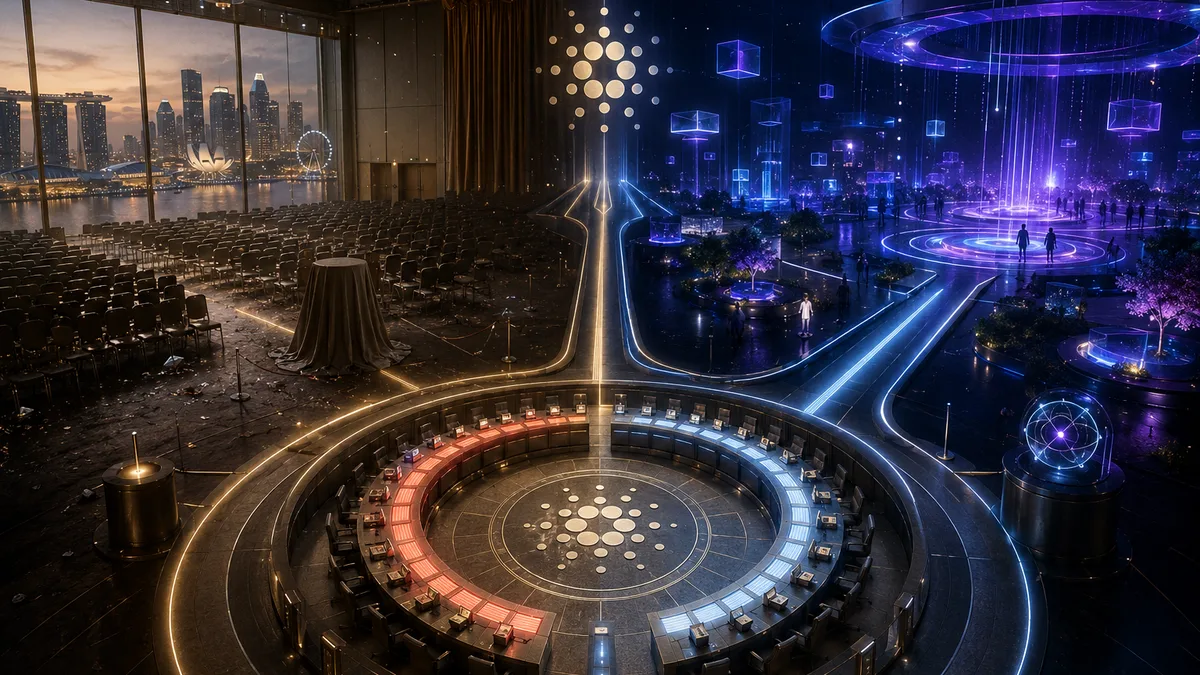
Cardano Summit 2026 will not take place this year after the revised 7.8 million ADA treasury withdrawal proposal failed to reach the required approval threshold. The proposal received 65.21 percent support from DRep stake, but needed 66.67 percent to pass.
The difference was only 1.46 percent, but that was enough to stop the proposal.
According to data from adastat.net, the vote ended with 135 Yes, 61 No and 24 Abstain delegates. The Yes side represented approximately 2.76 billion ADA in stake, while the No side represented approximately 1.47 billion ADA. The Cardano Foundation abstained on its own proposal, leaving the final outcome in the hands of DReps and the community.
The result showed that Cardano’s treasury process can stop a large and widely supported proposal if it fails to cross the required governance threshold.
Cardano Governance Accepted the Summit Result
The most important official response came from the Cardano Foundation. After the vote, the Foundation said governance requires not only participation, but also a commitment to accept collective decisions. It added that the Cardano community had spoken, that it respected the outcome and that the proposed Cardano Summit 2026 would not take place this year.
The Summit had clear arguments in its favor. Global visibility, networking, institutional presence and the ability to bring ecosystem projects together in Singapore all carry real value for Cardano. @YoroiWallet DRep supported the proposal, arguing that a flagship summit is important for Cardano’s growth and visibility.
The vote still showed that visibility alone is no longer enough. In the new governance environment, the treasury is being treated as shared capital, and major spending proposals must pass a detailed test of value, priority and justification.
NO voters did not necessarily reject Cardano events as a category. Most criticism focused on the size of the budget, the structure of the proposal and the timing of the request.
@GAIAstakepool, which voted No, argued that the Summit was supposed to be sustainable through earlier funding and that very little room remained in the 2026 NCL for community builders. The same response called on the Cardano Foundation to use its own genesis ADA and direct more support toward builders.
@InputEndorsers highlighted the governance side of the decision. According to its reaction, the key point was that the Cardano Foundation had enough ADA to influence the outcome, but abstained and left the final decision to the community.
@VirtualBacon summarized the tension in a simple dilemma: Cardano voted down its own Foundation’s summit, 65.21 percent supported it, 66.67 percent was required and the proposal still failed. His assessment, that this was either governance working or governance eating itself, captured the divided reaction around the decision.
A clear pattern emerged from those responses. Some DReps wanted stronger ROI, tighter treasury spending discipline, a clearer connection to builder funding priorities and a stronger case for withdrawing funds from the Cardano treasury.
Charles Hoskinson Opened an Alternative Path Through TOKEN2049
After the proposal failed, Charles Hoskinson did not challenge the decision from DReps or the Foundation. Instead, he opened a discussion about whether Cardano could scale up its presence at TOKEN2049 through an embedded MiniSummit, a hackathon with a large ADA prize and a stage for Cardano venture projects.
The conversation quickly shifted toward alternatives. The focus moved away from the failed proposal and toward a smaller, more flexible and more targeted format.
EMURGO’s separate TOKEN2049 proposal passed through governance. The proposal, titled Cardano at TOKEN2049 Singapore 2026: Baseline Platinum Sponsorship Proposal, was ratified as a separate initiative from the Summit. That keeps Cardano’s path to Singapore open, but through a differently structured presence.
The Summit vote did not close the door on international promotion for Cardano. It rejected one specific funding model, not the broader idea of being present at major industry events.
Midnight.city Adds a New Question for Cardano Gatherings
Another discussion emerged through @NightSwap’s proposal for a virtual Cardano Summit in Midnight.city. Charles Hoskinson publicly reacted to the idea and described it as very interesting, suggesting that such a format could work like a digital world’s fair, with dedicated zones for different dApps and projects.
The proposal has not been confirmed as a replacement Summit. It has, however, opened a new discussion about how Cardano can bring together a global community without depending only on one physical event.
After the physical Summit proposal failed, part of the community began considering formats that could be more accessible to a global audience, easier to scale and more natural for a Web3 environment.
Cardano has now passed through an important Voltaire test. The revised Summit proposal did not reach the treasury threshold, the Foundation accepted the outcome, Charles Hoskinson opened space for alternatives and DReps made clear that they expect stricter discipline when shared funds are used.
Cardano’s treasury is entering a phase where support no longer comes from the reputation of a proposal, but from its ability to convince the community.
The failed Summit vote did not remove Cardano from the global conference calendar. It moved the debate toward funding discipline, more targeted event formats and stronger justification for large treasury requests. If TOKEN2049, a MiniSummit, a hackathon or a Midnight.city format develops further, this vote may become the point where Cardano’s event strategy shifted from tradition to governance-tested execution.