Cardano Product Map Takes Shape Around Midnight City, Wallet Insurance, Leios and RealFi
Charles Hoskinson used a new appearance on The Breakdown to connect Midnight City, wallet insurance, Leios, RealFi and partner chains into a wider product strategy for Cardano.
By SongMarketCap
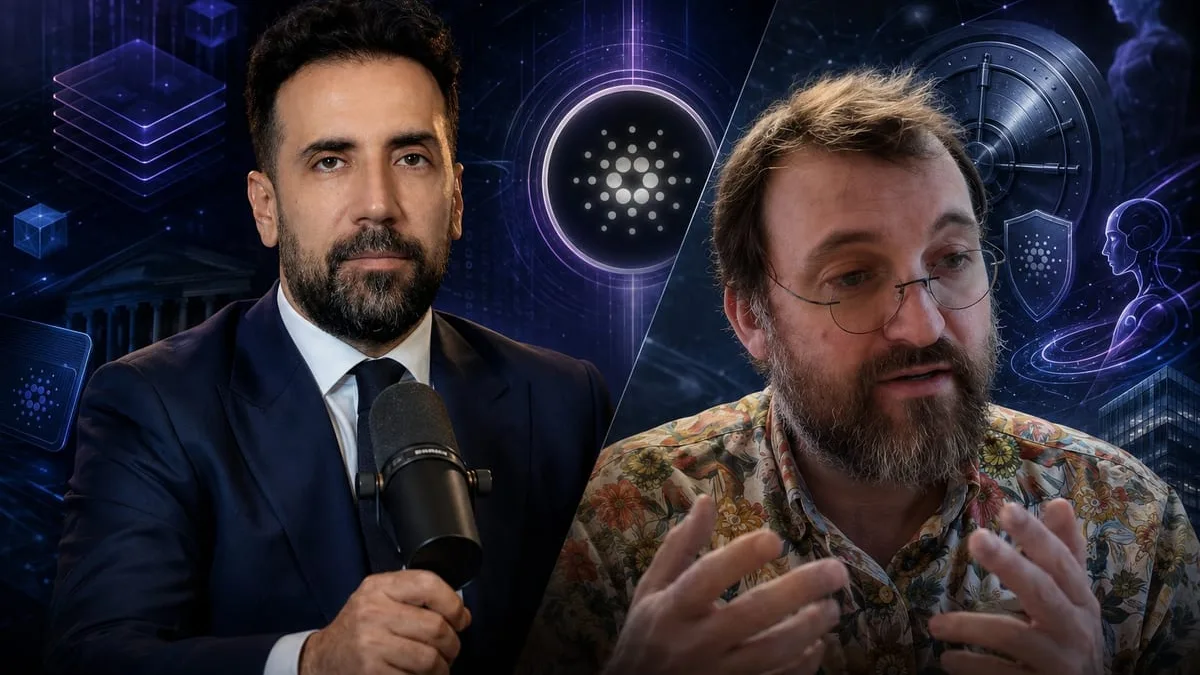
Cardano’s next phase is being framed less around a single protocol milestone and more around a set of products designed to bring users, security standards, throughput and real-world finance into the same ecosystem. During the conversation, Hoskinson described Midnight City as a consumer-facing AI and privacy entry point, wallet insurance as a possible response to self-custody risk, Leios as a scaling layer, RealFi as credit-linked financial infrastructure and partner chains as a model for specialized networks connected to Cardano.
Midnight City Turns Privacy and AI Into a User Product
Midnight City took a central role in the discussion because it gives Midnight a visible consumer layer rather than limiting the project to privacy infrastructure and zero-knowledge development tools. The product is built around AI agents that can operate inside a digital environment, interact with other agents, use identity tools and connect over time with trading, media, marketplaces and partner experiences.
Hoskinson described Midnight City as an agentic environment where privacy is part of the product itself. Instead of asking users to begin with technical concepts such as selective disclosure, zero-knowledge proofs or cross-chain architecture, the product starts with an interactive AI experience. The privacy layer sits underneath the user activity, giving Midnight a clearer route into consumer adoption.
For Cardano, that changes the distribution question. The ecosystem has often been judged through engineering delivery, protocol design and roadmap execution, while consumer entry points have been harder to scale. Midnight City gives the ecosystem a different product surface, one where users can interact with AI agents first and encounter privacy, identity and transaction tools through the experience.
The discussion also connected Midnight City with a broader AI economy. Hoskinson described agents that could become more capable, act more independently, support private interactions and eventually connect with trading and identity systems. In that model, Midnight is not only a privacy network. It becomes a platform where AI-driven activity can operate with privacy built into the application layer.
Wallet Insurance Opens a New Security Layer for Self-Custody
The interview also moved into wallet security and user protection. Hoskinson raised wallet insurance as a possible third option between custodial services, where users give control to a third party, and pure self-custody, where users carry nearly all operational risk themselves.
A wallet insurance model would allow users to retain control of their assets while receiving defined protection if policy conditions are met. Hoskinson connected that idea with certified wallet standards, since insurance coverage would require wallets to meet clear technical and security requirements before users could rely on that protection.
That would shift wallet security from informal trust toward product certification, audits and measurable standards. Users would not choose wallets only by brand, design or convenience. They would also be able to evaluate whether a wallet meets security requirements strong enough to support coverage. Wallet teams would face clearer incentives to improve infrastructure, recovery design and open security practices.
Hoskinson also connected the insurance concept with potential DeFi structures, including pools backed by real-world assets, collateralized capital and yield-bearing models. Under that structure, user protection would not sit outside the Cardano financial layer. It could become part of a broader risk-management system linking liquidity, security and user coverage.
Partner Chains, Leios and RealFi Connect Growth With Infrastructure
The third part of the discussion placed Cardano’s expansion inside a multi-layer product model. Partner chains were presented as a way for specialized networks to grow around Cardano while keeping their own product focus. Instead of forcing every use case onto one execution layer, the model allows different networks and applications to bring users, tokens and economic activity into the wider ecosystem.
Midnight is the first large-scale test of that approach. If Midnight City, identity tooling, agentic trading and privacy applications gain users, the partner chains model receives a real market test. Cardano then grows not only through base-layer activity, but through connected products that can create distribution and economic flow around the network.
Leios sits on the infrastructure side of that map. As Cardano’s major scaling initiative, Leios is designed to raise throughput and support more demanding application activity. Hoskinson referenced Musashi Dojo, the public Leios testnet, as part of the technical path toward a network that can carry heavier operational load while preserving the consensus principles behind Cardano’s design.
RealFi adds the real-world finance layer. The testnet direction around USDr and credit-linked use cases places Cardano closer to financial infrastructure tied to real economic activity rather than closed DeFi loops alone. That gives the ecosystem a separate track focused on credit, yield, asset structure and market access.
The product map described in the interview is now more clearly divided. Midnight City targets user entry and AI agents. Wallet insurance targets self-custody risk. Leios targets network capacity. RealFi targets real-world financial flows. Partner chains connect those efforts into a broader expansion model. The Cardano discussion therefore moves from the search for one catalyst to a more practical question, whether several products can deliver users, liquidity and utility at the same time.