Cardano Foundation Engineer Show Road to v1.0 for elm-cardano Developer Framework
Mathieu Pizenberg present the current state of elm-cardano during Cardano Developers Office Hours, talk about transaction building, Elm tooling, developer onboarding and the framework path toward a more stable release.
By SongMarketCap
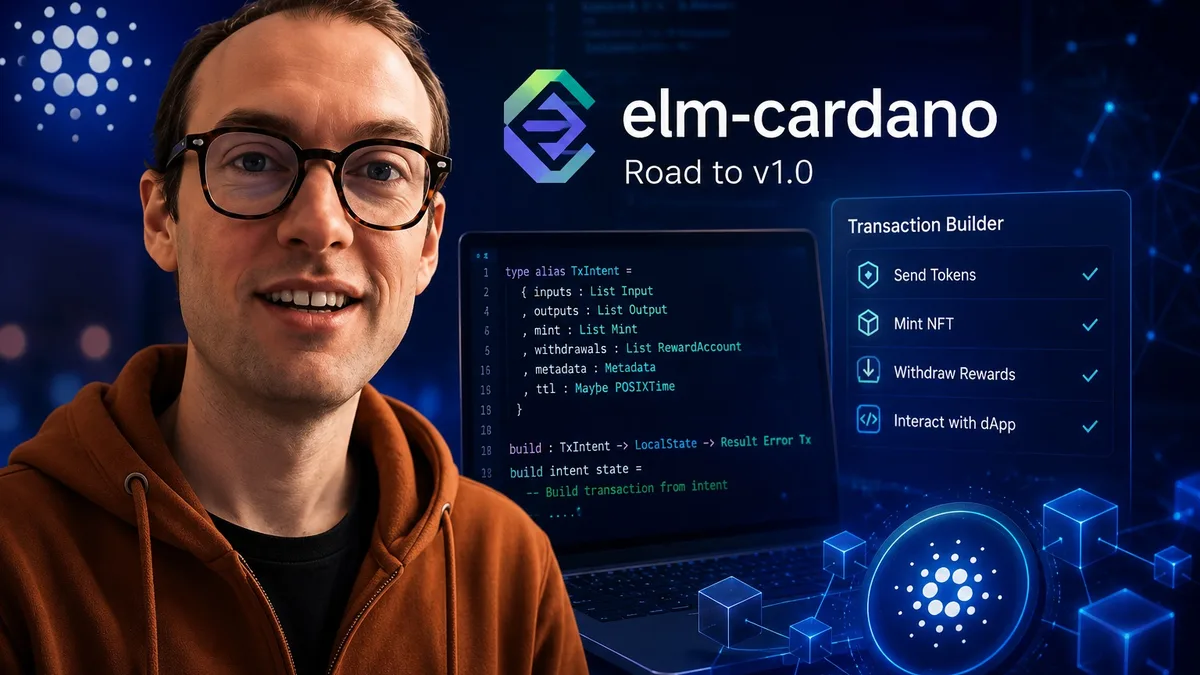
Cardano Developers Office Hours host one technical session wey focus on the road to v1.0 for elm-cardano, one developer framework wey connect the Elm programming language with Cardano application development. The session na Fabian Bormann host am, and Mathieu Pizenberg, Senior Software Engineer for Cardano Foundation, present the current status of the project and the developer tooling problems wey the framework wan solve.
elm-cardano dey positioned as framework to build Cardano front-end applications and transaction tooling with Elm, one functional programming language wey people know for strong typing, fast compiler feedback and stability. The discussion cover the framework transaction builder, im intent-based design, local UTXO handling, coin selection and the bigger question of how Cardano developers fit use more of the capabilities wey dey already available for the ledger.
elm-cardano Focus on Cardano Front-End and Transaction Tooling
Pizenberg explain say the original idea for the session come from work on one interactive transaction builder. The tool wey dem propose go allow developers to build different types of Cardano transactions visually through web interface, instead make person jump straight to write full application or depend on command line workflows.
The transaction builder concept dey designed to support actions like sending tokens, minting NFTs, withdrawing staking rewards and interacting with dApps. E go also allow developers to combine several actions inside one Cardano transaction, one practical capability of the eUTXO model.
According to Pizenberg, plenty developers need faster way to test specific transaction patterns. Instead make dem set up full JavaScript application or use CLI workflow for every experiment, the proposed interface go give developers more direct way to construct, inspect and test transaction behavior.
The presentation also place elm-cardano inside the broader Elm ecosystem. Dem describe Elm as stable functional language for front-end applications, with focus on avoiding runtime exceptions, reducing dependency risk and improving refactoring safety. Pizenberg talk say the language still active even though release cycle slow, add say people dey mistake the stability for inactivity.
Intent-Based Transaction Building Target More Flexible Cardano Development
Big part of the session focus on how elm-cardano dey approach transaction construction. Pizenberg compare the framework with common transaction builder patterns, especially for JavaScript libraries, where developer dey often work close to the ledger representation of a transaction.
elm-cardano dey use intent-based approach. Instead make developers describe each low-level transaction component by hand, the developer go describe wetin the transaction suppose do. For example, the intent fit be to send assets go one address, use defined UTXO set, create specific output or combine multiple actions inside one transaction.
The framework go then process those intents and work through the technical requirements wey need to produce valid Cardano transaction. Pizenberg describe am as way to separate the developer goal from the lower-level structure of the final transaction body.
The presentation also cover local UTXO state, wey allow the transaction builder to operate with defined set of outputs. This one useful for testing because the builder no need to depend directly on external services like blockchain API providers. E fit instead work with the state wey the developer supply.
That design also support transaction chaining. Once transaction don finalize locally, the resulting state fit help build another transaction without waiting for on-chain confirmation during development flow. This allow developers to test sequences of transactions under controlled conditions.
Pizenberg also discuss customizable coin selection. elm-cardano get default approaches like largest-first selection, plus separate collateral-focused selection method. The collateral example show practical issue because developers generally no want make high-value UTXO dey selected as collateral for Plutus transaction.
Road to v1.0 Include Cleaner APIs, Testing and Broader Cardano DevX
The road to v1.0 for elm-cardano include work on the framework core structure and developer-facing APIs. Pizenberg talk say some parts of the project start around three years ago and say several early design decisions now need rework before more stable release go land.
One area wey dem discuss na the multi-round process wey dey required to build certain Cardano transactions. Because transaction fees dey depend on transaction size, and transaction size fit change when UTXOs, redeemers or Plutus script evaluations join, the builder fit need several rounds before e reach stable final transaction.
Pizenberg talk say the current implementation dey run several build rounds manually, while future version suppose identify stable fixed point more cleanly. This go allow the framework to stop rebuilding once the transaction state no dey change again.
The session also cover redeemer indexing and output positioning, wey dey important for more advanced Cardano smart contract interactions. Some scripts dey depend on specific input or output indexes, and transaction builders need expose enough control make developers fit compose complex interactions across multiple protocols.
The discussion expand into Cardano developer experience more broadly. Pizenberg talk say many Cardano capabilities still dey underused by dApps and tooling. E still encourage developers wey dey build protocols to contribute fixes and improvements back to the libraries wey dem dey use, instead of solving problems only inside their own applications.
Dem also discuss the Elm language for the context of AI-assisted development. Pizenberg point to Elm compiler feedback and strong error messages as useful for working with LLM tools, because precise errors fit help models identify and correct problems faster.
elm-cardano no currently dey described as widely used production framework across Cardano projects. The session present am as active technical effort, experimental implementation and reference point for how Cardano transaction tooling fit expose more of the ledger existing capabilities. The next phase of elm-cardano center on cleaner APIs, improved transaction builder behavior and more stable framework for developers wey dey test advanced Cardano transaction flows.