Cardano Foundation Cancels Summit 2026 After Treasury Proposal Misses DRep Threshold
Cardano Foundation confirmed that Cardano Summit 2026 will not take place this year after its 7.8 million ADA treasury proposal failed to reach the required DRep approval threshold.
By SongMarketCap
Updated:
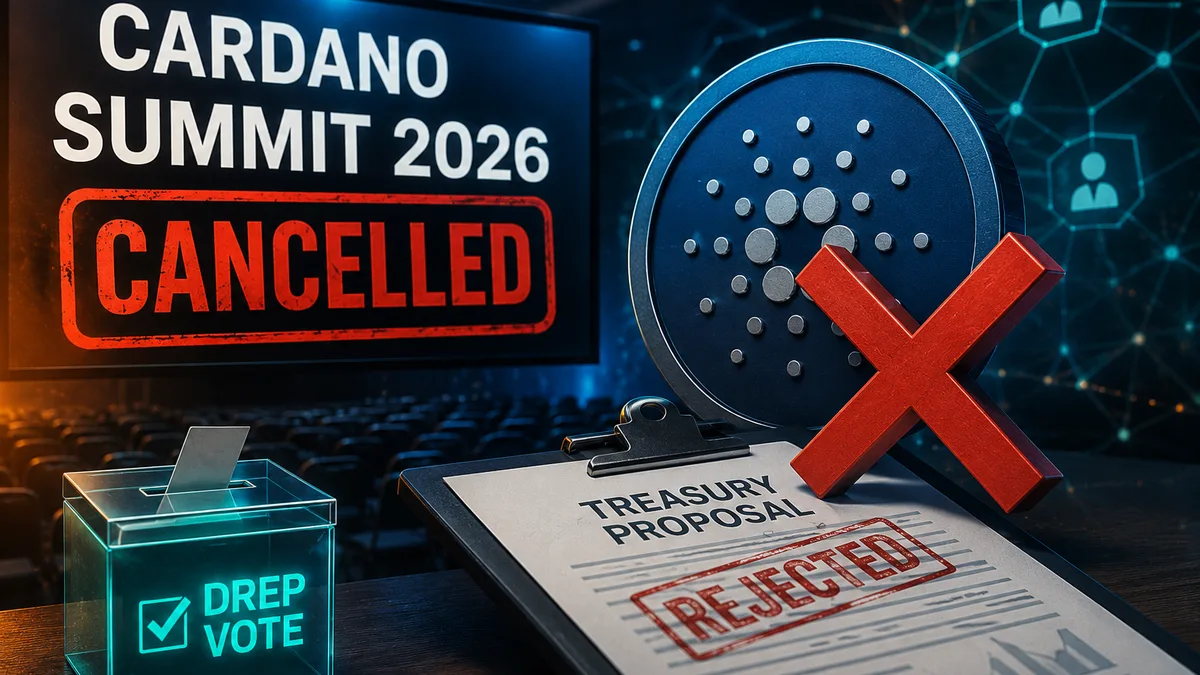
Cardano Foundation has confirmed that Cardano Summit 2026 will not take place this year after its treasury proposal failed to pass through Cardano’s on-chain governance process. The proposal requested 7.8 million ADA to fund the event, but reached about 65% support, below the required 66.67% threshold.
The decision gives Cardano governance a visible operational consequence: a major ecosystem event was cancelled because the proposal did not reach the required DRep threshold. A high-profile institution submitted the proposal, DReps evaluated it, the result landed just below the approval line, and the Foundation accepted the outcome publicly.
Cardano Summit 2026 Will Not Take Place This Year
Cardano Foundation said that governance requires not only participation, but also a commitment to accept collective decisions. Following the outcome of the treasury proposal votes, the Foundation confirmed that its proposed Cardano Summit 2026 will not take place this year.
The result was close, but the approval rule was decisive. In Cardano treasury governance, majority support alone is not enough when a proposal requires a defined approval level. Because the Summit proposal did not reach the required 66.67% DRep support, the requested funding was not approved.
The Foundation said it had read the feedback left by voting DReps and appreciated the level of engagement across the process. It also noted that Emurgo’s TOKEN2049 proposal passed, meaning part of Cardano’s global conference presence in 2026 will continue through a different approved initiative.
DRep Voting Shows Real Weight in Cardano Governance
The outcome places DReps at the center of practical treasury decision-making. Cardano Foundation remains one of the most visible institutions in the ecosystem, but its proposal did not receive automatic approval. That gives future treasury applicants a clear message: reputation matters, but it does not replace broad consensus.
For DReps, the vote strengthens the political weight of their role. They are not only representing sentiment, they are helping decide which ecosystem activities receive treasury funding and which do not. Future proposals will likely need stronger pre-vote communication, clearer cost justification and a more direct explanation of expected value for the Cardano ecosystem.
For the Foundation, accepting the result without attempting to soften or bypass the process adds credibility to the governance model. The decision is operationally difficult, but that is what gives it significance. Cardano governance was tested not only by the numbers on the vote, but by how a major institution responded when the numbers did not go its way.
Summit Cancellation Changes Cardano’s 2026 Event Strategy
The cancellation changes Cardano’s 2026 global visibility, but it also reinforces the credibility of decentralized decision-making. The Foundation said it will review its current commitments and remain focused on the existing roadmap. Instead of one large Summit, the ecosystem will now rely more heavily on other approved channels, including TOKEN2049 in Singapore, where Emurgo’s proposal passed the governance process.
That distinction is important. Cardano will still have a presence at one of Asia’s most important crypto conferences, but in a format that received community approval. The outcome gives future treasury applicants a clear precedent: ecosystem visibility can be funded through governance, but only when the proposal reaches the required level of support.
Cardano Summit 2026 will not take place, but the decision now carries a wider governance meaning. The Foundation accepted the DRep outcome and adjusted its own plans accordingly. For Cardano, this is a concrete demonstration that on-chain governance is no longer an experiment, but an operating system for real budgets, real events and real institutional decisions.