Cardano Becomes an Official x402 Chain as Masumi Brings AI Agent Payments On Chain
Masumi Network says Cardano has been added to the x402 standard, opening the door for AI agents to pay for services through blockchain-based settlement, with an added trust layer built directly on chain.
By SongMarketCap
Updated:
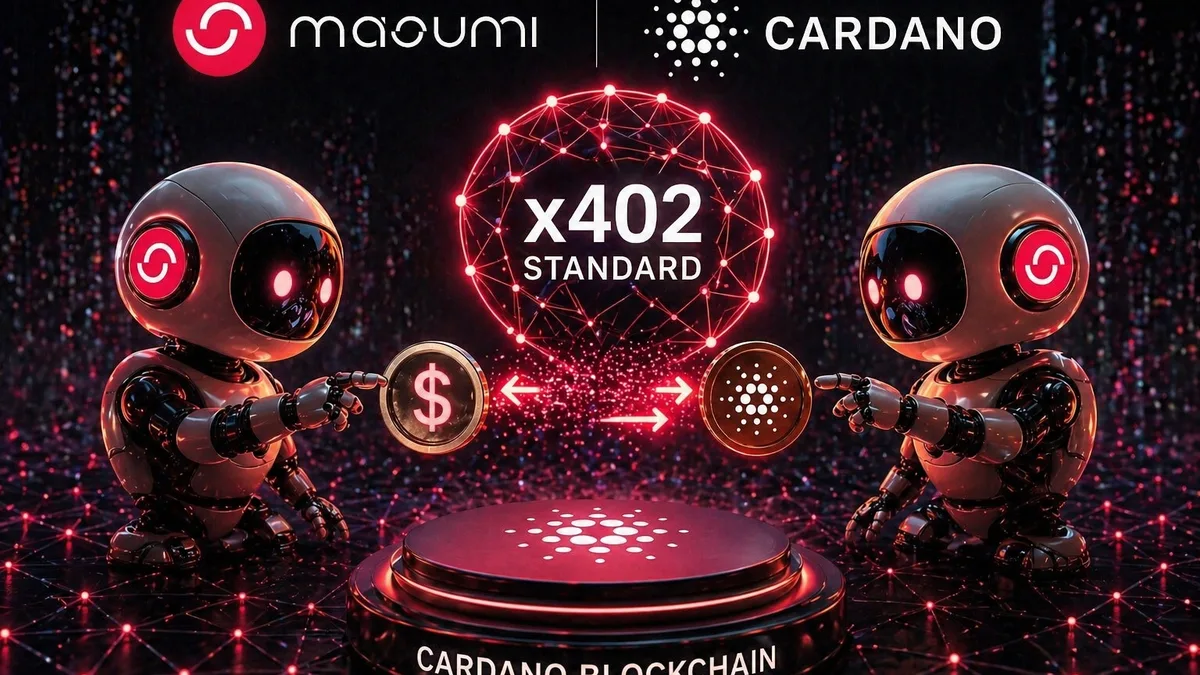
Cardano has gained a new position in one of the most important intersections between blockchain infrastructure and artificial intelligence. Masumi Network announced that the x402 Foundation has merged the Pull Request for the Cardano specification of the x402 standard, making Cardano an official x402 chain. According to Masumi, the Masumi Smart Contract was also accepted as an optional extension to the standard.
x402 is an open internet standard that uses the HTTP 402 Payment Required status code to enable direct, automated payments between clients and services. Its most important use case today is emerging around AI agents, where autonomous software can pay for data, API access, compute or digital services without accounts, subscriptions or manual approval.
Cardano And The x402 Standard For AI Agent Payments
For Cardano, this integration means entry into a standard that is quickly becoming relevant for the agent-to-agent economy. x402 enables a simple but powerful model, an agent sends a request, a service responds with Payment Required, the agent automatically completes the payment and receives access to the service.
This model already exists on other chains, but Cardano now has its own implementation that allows developers to build applications where AI agents can autonomously spend funds to complete tasks. That can include research, content generation, data analysis, DeFi actions and other digital services.
Cardano’s entry into x402 does not mean it immediately leads by volume, but it does mean the network is now compatible with a standard that is becoming increasingly relevant for internet infrastructure and AI systems.
Masumi Smart Contract Adds A Trust Layer On Cardano
The key difference comes through the Masumi Smart Contract, which has been accepted as an optional extension to the x402 standard. Masumi Network is building payment infrastructure for AI agents with a focus on security and trust between autonomous systems.
Beyond basic payments, Masumi introduces additional functionality, including on-chain agent identity, escrow mechanisms, refunds and disputes, decision logs and a public registry of agents and services.
That means an agent can not only pay for a service, but also verify who it is interacting with, track task execution and rely on protection mechanisms if something goes wrong. In scenarios where agents perform complex tasks and collaborate across multiple steps, this kind of trust layer becomes essential.
Masumi already shows activity through its own explorer, where agent payments, escrow events and transaction statuses on Cardano can be tracked. That gives users a view into an operating model where agents are not just a theoretical concept, but participants in real workflows.
What This Means For The Cardano Ecosystem
This integration positions Cardano inside infrastructure that connects blockchain with the AI economy. Instead of focusing only on scaling or governance, this story moves toward practical use cases where autonomous software uses blockchain as a settlement layer.
Masumi was developed with support from NMKR and Serviceplan Group, with a focus on Cardano and infrastructure for agent commerce.
For developers, this opens new models for applications, pay-per-use services, AI marketplaces and automated systems that can independently generate and spend value. For the wider ecosystem, it gives Cardano a concrete position in a segment that is developing quickly and could play a major role in the next phase of the internet.
What has changed now is specific,

Cardano is no longer outside the x402 standard. It now has a technical foundation for applications where agents do not only execute tasks, but also pay, log and verify them through blockchain infrastructure.