Argentine Burger Chain Pogg’s Plans RealFi Investment on Cardano
Pogg’s Burgers plans to deploy business capital through RealFi using Lace Wallet. A potential integration with Strike Finance remains under evaluation.
By SongMarketCap
Updated:
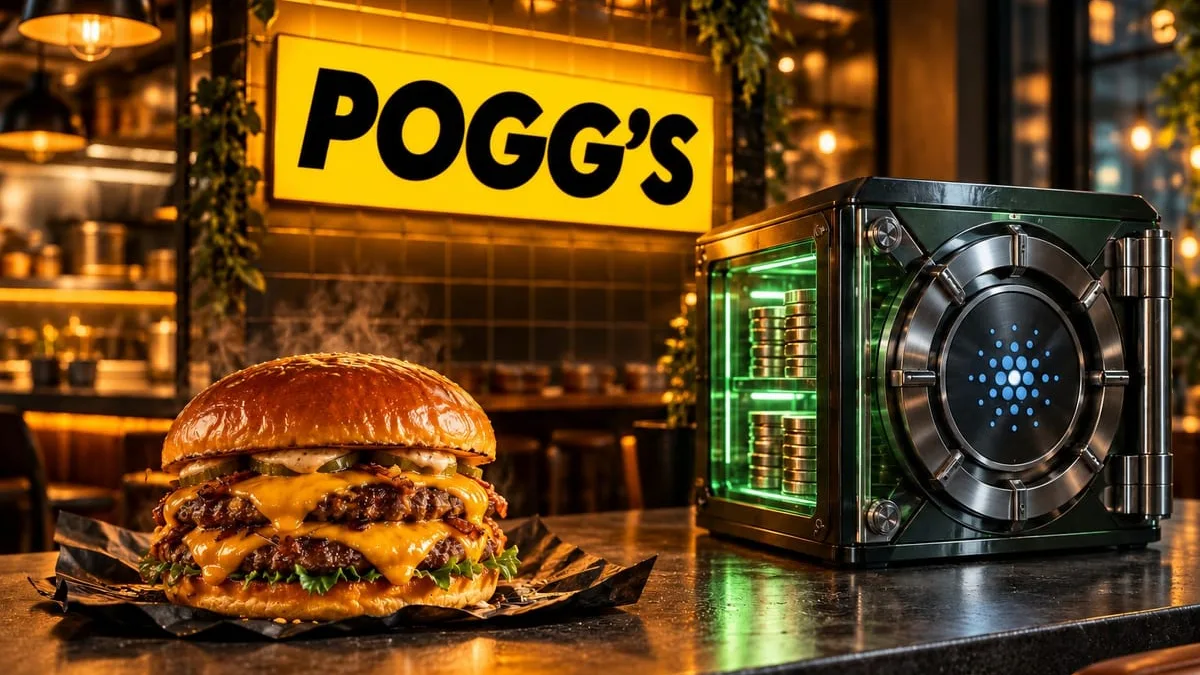
Pogg’s Burgers, a local Argentine restaurant chain, plans to invest through RealFi on Cardano, according to an October 19, 2026, announcement from Cardano and Midnight Ambassador Mauro Andreoli. The deployment was scheduled for the same day, connecting a food-service business with a protocol offering access to dollar-denominated assets and income from real-world investments.
Pogg’s Burgers Selects Lace for RealFi Deployment
Andreoli reported that his team has been working with Pogg’s to bring the company into blockchain-based finance, with RealFi as the initial focus.
“Their deployment into RealFi is confirmed for today, with the potential integration of Strike currently under evaluation,” he wrote.
Pogg’s operates in Argentina’s Buenos Aires province, with locations in the La Plata area, including City Bell. The announcement concerns the investment of business funds, extending RealFi’s reach to a company whose operations center on restaurants and food delivery.
Lace would provide wallet access and transaction signing. The company would use it to connect with RealFi, which supplies the financial product and manages the underlying investment framework.
The arrangement gives Pogg’s a route into Cardano finance through existing applications, without developing its own blockchain infrastructure.
How RealFi Connects Cardano With Real-World Assets
RealFi launched on Cardano mainnet on October 1, 2026. Its model separates a liquid digital dollar from a staked investment position, allowing eligible participants to use dollar-denominated assets within DeFi and gain exposure to income generated by a financial portfolio.
The base token, USDrf, is a dollar-denominated stablecoin. RealFi’s published reserve strategy encompasses U.S. Treasury bills, money market funds and credit assets. Users can acquire and trade it through supported decentralized exchanges, while approved participants can access direct issuance and redemption through the protocol.
Staking the base asset produces sUSDrf, a receipt token whose redemption value reflects the staking portfolio’s performance. Income comes from underlying financial assets, including private credit, rather than rewards for securing the Cardano network.
The structure also determines how investment losses are allocated. Designated protocol reserves absorb losses first, followed by the staked layer before base-token holders are affected. Losses reaching the staking portfolio can therefore reduce the value redeemable by its participants.
RealFi identifies corporate treasuries, institutional partners and family offices among its intended users. Pogg’s planned participation brings that corporate investment model into a local Argentine business setting, less than three weeks after the protocol’s mainnet launch.
Strike Finance Remains a Separate Decision
Strike Finance, a perpetual futures platform initially launched on Cardano, recently announced the integration of RealFi yield into its liquidity vault. That product combines income from RealFi with the results of market-making activities, creating a different exposure from a standalone RealFi position.
Andreoli’s announcement leaves Pogg’s possible use of Strike under evaluation. It does not identify a chosen Strike product or commit the restaurant chain to the platform’s liquidity vault.
The investment amount, selected RealFi position and intended holding period were not disclosed. The announcement also did not include a transaction identifier confirming completion of the scheduled deployment.
Pogg’s initial plan centers on investing company funds through RealFi. Any subsequent allocation to Strike would expand that arrangement to a separate financial product, with its own trading-related returns and risks.